

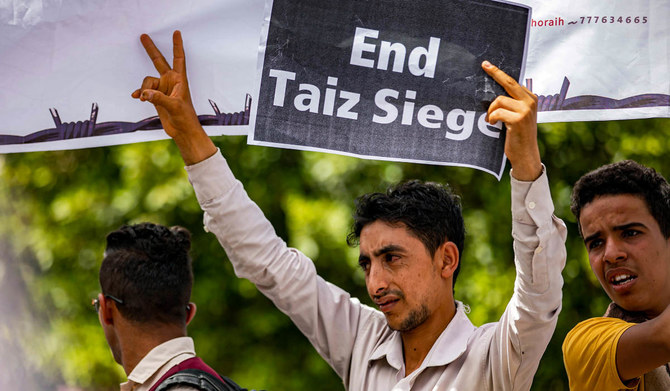

AL-MUKALLA: People in Yemen’s southern city of Taiz staged a protest near a Houthi-manned checkpoint on Saturday to condemn the militia’s ongoing siege of the city. Yemenis have also organized an online campaign to mark 3,000 days since the Houthis’ siege began in the spring of 2015.
Dozens of Yemenis stood in a line near the Houthi-controlled eastern entrance to Taiz to protest the siege, which has lasted more than eight years, and to urge the world to intervene.
People carried signs criticizing the international community, primarily the UN, for allowing the Houthis to continue the siege. They also displayed images of people traveling on treacherous steep roads to avoid the checkpoints that choke the city.
“Taiz’s siege is the crime of the century,” one of the posters read.
“Save humanity in Taiz,” read another English-language post.
FASTFACT
On social media, Yemeni leaders, politicians, activists, and many Taiz residents have participated in a campaign to mark 3,000 days of the siege and to raise awareness of the plight of those trapped inside.
The Houthis laid siege to Yemen’s third largest city in the middle of 2015, months after engaging in fierce combat with Yemeni army troops and allied resistance fighters who successfully defended the city with the assistance of the Arab coalition.
To force the city’s surrender, the Houthis surrounded the city’s main entrances, preventing anyone from leaving or entering the city and halting the delivery of goods and humanitarian aid.
On social media, Yemeni leaders, politicians, activists, and many Taiz residents have participated in a campaign to mark 3,000 days of the siege and to raise awareness of the plight of those trapped inside.
Eshraq Al-Maqtari, a human rights activist based in Taiz, said the Houthi siege has had a significant impact on the city’s residents, with many being killed in car accidents while attempting to leave or access the city on perilous roads.
She criticized the international community for not exerting sufficient efforts to end the siege.
“During 3,000 days of blockade, the people of Taiz have endured various forms of torment. They have traversed it on foot via treacherous mountainous roads, carrying only essential supplies — medication, food, and oxygen for the patients on their backs. The world is silently observing our tribulations,” she wrote on Twitter.
Speaking to Arab News from the city, Aqeel Al-Samei, who also took part in the campaign, compared the Houthi checkpoints outside the city to the Berlin Wall, saying that the Houthi-controlled Al-Hawban road “separates families, depriving children of fathers, sons of mothers, and patients of hospitals.”
Yemeni leaders have pledged to end the siege through diplomacy or force. Rashad Al-Alimi, chairman of Yemen’s Presidential Leadership Council, praised Yemenis’ efforts to end the siege.
“We affirm our unwavering commitment to making the end of the fascist militia’s siege of the city a top priority,” Al-Alimi said.
Under a UN-brokered truce that came into effect in April last year, the Houthis were supposed to lift the siege in exchange for the Yemeni government facilitating the resumption of commercial flights from Sanaa airport as well as the entrance of fuel ships to Hodeidah port.
However, to date, the Houthis have opened only a small unpaved road heading into and out of Taiz.
Tareq Mohammed Abdullah Saleh, presidential council member, said that the siege of Taiz will be lifted only when the Houthis are beaten by military force.
“The siege of Taiz will be broken by the guns of men, and the era of Houthi tyranny will come to an end and vanish in the same manner as other bloodthirsty militias and terrorist bands,” Saleh said.


