

Pakistan criticizes UN report on conflict-related sexual violence for omitting Indian and Israeli ‘crimes’

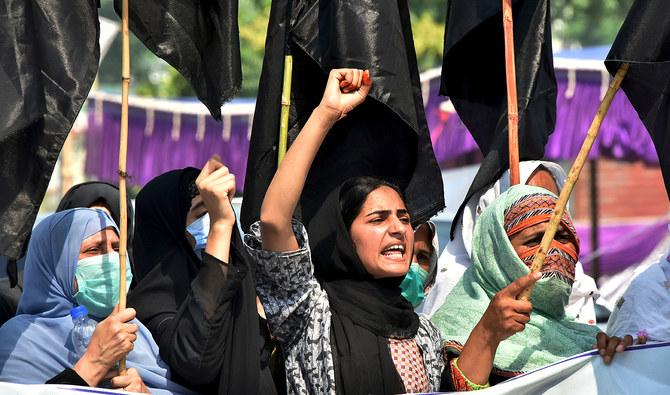
Activists of Pasban-e-Hurriyat, a Kashmiri refugee organisation, hold an anti-India protest in Muzaffarabad, the capital of Pakistan-administered Kashmir on May 22, 2023. (AFP/File)
Short Url
Updated 15 July 2023
Follow

Pakistan criticizes UN report on conflict-related sexual violence for omitting Indian and Israeli ‘crimes’

  • UN brought out a report on the subject last month which documented about 2,500 wartime rapes in 2022
  • Pakistan tells the Security Council to ‘rectify the report’s omissions’ by including data from Kashmir, Palestine

ISLAMABAD: Pakistan’s top diplomat at the United Nations has criticized a report on conflict-related sexual violence published by the world body for overlooking relevant incidents in Indian-administered Kashmir and Israeli-occupied Palestine.

The UN brought out a comprehensive report on the issue in June which documented about 2,500 verified cases of wartime rape in 2022. It also arranged a debate over the issue in the Security Council which was convened by the United Kingdom that currently holds the 15-member council’s rotating presidency.

“There is ample documented evidence that since 1989 Indian occupation forces have used rape and sexual violence as a weapon of war in occupied Kashmir,” Pakistan’s state-owned APP news agency reported the country’s envoy, Ambassador Munir Akram, as saying at the UNSC.

“The credibility of the Report is seriously eroded because of what looks like a deliberate decision not to report the crimes of sexual violence being committed in Indian-occupied Jammu and Kashmir and in Israeli-occupied Palestine,” he added.

Akram maintained thousands of men, women, boys and girls had been detained and tortured in both the places.

“Since India’s unilateral and illegal measures of 5 August 2019, conflict-related violence and harassment and humiliation of women and girls in Kashmir has increased significantly,” he said while referring to New Delhi’s decision to revoke the special constitutional status of the only Muslim-majority state administered by it and integrate it with the rest of the Indian union.

“We would, therefore, urge the Secretary-General to rectify the Report’s omissions and include information on the incidence of sexual violence in foreign-occupied Kashmir and Palestine and list India and Israel amongst those parties perpetrating conflict-related sexual violence in future reports to the Security Council.”


Pakistani president arrives in Iraq to deepen trade, energy cooperation

Updated 20 December 2025
Follow

Pakistani president arrives in Iraq to deepen trade, energy cooperation

  • Visit follows recent high-level contacts as Islamabad seeks to expand limited commercial ties with Baghdad
  • Talks are expected to cover investment, manpower and facilitation of Pakistani pilgrims visiting holy sites in Iraq

ISLAMABAD: President Asif Ali Zardari arrived in Iraq on Saturday on an official visit aimed at expanding cooperation in trade, energy and investment, as Pakistan seeks to deepen ties with Baghdad after years of limited engagement.

Pakistan and Iraq established diplomatic relations in 1947 and have traditionally maintained cordial ties, though commercial links remain modest, with officials and business groups identifying scope for cooperation in construction services, pharmaceuticals, manpower and agricultural exports.

“President Asif Ali Zardari arrived in Baghdad on a four-day official visit to Iraq,” his office said in a post on X. “He was received by Culture Minister Dr. Ahmed Fakkak Al-Badrani. During the visit, meetings with senior Iraqi leadership are expected to advance cooperation and further strengthen Pakistan-Iraq relations.”

Zardari’s visit follows a series of recent high-level contacts between the two countries, reflecting efforts to broaden bilateral engagement beyond traditional diplomatic ties and explore collaboration across economic, political and people-to-people domains.

According to Pakistan’s foreign office, the president is expected to hold meetings with Iraq’s senior leadership to discuss cooperation in various areas such as trade and investment, energy, technology, education and manpower.

He is also expected to discuss regional and international issues with Iraqi officials.

Earlier this month, Pakistan’s Interior Minister Mohsin Naqvi met his Iraqi counterpart, Abdul Ameer Al-Shammari, on the sidelines of meetings in Brussels, where both sides agreed to enhance cooperation on security and facilitate travel for Pakistani Shia pilgrims to Najaf and Karbala.

The two officials discussed measures to ensure the smoother movement of these pilgrims and their compliance with visa regulations.