

Pakistan says UN to hold panel discussion on desecration of holy scripture in March next year

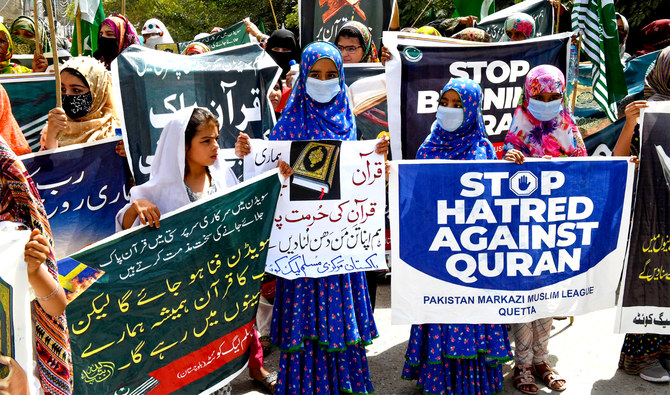
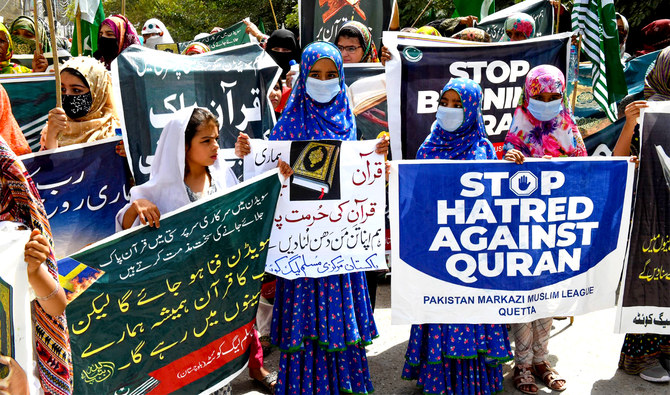
Women march during an anti-Sweden demonstration in Quetta on July 9, 2023, as they protest against the burning of the Koran outside a Stockholm mosque that outraged Muslims around the world. (AFP/File)
Short Url
Updated 13 July 2023
Follow

Pakistan says UN to hold panel discussion on desecration of holy scripture in March next year

  • The UN Human Rights Council adopted a resolution introduced by Pakistan against the desecration of Holy Qur’an
  • Pakistan says the UN debate will identify drivers, root-causes and the overall impact of such anti-religious acts

ISLAMABAD: Pakistan announced on Thursday the UN Human Rights Council (UNHRC) would hold a panel discussion over the impact of the desecration of sacred scriptures next year after the recent adoption of a historic resolution to address religious hatred in the wake of the Qur’an burning incident in Sweden.

The resolution was introduced by Pakistan on behalf of the 57-member Organization of Islamic Cooperation (OIC) and requested the UN rights chief to publish a report on religious hatred. It also urged countries across the world to review their laws and plug any gaps that could “impede the prevention and prosecution” of such anti-religious acts.

The resolution was opposed by Western nations, though it was still adopted after 28 countries voted in its favor.

Pakistan’s foreign office spokesperson Mumtaz Zahra Baloch noted in her weekly news conference the resolution condemned any advocacy of religious hatred, including the recent acts of the desecration of the Holy Qur’an, while emphasizing the need to hold the perpetrators to account.

“In the follow-up to the resolution, the Council will hold panel discussions of experts at its March 2024 session to identify the drivers, root-causes and human rights impact of the desecration of sacred books, places of worship and religious symbols,” she added.

Baloch said Pakistan shared disappointment with other OIC countries that such an important resolution was put to vote despite its “balanced and apolitical nature,” derailing the UN council’s consensus.

“We believe that the Council must speak with one voice on the salient issue of Islamophobia, which affects human rights, fundamental freedoms, dignity and identity of over two billion Muslims,” she continued.

The spokesperson said Pakistan would do its best to raise global awareness about issues like Islamophobia and xenophobia while trying to foster interfaith dialogue, harmony and peaceful coexistence.


Pakistan offers Kyrgyzstan Arabian Sea access as two states sign 15 cooperation accords

Updated 5 sec ago
Follow

Pakistan offers Kyrgyzstan Arabian Sea access as two states sign 15 cooperation accords

  • Pakistan and Kyrgyzstan sign MOUs spanning trade, energy, agriculture, ports, education, security cooperation
  • Kyrgyz president is on first visit to Pakistan in 20 years as both sides push connectivity and CASA-1000 power links

ISLAMABAD: Pakistan on Thursday offered Kyrgyzstan the shortest and most economical route to the Arabian Sea as the two countries signed 15 agreements and memoranda of understanding aimed at boosting cooperation across trade, energy, agriculture, education, customs data-sharing and port logistics.

The accords were signed during a visit to Islamabad by President Sadyr Zhaparov, the first by a Kyrgyz head of state to Pakistan in two decades, and part of Islamabad’s renewed push to link South Asia with landlocked Central Asian economies through ports, power corridors and transport routes.

For Pakistan, Kyrgyzstan offers access to hydropower through CASA-1000, a $1.2 billion regional electricity transmission project designed to carry surplus summer electricity from Kyrgyzstan and Tajikistan through Afghanistan into Pakistan. For Bishkek, Pakistan provides overland access to warm-water ports on the Arabian Sea, creating a shorter commercial route to global markets.

“President Asif Ali Zardari has reiterated Pakistan’s readiness to offer Kyrgyzstan the shortest and most economical route to the Arabian Sea,” Radio Pakistan reported after Zhaparov met the Pakistani president. 

The two leaders also discussed expanding direct flights to deepen business, tourism and people-to-people ties.

Zardari welcomed Kyrgyzstan’s completion of its segment of the CASA-1000 project and “reaffirmed Pakistan’s commitment to completing its part of the project, which is now at an advanced stage,” the state broadcaster said. 

Zhaparov thanked Islamabad for supporting Bishkek’s candidacy for a non-permanent UN Security Council seat and invited Zardari to visit Kyrgyzstan at a time of his convenience. Both sides expressed satisfaction with progress under the Quadrilateral Traffic in Transit Agreement, designed to facilitate road movement between Pakistan, Kyrgyzstan, Kazakhstan and China.

Earlier, both governments exchanged 15 sectoral cooperation documents covering commerce, mining, geosciences, power, agriculture, youth programs, the exchange of convicted persons, customs electronic data systems and a sister-city linkage between Islamabad and Bishkek.

According to APP, the MOUs were signed by ministers representing foreign affairs, commerce, economy, energy, power, railways, interior, culture, health and tourism. Agreements also covered cooperation between Pakistan’s Foreign Service Academy and the Diplomatic Academy of Kyrgyzstan, as well as collaboration between universities, youth ministries and cultural institutions.

“Our present mutual trade, comprising of about $15–16 million will be enhanced to $200 million in the next two years,” Prime Minister Shehbaz Sharif said after the agreements were signed, calling them “a framework for structured, result-oriented engagement and closer institutional linkages.”

Sharif said Pakistan was ready to serve as a maritime outlet for the landlocked Central Asian republic, offering access to Karachi, Port Qasim and Gwadar to help Kyrgyz goods reach regional and global markets.