

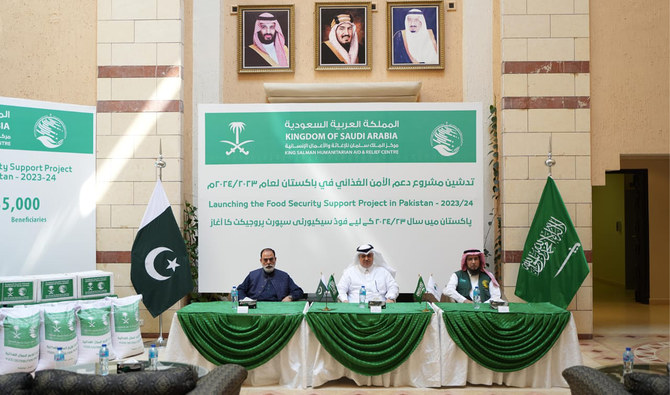
KSrelief launches food security project for flood-affected families in Pakistan

Saudi ambassador to Pakistan Nawaf bin Said Al-Malki (center) and Pakistan's religious affairs minister Senator Talha Mahmood (left) attend the launch ceremony of a food security project for flood-affected families in Pakistan in Islamabad on July 17, 2023. (KSrelief)
Short Url
Updated 12 July 2023
Follow

KSrelief launches food security project for flood-affected families in Pakistan

  • The Saudi humanitarian organization will distribute food packages among deserving people in 40 districts of the country
  • The initiative aims to benefit 735,000 individuals across Pakistan through distribution of flour, cooking oil, sugar and pulses

ISLAMABAD: King Salman Humanitarian Aid and Relief Center (KSrelief) has launched a food distribution project in to help food-affected and other marginalized people residing in 40 districts of Pakistan, said an official statement circulated by the organization on Wednesday.

KSrelief has provided humanitarian and development assistance to more than 92 countries over four continents. With international, regional, and local partners, the organization has benefitted millions worldwide.

“King Salman Humanitarian Aid & Relief Center has initiated a project aimed at ensuring food security for the year 2023-24,” the statement said. “In collaboration with the National Disaster Management Authority, KSrelief will distribute a total of 105,000 food packages weighing 10,013 tons in four phases among flood affected and deserving people living in 40 districts … across all the provinces of Pakistan.”


Saudi ambassador to Pakistan Nawaf bin Said Al-Malki (center) and Pakistan's religious affairs minister Senator Talha Mahmood (right) attend the launch ceremony of a food security project for flood-affected families in Pakistan in Islamabad on July 17, 2023. (KSrelief)

The statement said the initiative would benefit 735,000 individuals throughout the country.

It informed that each package would weigh 95 kilograms, with 80 kilograms of flour, five liters of cooking oil and five kilograms each of sugar and pulses. The package, it added, would be sufficient for a family throughout the month.

This project falls under the umbrella of Saudi humanitarian projects, represented by KSrelief, to assist needy families in different parts of Pakistan.

Pakistan has strong political, cultural, economic, and defense ties with Saudi Arabia. The kingdom is also home to more than 2.5 million Pakistani expatriates and serves as a key source of remittances and oil supply to Islamabad.

The South Asian country is also the fifth largest recipient of KSrelief’s humanitarian assistance.


Pakistan remittances seen surpassing $40 billion in FY26 as Saudi Arabia leads November inflows

Updated 4 sec ago
Follow

Pakistan remittances seen surpassing $40 billion in FY26 as Saudi Arabia leads November inflows

  • The country’s November remittances rose 9.4 percent year-on-year to $3.2 billion, official data show
  • Economic experts say rupee stability and higher use of formal channels are driving the upward trend

ISLAMABAD: Pakistan’s workers’ remittances are expected to exceed the $40 billion mark in the current fiscal year, economic experts said Tuesday, after the country recorded an inflow of $3.2 billion in November, with Saudi Arabia once again emerging as the biggest contributor.

Remittances are a key pillar of Pakistan’s external finances, providing hard currency that supports household consumption, helps narrow the current-account gap and bolsters foreign-exchange reserves. The steady pipeline from Gulf economies, led by Saudi Arabia and the United Arab Emirates, has remained crucial for Pakistan’s balance of payments.

A government statement said monthly remittances in November stood at $3.2 billion, reflecting a 9.4 percent year-on-year increase.

“The growth in remittances means the full-year figure is expected to cross the $40 billion target in fiscal year 2026,” Sana Tawfik, head of research at Arif Habib Limited, told Arab News over the phone.

“There are a couple of factors behind the rise in remittances,” she said. “One of them is the stability of the rupee. In addition, the country is receiving more inflows through formal channels.”

Tawfik said the trend was positive for the current account and expected inflows to remain strong in the second half of the fiscal year, noting that both Muslim festivals of Eid fall in that period, when overseas Pakistanis traditionally send additional money home for family expenses and celebrations.

The official statement said cumulative remittances reached $16.1 billion during July–November, up 9.3 percent from $14.8 billion in the same period last year.

It added that November inflows were mainly sourced from Saudi Arabia ($753 million), the United Arab Emirates ($675 million), the United Kingdom ($481.1 million) and the United States ($277.1 million).

“UAE remittances have regained momentum in recent months, with their share at 21 percent in November 2025 from a low of 18 percent in FY24,” said Muhammad Waqas Ghani, head of research at JS Global Capital Limited. “Dubai in particular has seen a steady pick-up, reflecting improved inflows from Pakistani expatriates owing to some relaxation in emigration policies.”