

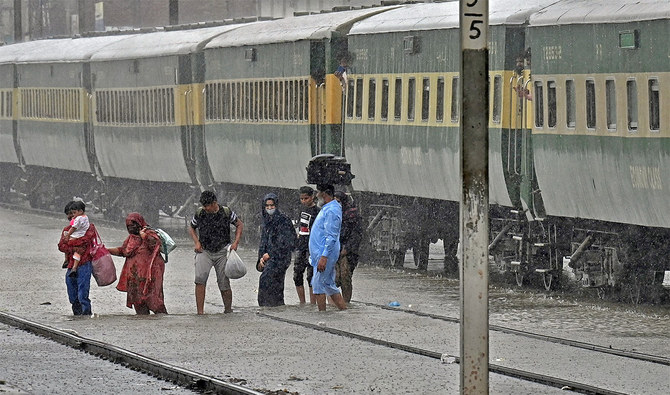

ISLAMABAD: Pakistan’s meteorological department on Wednesday forecasted “normal rainfall” for the country this year, with officials stating that preventive measures have been taken as authorities remain on “high alert” for possible floods in various parts of the country.
The Pakistan Meteorological Department (PMD) forecast heavy rainfall from Thursday, July 13 till Monday, July 17 in many parts of the country. as the country deals with floods in the low-lying areas of its eastern Punjab province. This week, India released thousands of cusecs of water into Pakistani rivers Sutlej, Chenab, and Ravi this week, making the level of water in these rivers rise to dangerous levels.
Flash floods triggered by monsoon rains and melting glaciers killed over 1,700 people last year in Pakistan and destroyed large swathes of crops and critical infrastructure, costing the country an estimated $30 billion in losses. Pakistani officials say they are expecting “normal rainfall” this monsoon season compared to the previous one.
“The monsoon is progressing according to expectations as approximately 12 days have passed since the beginning of the season, and this year we have forecast normal rainfall, unlike last year,” Mahr Sahibzad Khan, director-general of the PMD, told Arab News.
“Last year, we had exceptionally heavy rainfall due to an extended heatwave, but we are not predicting a similar situation this year,” he added.
He said Pakistan’s southern Sindh and Balochistan provinces were expected to receive slightly below-average rainfall while the country’s northwestern Khyber Pakhtunkhwa, Azad Kashmir, and upper Punjab areas are expected to receive normal rainfall.
Pakistan’s disaster management agency warned in a statement earlier this week heavy rains could trigger landslides and floods in low-lying areas. The chairman of the National Disaster Management Authority (NDMA) issued directives to authorities to remain alert and continuously monitor rivers and streams, and to evacuate people to safe places.
Muhammad Tasawar Chaudhary, spokesperson of the Provincial Disaster Management Authority (PDMA) of Punjab, said India had released thousands of cusecs of water into the Sutlej river, causing floods in areas close to the river.
“In the Sutlej River, approximately 61,000 cusecs of water have entered Pakistan through Gunda Singh, and it is expected to rise further,” Chaudhary told Arab News.
He said India had also released water into the Chenab and Ravi rivers, adding that the situation was under control in areas close to both rivers.
“We have placed all districts connected to the Sutlej River on high alert, and relief camps have been set up under the supervision of district administrations,” he said, adding that rescue operations were currently underway in the affected areas.
Chaudhry said flash floods were anticipated in Punjab’s Mianwali and Dera Ghazi Khan districts due to monsoon rains from July 14 to 17.
“All necessary preparations have been completed, and district and provincial machinery are proactively working to prevent any adverse situations,” he added.
Taimur Ali, a spokesperson of the Khyber Pakhtunkhwa (KPK) PDMA said there are no floods currently in the province. However, he said the provincial authority had developed a Monsoon Contingency Plan 2023 to deal with any untoward situation.
“It is a comprehensive strategy aimed at minimizing disaster risks and facilitating a coordinated and timely response,” he told Arab News in a statement.
“According to the plan, 10 districts are identified as very highly prone [to floods] and another six districts are classified as high risk,” Ali explained, adding that the authority had ensured prevention measures are taken in flood-prone areas.
“Emergency response plans are being developed to ensure a swift and effective response in the event of a flood,” he added.
Muhammad Younus, a spokesperson of the PDMA Balochistan, said the authority had provided relief items and moved the required machinery for flood relief activities to flood-prone areas.
“Our Kalat, Loralai, Sibi, and Zhob divisions are expected to experience heavy rainfall and we have already provided relief items, including camps, for approximately 500 families,” he told Arab News, adding that all deputy commissioners in these areas were instructed to deploy relevant machinery in vulnerable areas to handle any potential floods.
“Based on last year’s experience, we have also warned nearby villages to avoid these areas during the next two weeks and with the assistance of district administrations, we have successfully removed all encroachments from the floodwater passage,” he added.
PDMA Sindh also issued an alert for heavy rain and thundershowers in Sukkur, Jacobabad, Tharparkar, Umerkot, Sanghar, and Mirpurkhas cities from July 14-16.


