

Saudi Arabia signs cooperation treaty with ASEAN

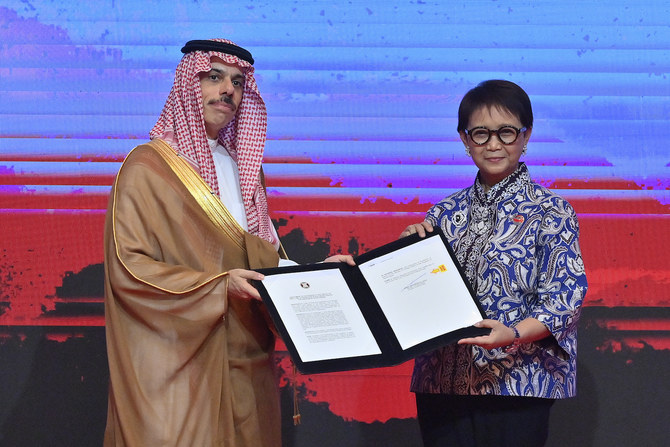
Saudi FM Prince Faisal bin Farhan poses with his Indonesian counterpart, Retno Marsudi, after signing the Treaty of Amity and Cooperation with ASEAN in Jakarta on July 12, 2023. (Indonesian Ministry of Foreign Affairs)
Short Url
Updated 13 July 2023
Follow

Saudi Arabia signs cooperation treaty with ASEAN

  • Saudi FM inks Treaty of Amity and Cooperation during Jakarta visit
  • Bloc’s chair Indonesia welcomes Kingdom to ‘ASEAN family’

JAKARTA: Saudi Arabia on Wednesday signed the Treaty of Amity and Cooperation with the Association of Southeast Asian Nations during Foreign Minister Prince Faisal bin Farhan’s visit to Jakarta.

The TAC is a peace accord signed in 1976 by ASEAN members to establish a set of guidelines to govern inter-state relations in the region based on mutual respect for sovereignty, territorial integrity and national identity, and non-interference of its signatories in the internal affairs of one another.

Besides the 10 member states of ASEAN, countries not located in Southeast Asia have also been entering into the agreement. China and India were the first to accede to it in 2003, and the US and the EU joined in 2009.

Saudi Arabia became the 51st signatory of the treaty — a decision that was welcomed by the ASEAN chair Indonesia.

“We welcome Saudi Arabia to the ASEAN family,” Indonesian Foreign Minister Retno Marsudi said as she addressed Prince Faisal during the signing ceremony in Jakarta.

“On behalf of my ASEAN colleagues, I wish to convey our highest appreciation for your presence today to sign the instrument of accession to the TAC. We appreciate your extra efforts to come to Jakarta.”

Marsudi pointed out that the inking of the treaty reflected for ASEAN members Saudi Arabia’s willingness to acknowledge the regional bloc’s values and commitment to contribute to peace and stability in Southeast Asia and beyond.

“These values and principles are even more critical amidst current geopolitical dynamics,” she added.

“Together, we must serve as a positive force for peace, stability, and prosperity in the Indo-Pacific region.”

She noted that the bloc was anticipating its upcoming summit with the Gulf Cooperation Council, scheduled to take place in Riyadh.

“We look forward to the ASEAN-GCC Summit in Saudi Arabia in October this year,” she said.

With more than 600 million people on 4.5 million square kilometers, ASEAN’s population and area is greater than that of the EU.

In 2022, the grouping generated a purchasing power parity gross domestic product of around $10.2 trillion, or about 6.5 percent of global GDP.


Ziryab bridges Arab musical heritage with modern electronic sound

Updated 7 sec ago
Follow

Ziryab bridges Arab musical heritage with modern electronic sound

  • Location and visual identity carry equal weight with audio elements in Ziryab’s content strategy, says co-founder

MAKKAH: Saudi Arabia’s music landscape is experiencing significant evolution as independent initiatives emerge to reshape how tradition intersects with contemporary styles, reflecting the Kingdom’s wider cultural renaissance.
Among these ventures, the Ziryab platform has distinguished itself as a Saudi musical project delivering modern artistic expressions rooted in Arab identity.
It is fusing heritage music with electronic rhythms while maintaining distinctly local elements in its sonic palette, visual aesthetic, and production locations.
Platform co-founder Abdulaziz Al-Aqeel, working alongside partners Abdullah Al-Aujan and Hamad Al-Aidhani, described how the project originated from a deep engagement with Arab identity as the essential foundation for any contemporary musical endeavor.
“This philosophical approach permeates the platform’s character and output, positioning music as a universal language capable of carrying local culture to international audiences without diluting its unique qualities.”
The platform’s namesake carries deliberate historical weight, Al-Aqeel explained.
Ziryab — the legendary Arab musician renowned for innovation and expanding art beyond conventional boundaries — embodies the project’s mission.
It presents Arab music through a modern lens that honors tradition while engaging with today’s global music conversation.
Merging Arab musical traditions with contemporary electronic production presented genuine challenges, Al-Aqeel acknowledged.
“The project encountered contrasting perspectives — some critics viewing the fusion as threatening authenticity, while others embraced it as creative exploration,” he said.
Rather than retreat, the team responded by refining their artistic approach while maintaining cultural identity as an unwavering cornerstone of every composition.
Modern technology has proven instrumental in advancing Ziryab’s musical production, Al-Aqeel said.
Digital tools enable sophisticated experimentation, seamlessly weaving traditional sounds into electronic frameworks while streamlining workflows and elevating production quality.
Yet throughout this technological integration, Saudi identity remains central through deliberate use of local rhythmic patterns, Arab maqamat scales, and traditional instrumental textures.
The outlook for heritage-electronic fusion music in Saudi Arabia appears exceptionally promising, Al-Aqeel said, citing support from the Music Commission and heightened emphasis on national identity within Saudi Vision 2030’s framework.
These factors have cultivated an ecosystem favorable to musical innovation and homegrown talent cultivation.
Ziryab has broadened its mission beyond pure performance to actively nurture emerging artists through the “Ziryab Community” initiative, Al-Aqeel said.
“The program empowers Saudi DJs to explore Arab sonic traditions and reinterpret them through contemporary production, providing professional filming sessions and promotional support.”
All video content has been captured at the family residence with technical assistance from Al-Aqeel’s father, a television cinematographer.
Location and visual identity carry equal weight with audio elements in Ziryab’s content strategy, Al-Aqeel stressed. The platform treats cinematography as music’s natural extension — an integral component of the complete artistic experience.
“Every aspect — from site selection and directorial choices to meticulous visual composition — works to communicate Saudi identity to viewers.”
This deliberate synthesis of sound and image represents a calculated strategy toward producing comprehensive musical content meeting international standards while preserving cultural authenticity, Al-Aqeel said.
The platform aspires to construct an audiovisual archive capturing a defining moment in Saudi Arabia’s contemporary music evolution.