Pakistan’s foreign minister urges global unity against desecration of Holy Qur’an

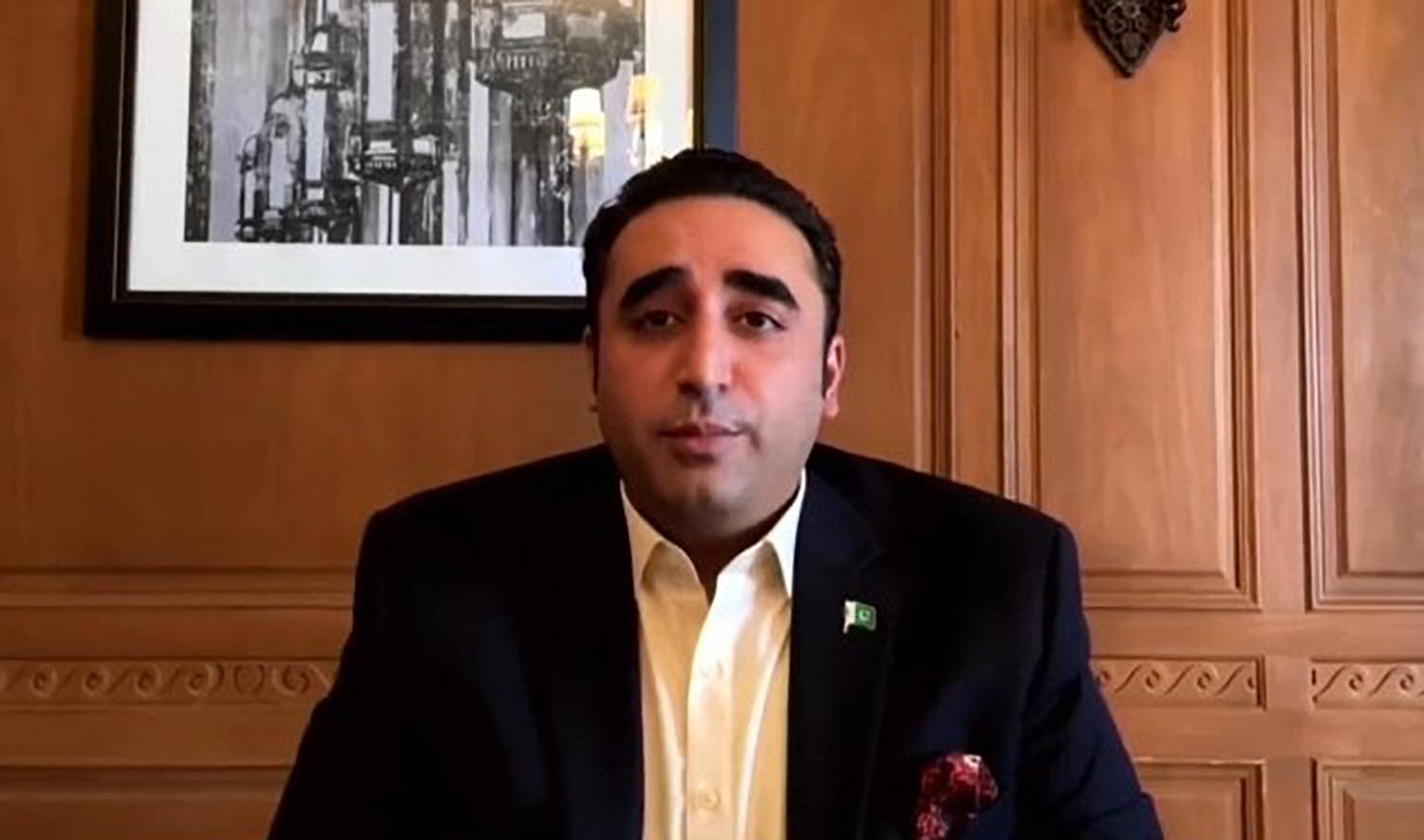
Pakistan Foreign Minister Bilawal Bhutto-Zardari addresses the UN Human Rights Council via video link on July 11, 2023. (Photo courtesy: @UN_HRC/Twitter)
Short Url
Updated 11 July 2023
Follow

Pakistan’s foreign minister urges global unity against desecration of Holy Qur’an

  • Bhutto-Zardari tells the world last month’s Qur’an burning in Stockholm was an attempt to provoke religious violence
  • He says the vigor to protect free speech should not make the world lose sight of the imperative to reject hate speech

ISLAMABAD: Pakistan’s foreign minister Bilawal Bhutto-Zardari on Tuesday urged the world to unite against hatred, discrimination and intolerance, calling upon the international community to join hands in condemning the desecration of the Holy Qur’an while seeking to isolate those who trying to stoke hatred by committing such acts.

Bhutto-Zardari virtually addressed the United Nations Human Rights Council to participate in a global conversation on incidents of religious hatred, with specific focus on the recent Qur’an burning in Stockholm.

An Iraqi immigrant to Sweden burned the Islamic scripture outside a mosque in the European state last month, leading to protests across the Muslim world.

In a draft resolution presented by Pakistan on behalf of the 57-nation Organization of Islamic Cooperation (OIC), the group described the incident as “offensive, disrespectful and a clear act of provocation.”

“Let’s unite against hatred, discrimination, intolerance and forge pathways for mutual respect, understanding and tolerance,” said the Pakistani minister in his virtual address.

“We must join hands in condemning [such incidents], must isolate those who stoke hatred as the Holy Qur’an is a spiritual anchor for two billion Muslims,” he added.

Bhutto-Zardari maintained it was unfortunate that such deliberate acts of desecration of the Holy Qur’an had continued under “government sanction and with a sense of impunity” in Europe.

“Increasingly, these acts are designed to maximize provocation,” he said, adding the world must see such incidents clearly as incitement to religious hatred, discrimination and attempts to provoke violence.

“It is in the same spirit I resolutely stand alongside those who are calling for prevention, legal deterrence and accountability of actions that constitute incitement to hostility against people of faith,” he continued.

The Pakistani minister noted the world had observed the first international day to combat Islamophobia only three months ago, pointing out that everyone had spoken with a single voice in condemnation of such hatred back then.

He maintained it was important to understand the emotional injury that a public and premeditated act of the Qur’an’s desecration caused Muslims.

“It is an attack on their faith,” he said, adding the draft text before the council called for the prevention of such incidents and accountability of those guilty of perpetrating it.

“In making this call, I am not losing sight of the fundamental right of free speech, it is as indispensable as hate speech should be indefensible,” the minister continued.

However, he emphasized that the vigor to protect free speech must not make the world lose sight of the imperative to reject hate speech.

“There is not a single Muslim country on the planet that allows for the desecration of the holy texts of other religions as such an act is unthinkable to any Muslim and is forbidden by faith, by culture and by law,” he added.

Pakistan sets expectations for Trump-backed Gaza Board of Peace at UN

Updated 4 sec ago
Follow

Pakistan sets expectations for Trump-backed Gaza Board of Peace at UN

  • The country calls for ceasefire enforcement and reconstruction of the war-ravaged territory
  • Pakistani diplomat warns Gaza recovery must proceed without annexation or forced displacement

ISLAMABAD: Pakistan on Wednesday highlighted its expectations of US President Donald Trump’s Board of Peace (BoP) in Gaza, saying it joined the United Nations-backed body alongside other Muslim nations since it expected concrete steps toward a permanent ceasefire, reconstruction of Gaza and a lasting and just peace grounded in the Palestinian right to statehood.

Prime Minister Shehbaz Sharif signed the Gaza Board of Peace charter earlier this week along with other world leaders on the sidelines of the 56th Annual Meeting of the World Economic Forum in Davos.

Pakistan’s Permanent Representative to the UN, Ambassador Asim Iftikhar Ahmad, told an open Security Council debate on the Middle East that the decision was driven by the need to address the “unresolved Palestinian question,” which he described as “the core of the instability” in the region.

“We hope that the BoP under the framework of resolution 2803 will lead to concrete steps toward the implementation of a permanent ceasefire, further scaling up of humanitarian aid, reconstruction of Gaza, and realization of the right to self-determination of the people of

Palestine through a credible, time-bound political process, consistent with international legitimacy and relevant UN resolutions resulting in an independent, sovereign and contiguous state of Palestine based on pre-1967 borders with Al-Quds Al-Sharif as its capital,” Ahmad said while addressing the council.

“That is the ultimate goal supported by the international community,” he added. “Palestinian-led governance and institutional strengthening, with a central role of the Palestinian Authority, are indispensable in this regard.”

Ahmad maintained Pakistan was deeply concerned about the fragile situation in Gaza, pointing to Israel’s continued ceasefire violations that he said were putting civilian lives at risk. He stressed that the ceasefire must be fully respected with a view to a permanent cessation of hostilities.

The Pakistani diplomat said recovery and reconstruction should begin without delay and must proceed without annexation, forced displacement or any alteration of the territorial unity of the Occupied Palestinian Territory.

“The contiguity of Gaza and the West Bank is indispensable for the viability of the Palestinian state,” he said.

Ahmad also called for a credible, irreversible and time-bound political process culminating in the realization of Palestinian statehood in accordance with international legitimacy.

“The international community, particularly this council, bears the responsibility to translate renewed engagement into measurable change on the ground for the betterment of the Palestinian people,” he said, adding that Pakistan was ready to work with “members of the council, regional and international partners, and the United States to advance a just and lasting solution to the Palestinian question, and comprehensive peace in the Middle East.”