NEW DELHI: The Muslim World League chief has started his official visit to India as he addressed on Tuesday a conference with the country’s national security adviser in New Delhi.
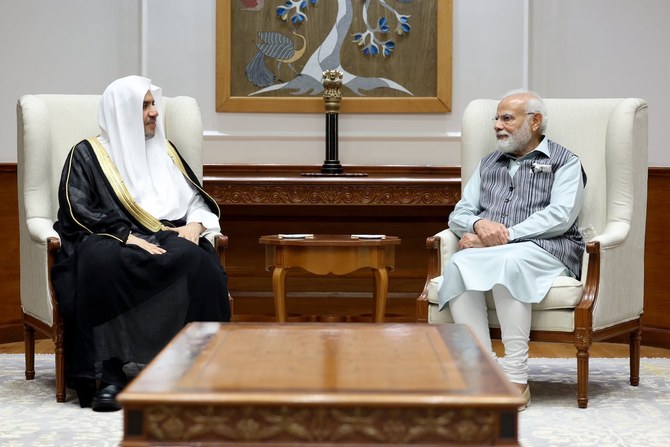
An MWL delegation headed by Secretary-General Mohammed bin Abdulkarim Al-Issa arrived in New Delhi on Monday for a five-day visit, during which he is expected to meet President Droupadi Murmu, Prime Minister Narendra Modi and Minority Affairs Minister Smriti Irani.
During the trip, Al-Issa will also meet religious leaders of different faiths, and on Friday is scheduled to lead congregation prayers and deliver a sermon at the historical Jama Masjid in New Delhi, one of the largest mosques in India.
“We know that Indian Muslims have contributed a lot to humanity. We know that they have a common objective of existing peacefully,” Al-Issa told the audience at the India Islamic Center in New Delhi as he spoke about the MWL’s mission to promote peace, coexistence and tolerance.
“I appreciate the history of diversity that is there in India, and believe in the necessity of establishing communication and outreach with this diverse culture in India,” he said.
“Through our partnership here, it would be a message to the whole world that we are working for inspiration and peace.
“This is an alliance of civilization, an alliance which would be tangible and not limited to speeches and conferences.”
National Security Adviser Ajit Doval welcomed the Saudi scholar and lauded his “incessant efforts toward interfaith harmony,” which have contributed to a “better understanding of Islam and its contribution to humanity.”

MWL chief starts official visit to India
https://arab.news/j6mz5
MWL chief starts official visit to India
- Secretary-General Mohammed bin Abdulkarim Al-Issa addresses conference on 5-day trip
- He is expected to meet President Droupadi Murmu, PM Narendra Modi
Philippines signs free trade pact with UAE
- UAE deal is Philippines’ fourth free trade pact, after South Korea, Japan, and EFTA
- Business body warns of uneven gains if domestic safeguard mechanisms insufficient
MANILLA: The Philippines signed on Tuesday a comprehensive economic partnership agreement with the UAE, its first such deal with a Middle Eastern nation.
The Philippines and the UAE first agreed to explore a free trade pact in February 2022 and formalized the process with terms of reference in late 2023. Negotiations started in May 2024 and were finalized in 2025.
The CEPA signing was witnessed by President Ferdinand R. Marcos Jr. who led the Philippine delegation to Abu Dhabi.
“The CEPA is the Philippines’ first free trade pact with a Middle Eastern country, marking a milestone in expanding the nation’s global trade footprint,” Marcos’s office said.
“The agreement aims to reduce tariffs, enhance market access for goods and services, increase investment flows, and create new opportunities for Filipino professionals and service providers in the UAE.”
The UAE is home to some 700,000 Filipinos, the second-largest Filipino diaspora after Saudi Arabia.
With bilateral trade worth about $1.8 billion, it is also a key trading partner of the Philippines in the Middle East, and accounted for almost 39 percent of Philippine exports to the region in 2024.
The Philippine Department of Trade and Industry earlier estimated it would lead to at least 90 percent liberalization in tariffs and give the Philippines wider access to the GCC region.
“Preliminary studies indicate the CEPA could boost Philippine exports to the UAE by 9.13 percent, generate consumer savings, and strengthen overall trade linkages with the Gulf region,” Marcos’s office said.
The Philippine Chamber of Commerce and Industry-Makati expects the pact to bring stronger trade flows, capital and technology for renewable energy, infrastructure, food, and water security projects as long as domestic policy supports it.
“CEPA can serve as a trade accelerator and investment catalyst for the Philippines,” Nunnatus Cortez, the chamber’s chairman, told Arab News.
The pact could result in “expanding exports, attracting capital, diversifying economic partners, upgrading industries, and supporting long-term growth — provided the country actively supports exporters and converts provisions into concrete commercial outcomes,” said Cortez.
“The main downside risk of CEPA lies in domestic readiness. Without strong industrial policy, MSME (Micro, Small and Medium Enterprises) support, safeguard mechanisms, and export development, CEPA could lead to import dominance, uneven gains, fiscal pressure, and limited structural transformation.”
The deal with the UAE is the Philippines’ fourth bilateral free trade pact, following agreements with South Korea, Japan, and the European Free Trade Association, which comprises Iceland, Liechtenstein, Norway, and Switzerland.