

Pakistan rejects Israel’s advice on human rights, slams ‘history of oppression’ of Palestine

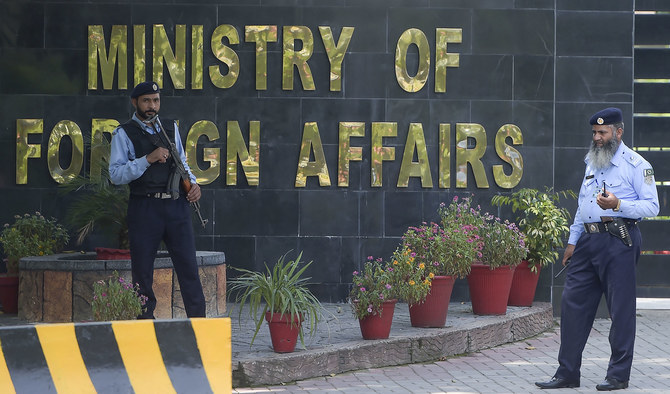
Pakistani policemen stand guard outside the Pakistan's Foreign Ministry building in Islamabad on Sept. 2, 2019. (AFP/File)
Short Url
Updated 11 July 2023
Follow

Pakistan rejects Israel’s advice on human rights, slams ‘history of oppression’ of Palestine

  • Pakistan has no diplomatic relations with Israel, has for decades called for independent Palestinian state
  • Pakistan’s foreign office rejects comments by Israel on the South Asian nation’s human rights record

ISLAMABAD: Pakistan’s foreign office on Monday rejected comments by Israel on the South Asian nation’s human rights record and called out Israel’s “history of oppression” of Palestine.

Pakistan has no diplomatic relations with Israel and has for decades called for an independent Palestinian state based on “internationally agreed parameters” and borders before the 1967 war.

“The UN Human Rights Council today adopted Pakistan’s Universal Periodic Report unanimously,” the foreign office said in response to Israel calling on Pakistan to respect human rights.

“Several states and civil society organizations commended Pakistan on the progress achieved in promoting human rights.”

“Israel’s politically motivated statement is fundamentally at variance with the otherwise positive tone of the session and the statements made by a vast majority of states,” the foreign office added. “Given Israel’s long history of oppression of Palestinians, Pakistan can certainly do without its advice on protecting Human Rights.”

Pakistan and Israel have never had official relations and successive Pakistani government have repeatedly said there would be no recognition of Israel without the resolution of the Palestinian situation.

However, the two countries have maintained discreet unofficial ties for many decades, with a British government report in 2013 suggesting Israel had sold Pakistan military technology, which was publicly denied by both countries.

A delegation of Pakistani-Americans went to Israel in 2022, provoking outrage in Pakistan, with then prime minister Imran Khan accusing them of seeking to undermine the country’s diplomatic stance on the Israel-Palestine issue.


Security forces kill four militants in Pakistan’s volatile southwest, military says

Updated 13 January 2026
Follow

Security forces kill four militants in Pakistan’s volatile southwest, military says

  • Balochistan, Pakistan’s largest province by land area bordering Iran and Afghanistan, has long been the site of a low-level insurgency
  • The Balochistan government has recently established a threat assessment center to strengthen early warning, prevent ‘terrorism’ incidents

ISLAMABAD: Pakistani security forces gunned down four militants in an intelligence-based operation in the southwestern Balochistan province, the military said on Tuesday.

The operation was conducted in Balochistan’s Kalat district on reports about the presence of militants, according to the Inter-Services Public Relations (ISPR), the Pakistani military’s media wing.

The “Indian-sponsored militants” were killed in an exchange of fire during the operation, while weapons and ammunition were also recovered from the deceased, who remained actively involved in numerous militant activities.

“Sanitization operations are being conducted to eliminate any other Indian-sponsored terrorist found in the area,” the ISPR said in a statement.

There was no immediate response from New Delhi to the statement.

Balochistan, Pakistan’s largest province by land area bordering Iran and Afghanistan, has long been the site of a low-level insurgency involving Baloch separatist groups, including the Balochistan Liberation Army (BLA) and the Balochistan Liberation Front (BLF).

Pakistan accuses India of supporting these separatist militant groups and describes them as “Fitna Al-Hindustan.” New Delhi denies the allegation.

The government in Balochistan has also established a state-of-the-art threat assessment center to strengthen early warning and prevention against “terrorism” incidents, a senior official said this week.

“Information that was once scattered is now shared and acted upon in time, allowing the state to move from reacting after incidents to preventing them before they occur,” Balochistan Additional Chief Secretary Hamza Shafqaat wrote on X.

The development follows a steep rise in militancy-related deaths in Pakistan in 2025. According to statistics released by the Pakistan Institute for Conflict and Security Studies (PICSS) last month, combat-related deaths in 2025 rose 73 percent to 3,387.

These included 2,115 militants, 664 security forces personnel, 580 civilians and 28 members of pro-government peace committees, the think tank said.