

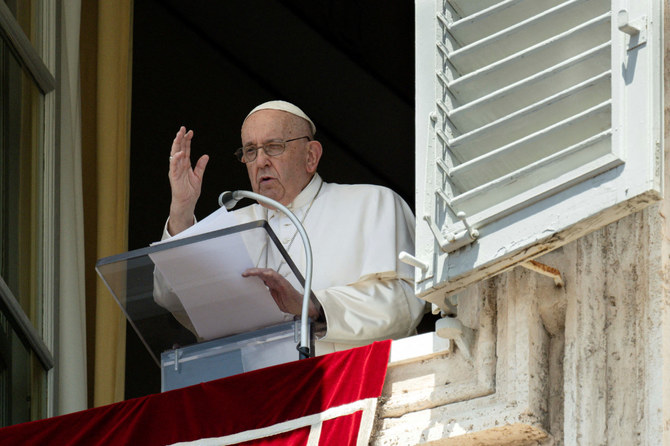


VATICAN CITY: Pope Francis on Sunday announced he has chosen 21 new cardinals, including prelates from Jerusalem and Hong Kong — places where Catholics are a small minority — as he continues to leave his mark on the body of churchmen who will select his successor.
The pope announced his picks during his customary weekly appearance to the public in St. Peter’s Square, saying the ceremony to formally install the churchmen as cardinals will be held on Sept. 30.
Among those tapped are several prelates holding or about to assume major Vatican posts, including the archbishop from La Plata, Argentina, Archbishop Victor Manuel Fernández, 59, whom the pope just named to lead the Holy See’s powerful office for ensuring doctrinal orthodoxy a nd overseeing processing of allegations of sexual abuse against clergy worldwide.
The new cardinals also include Hong Kong Bishop Stephen Sau-yan Chow, 64, and the Vatican’s top official in the Middle East, Monsignor Pierbattista Pizzaballa, 58, the Latin Patriarch of Jerusalem.
Those two churchmen guide flocks in geopolitical areas of keen concern to the Vatican.
On Sunday, in remarks preceding his reading out of the list of new cardinals, Pope Francis expressed hope that Israeli and Palestinian authorities would take up “direct dialogue” to end the “spiral of violence” — a reference to recent deadly clashes.
Francis repeatedly has cited the hardships of the Christian minority in the Middle East in recent decades.
In an interview in April with The Associated Press, Pizzaballa, an Italian prelate who is the top Catholic churchman in the Holy Land, said that the region’s 2,000-year-old Christian community has come under increasing attack, with the most right-wing government in Israel’s history emboldening extremists who have harassed clergy and vandalized religious property at a quickening pace.

People gather to attend the Angelus prayer led by Pope Francis at Saint Peter's Square at the Vatican on July 9, 2023. (Vatican Media/Handout via REUTERS)
For decades, the Vatican and China have experienced tensions alternating with improvement of relations over the Communist-led nation’s insistence that it has the right to appoint bishops and the jailing of priests who professed loyalty to the pope.
Earlier this year, the Hong Kong bishop, who, like Francis, is a Jesuit, made the first visit to mainland China in nearly 30 years by a prelate in that post.
In announcing their names, Francis said the appointment of cardinals from across the globe “expresses the universality of the Church that continues to announce the merciful love of God to all men of the Earth.”
Cardinals serve as advisers to the pontiff on matters of teaching and administration, including the Vatican’s scandal-plagued finances. But their most crucial duty is gathering in a secret conclave to elect the next pontiff.
Francis has now named nine batches of new cardinals in his 10-year papacy. Even before this latest group, he had already appointed the large majority of those eligible to elect the next pontiff — those aged under 80. With the latest appointments, the number of cardinals who meet that condition stands at 137.
That means, increasingly, the men who will vote for whoever succeeds Francis, in the event of his resignation or death, are churchmen supportive of his values, priorities and perspectives and who share his vision for the future of the Catholic Church.
Three of the churchmen chosen to receive the cardinal red work in Africa, a continent where the Church has experience growth in recent decades. They are Monsignor Stephen Brislin, 66, archbishop of Cape Town, South Africa; Monsignor Protase Rugambwa, 63, co-adjutor archbishop of Tabora, Tanzania; and Monsignor Stephen Ameyu Martin Mulla, 59, archbishop of Juba, South Sudan, which the pope visited earlier this year.
The office that Francis appointed Fernández to is traditionally headed by a cardinal. But the speed with which the La Plata archbishop was tapped publicly as a cardinal — eight days after the appointment — was notable and highlights the attention the pontiff gives to that office.
A US-based group that tracks how the Catholic hierarchy deals with allegations of sexual abuse by clergy says Francis made a “troubling” choice in picking the Argentine archbishop, who, in 2019, refused to believe victims who accused a priest in that archdiocese of sexually abusing boys.
Two others holding important offices at the Vatican were also among the pope’s picks on Sunday. They are the Chicago-born Monsignor Robert Francis Prevost, 67, who heads the Dicastery for Bishops; and Monsignor Claudio Gugerotti, 67, an Italian in charge of the Dicastery for Eastern Churches.
Also on the list are:
Monsignor Americo Manuel Alves Aguiar, an auxiliary bishop from Lisbon, Portugal, which the pope will visit next month for a Catholic youth jamboree, was also on the list. At 49, he is exceptionally young for a cardinal.
Monsignor Sebastian Francis, 71, bishop of Penang, Malaysia, who heads the bishops conference of Malaysia, Singapore and Brunei; Monsignor Francois-Xavier Bustillo, 54, a Franciscan and native Spaniard who is bishop of Ajaccio, on the French island of Corsica; Monsignor Luis Jose Rueda Aparicio, 71, archbishop of Bogota, Colombia; and Monsignor Grzegorz Rys, 59, archbishop of Lodz, Poland.
Monsignor Emil Paul Tscherrig, 76, a Swiss prelate who is the first non-Italian to serve as papal ambassador to Italy and San Marino; and Monsignor Christopher Louis Yves Pierre, 77, a Frenchman whose diplomatic postings included Washington, D.C.
Monsignor Angel Sixto Rossi, 64, a Jesuit who is archbishop of his native Cordoba, Argentina; Monsignor Jose Cobo Cano, 57, who was just appointed last month by Francis to be archbishop of Madrid; and the Rev. Angel Fernández Artime, 62, a Spaniard who is rector major of the Salesians, a congregation of priests present in 133 countries.
Three of the 21 new cardinals are 80 or older and thus not eligible to vote in a conclave. They are Italian prelate, Agostino Marchetto, 82, who served as the top Vatican diplomat in Belarus, Madagascar, Mauritius and Tanzania; Monsignor Diego Rafael Padron Sanchez, 84, archbishop emeritus of Cumana, Venezuela; and a Franciscan priest, Luis Pascual Dri, 96, famed for hearing confessions in the pope’s native Buenos Aires and who has been praised by Francis for his stress on mercy.


