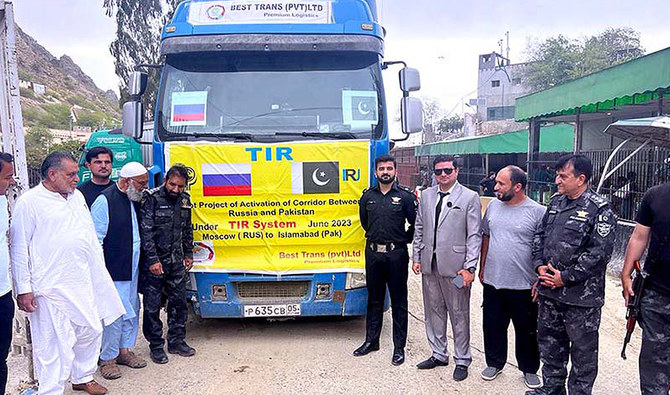

PESHAWAR: The first truck carrying export goods from Russia arrived in Pakistan this week as part of an agreement between the two countries, officials said on Sunday, days after Islamabad received a second cargo of discounted crude oil from Moscow.
The consignment carrying chickpeas and other goods entered Pakistan via the Torkham border crossing between Pakistan and Afghanistan in the northwestern Khyber Pakhtunkhwa province late Friday. It came under the Transport International Route (TIR) Convention.
The bilateral TIR treaty with Russia was signed during Pakistani Communications Minister Asad Mahmood’s visit to Moscow in March to boost trade with the neighboring countries, according to officials. This is the first road trade route established between the two countries since the beginning of their bilateral ties in 1948.
“It was the first consignment imported from Russia under the Transport International Route (TIR) Convention,” Afnan Khan, an additional collector at the Peshawar Customs Headquarters, told Arab News on Sunday.
“A small inaugural ceremony was also conducted at the National Logistic Cell (NLC) Terminal, Torkham to acknowledge the [arrival of the] first consignment.”
The TIR Convention is an international customs transit system that facilitates the movement of goods across borders using sealed containers or vehicles, simplifying customs procedures by using standardized documentation and mutual recognition of customs controls among participating countries.
The TIR Carnet, a customs document, and seals on containers or vehicles ensure the integrity of the goods during transit. Over 70 countries, primarily in Europe, Asia, and parts of the Middle East, are parties to the TIR convention, enabling faster and more efficient cross-border transport operations. Pakistan became a signatory of the TIR Convention in January 2016.
The Russian consignment arrived nearly two weeks after a vessel carrying a second cargo of discounted Russian crude oil, arranged under another deal struck between Islamabad and Moscow this year, docked at the port in the southern Pakistani city of Karachi. The first cargo arrived on June 11, with 45,122 metric tons of Russian crude oil.
Communications Minister Mahmood and other officials were scheduled to receive the consignment at the Torkham border crossing, but the visit had to be canceled because of bad weather, according to Khan.
“Consignments though come in from other countries via Torkham but this is the first delivery from Russia that crossed the border,” he said, adding more trucks carrying Russian goods were expected to arrive in Pakistan soon.
Akhtar Nawaz, a Pakistani customs clearance agent in Torkham, was optimistic that continuation of trade with Moscow through the land route would help strengthen Pakistan’s economy and benefit local businesses in the border region.
“Pakistan needs to ease custom procedures for goods clearance to expedite business at the border,” he said. “Land trade greatly encourages businesses and keeps prices of commodities stable.”
Best Trans (Pvt.) Ltd. was the logistics company responsible for handling Friday’s shipment, while the truck carrying it was driven by a Russian driver, according to Hammad Ali, another customs official deployed at the Torkham border crossing.
Pakistan had previously been trading under the TIR Convention with Central Asian republics, but trade with Russia under the bilateral treaty would now further the economic cooperation between the two countries.
Last month, a consignment of 21 trucks carrying liquefied petroleum gas (LPG) from Uzbekistan and Turkmenistan reached Pakistan through the Torkham border crossing, according to customs officials. The LPG orders started arriving shortly after the first cargo of discounted Russian crude oil arrived in Karachi last month.
As per the Torkham custom department, the benefits of TIR include simplified customs procedures, cost and time savings for trade, enhanced security and safety for cargo, global reach and mutual recognition, facilitation of international trade and risk reduction and guarantee system.