

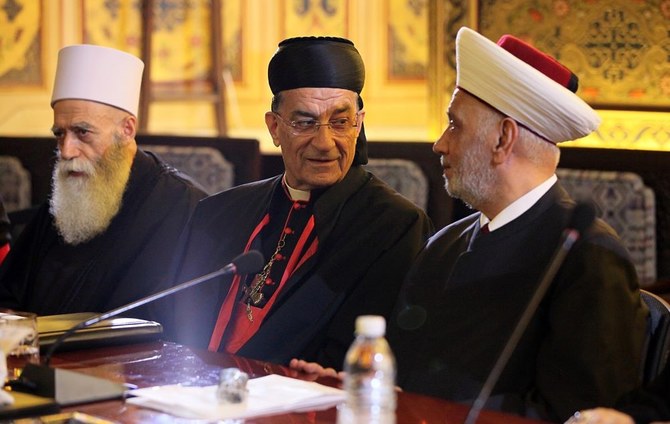

BEIRUT: Maronite Patriarch Bechara Al-Rahi reiterated his call for an “international conference for Lebanon after Lebanese politicians fled from dialogue due to being beholden to their own interests” on Wednesday.
Al-Rahi was speaking at the launch of a new document titled “A New Vision for Lebanon Tomorrow: A Secular, Decentralized, and Neutral State.”
He expressed his doubts about the sincerity of politicians toward the country, saying that “there is no salvation for Lebanon if we remain as we are. Lebanon is sick, and officials do not want to treat its illness or know its cause.”
Al-Rahi continued: “It is not the right of officials to devastate a country and its people by destroying the system and the constitution.”
The presidential vacuum in Lebanon has entered its ninth month without MPs being able to elect a head of state due to ongoing political divisions.
Meanwhile Al-Rahi was briefed by Lebanon’s caretaker minister of justice, Henri Khoury, on the progress of army investigations into the murder of two people in the Qurnat as Sawda area last Saturday.
Haitham Tawk and Malek Tawk were killed in a dispute over water and real estate near the town of Bsharri, an area frequently riven by disputes over land and resources due to a lack of demarcation of some areas, including the Qurnat as Sawda summit itself, which is the highest peak in Lebanon and the Levant.
Multiple people from Bsharri and the neighboring town of Dennieh were arrested and weapons seized.
“Army Intelligence investigators have formed an initial picture of how the crime took place and how the first bullet was fired, which hit Haitham Touk, 36, and led to his death,” said a security source.
After meeting with Al-Rahu, the minister said the real estate judge responsible for the north of the country has completed the demarcation of six towns and sent documents and maps for them to the land registry, and has until the end of the summer to send further documents for two more towns. However, he noted that he was facing “many obstacles.”
Caretaker Prime Minister Najib Mikati has formed a committee tasked with studying the disputes between real estate borders and over water, headed by the minister of interior.
According to a source close to the prime minister’s office, the committee contributes to “relieve” what it called “popular tension” and takes steps “toward addressing chronic border disputes.”
However, Mikati’s opponents said that the formation of the committee is “an attempt to push the blame for government negligence and delay in resolving border disputes,” with one source saying “formal steps” had “led to a terrible crime and two victims, which almost caused … sectarian strife (had it) not (been) for the quick action of the region’s leaders and the absorption of tension by the Lebanese Army, despite calls for revenge.”
Samir Geagea, the leader of the Lebanese Forces party, said that Mikati “overstepped his authority by forming a committee to study the issue of property border disputes, as the matter falls within the jurisdiction of the judicial authorities, not the political ones.”
Geagea pointed out that “the file of defining the real estate borders in the Qurnat as Sawda area has been in the hands of the judiciary for three years, and the survey and determination work is in full swing, albeit slowly.”
Fares Souaid, president of the National Council to End the Iranian Occupation of Lebanon, called for the committee to include village chiefs and municipalities of the affected areas.


