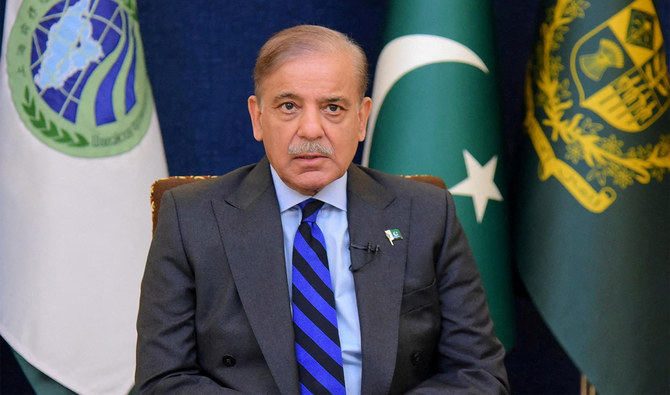
Pakistan PM hopes for bailout approval from IMF board on July 12

In this file photo, Pakistan's Prime Minister Shehbaz Sharif, addresses the 23rd Shanghai Cooperation Organization (SCO) Summit in Islamabad, Pakistan, on July 4, 2023. (PID/REUTERS)
Short Url
Updated 05 July 2023
Follow

Pakistan PM hopes for bailout approval from IMF board on July 12

  • After eight months of negotiations, Pakistan and IMF siged a staff-level agreement on last week for bailout 
  • Finance Minister Ishaq Dar says Pakistan yet to receive first installment of $1.1 bn, which needs IMF approval

Prime Minister Shehbaz Sharif said on Wednesday that he hoped the $3 billion short-term bailout for Pakistan would be given final approval by the International Monetary Fund board when it meets on July 12.

After eight months of negotiations, both sides signed a staff-level agreement on Friday, to avert an imminent default on sovereign debt. Finance Minister Ishaq Dar has said Pakistan will receive a first installment of $1.1 billion, but the IMF board’s approval is needed before funds can be disbursed.

“The agreement will go through, God willing,” Sharif said during a ceremony in Islamabad.

Sharif also thanked longtime allies China, Saudi Arabia, and United Arab Emirates for their support while his government was in negotiations with the IMF.

The allies had pledged bilateral financing or rolled over debts to help slow the drain on Pakistan’s foreign currency reserves, which by the end of last month were down to just a little below $4 billion, barely enough to pay for a month of controlled imports.

Dar said on Friday that the IMF deal would unlock bilateral lending from friendly governments and other multilateral lenders, and Pakistan’s reserves could rise up to $15 billion by the end of this month.

Pakistan is due to hold a general election by early October, though Sharif’s coalition government only came to power in April last year, after former prime minister Imran Khan lost a confidence vote in parliament.

The government desperately needed the IMF bailout to avoid the deepening balance of payments crisis, while dealing with an economy suffering record high inflation, running at 38 percent annually in May.

Sharif has had to take unpopular policy decisions demanded by the IMF since February. It has already announced an increase in the petroleum levy, and it will be raising electricity prices too.

The government has also committed to raise more than 385 billion rupee ($1.34 billion) in new taxation, and in recent days the central bank raised the policy interest rate 22 percent.


Pakistan PM calls for faster CPEC implementation, pledges security for Chinese workers

Updated 27 February 2026
Follow

Pakistan PM calls for faster CPEC implementation, pledges security for Chinese workers

  • Shehbaz Sharif pushes expanded cooperation in agriculture, IT and mining under CPEC phase two
  • Chinese envoy reaffirms Beijing’s support for Pakistan’s sovereignty and economic development

ISLAMABAD: Prime Minister Shehbaz Sharif on Friday called for speeding up projects under the China-Pakistan Economic Corridor (CPEC) and pledged stronger security guarantees for Chinese workers and investments, during a meeting with China’s ambassador in Islamabad.

Sharif made the remarks as the two countries strive to launch the second phase of CPEC, a multibillion-dollar infrastructure and energy initiative launched in 2015 as part of China’s Belt and Road Initiative (BRI).

CPEC’s first phase focused largely on power generation and transport infrastructure aimed at easing Pakistan’s chronic energy shortages and improving connectivity. The second phase seeks to expand cooperation into industrial development, with an emphasis on special economic zones and export-oriented growth.

“While highlighting the importance of accelerating ongoing CPEC projects, the Prime Minister stressed on the need to enhance cooperation in agriculture and IT and mining & minerals,” said a statement circulated by the PM Office after the meeting.

“He also underscored Pakistan’s resolve to provide a secure and conducive environment for Chinese personnel, investments, and institutions in Pakistan,” it added.

Chinese nationals and projects in Pakistan have faced security threats in the past, including attacks by militant groups targeting infrastructure sites and convoys. Islamabad has repeatedly vowed to tighten security and has deployed special protection units for Chinese workers.

China is Pakistan’s closest ally in the region and a key economic partner, with CPEC widely regarded by Islamabad as central to long-term economic growth.

During the meeting, the prime minister conveyed greetings to Chinese President Xi Jinping and Premier Li Qiang, particularly on the occasion of the Chinese New Year.

China’s Ambassador to Pakistan, Jiang Zaidong, reiterated Beijing’s support for Pakistan’s sovereignty and socioeconomic development, according to the statement. Both sides also exchanged views on regional and international issues and agreed to maintain close coordination.