Meeting of Islamic leaders called after Qur’an burning in Sweden
Countries throughout the Middle East and beyond have denounced the burning
Updated 01 July 2023
Arab News
JEDDAH: The Organization of Islamic Cooperation has called an emergency meeting of its executive committee in Jeddah next week to discuss the consequences of the burning of a copy of the Qur’an in Sweden this week.
The meeting will “discuss the measures to be taken against this heinous act and adopt a collective position on the necessary course of action,” a spokesman said.
There has been widespread outrage and condemnation in the Muslim and Arab world since Salwan Momika, 37, a refugee from Iraq, desecrated the Qur’an and set fire to its pages in front of the Stockholm’s largest mosque on Wednesday.
Countries throughout the Middle East and beyond denounced the burning, some recalled their ambassadors, and foreign ministries summoned the Swedish ambassadors to their countries to hear official protests.
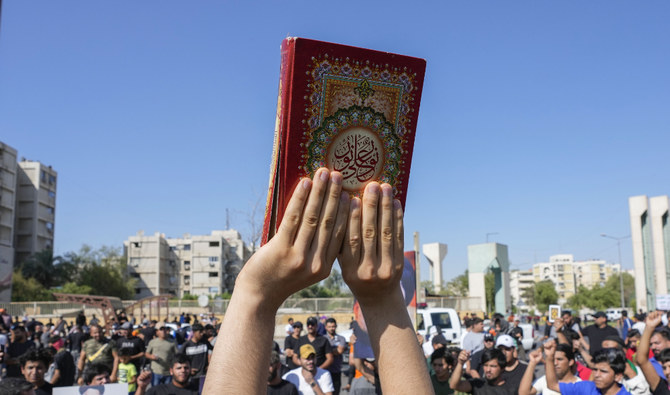
The anger continued on Friday. Thousands of supporters of populist Shiite cleric Moqtada Al-Sadr held a protest in front of the Swedish Embassy in Baghdad to demand an end to diplomatic ties.
Protesters carried Iraqi flags and portraits of Al-Sadr and his father, also a prominent cleric, and chanted “Yes, yes to the Qur’an, Moqtada, Moqtada.”
The cleric had called for “mass angry protests against the Swedish Embassy in Baghdad” to demand the expulsion of the Swedish ambassador and the cutting of ties with Sweden.
Meanwhile, the man behind the row has threatened to do it again. “Within 10 days I will burn the Iraqi flag and the Qur’an in front of Iraq’s Embassy in Stockholm,” he said.
Momika said he knew his action would provoke reactions and that he had received “thousands of death threats.”
He denied that his actions constituted a “hate crime” or “agitation toward any group.”
The secret keepers of desert balance in Saudi Arabia
How the Kingdom’s wildcats control pests, protect public health, and sustain the ecosystem
Updated 27 December 2025
Haifa Alshammari
RIYADH: During the summer of 2024, two desert lynx kittens were born in Taif as part of Saudi Arabia’s efforts to protect and increase the population of caracals in the country.
Although caracals are critically endangered, wildcats in general play a significant ecological role in the Kingdom. They act as natural pest control, and Saudi Arabia is committed to conserving these species while increasing their populations to support a thriving ecosystem.
Despite the Kingdom’s harsh, arid climate, conditions are suitable for wildcats not only to survive but also to flourish. Among the terrestrial species inhabiting Saudi Arabia are sand cats, Arabian wildcats, and the desert lynx.
Felis margarita, or sand cats, are small — around 40-60 cm — with pale sandy fur that allows them to blend into the desert. They have a broad head, large ears, and long hair on the bottom of their feet to walk on hot sand.
Sand cats have long hair on the bottom of their feet, allowing them to walk on hot sand and prevent them from sinking into the sand. (SPA/Visitsaudi)
“It is small in size and does not mate with other cats. It is the only cat species in the world with hair on the soles of its feet instead of skin to prevent it from sinking into the sand,” said Obaid Alouni, a Saudi environmentalist.
Alouni explained that one defensive technique sand cats use is to lie flat on the ground to avoid detection.
“It lies flat on the ground when it senses danger to avoid being noticed by other animals.”
These cats primarily feed on rodents and small reptiles, occasionally large insects, obtaining their water from their prey. Sand cats are native to West Asia and help regulate rodent and insect populations, preventing outbreaks and reducing disease spread.
Opinion
This section contains relevant reference points, placed in (Opinion field)
Interestingly, raising sand cats as domestic pets is becoming more popular, Alouni said. But he emphasized that adoption is easier when they are kittens, as they remain wild animals. Although widely distributed across the Kingdom, exact population numbers are difficult to determine due to their elusive nature. They are currently listed as “least concern” by the International Union for Conservation of Nature.
Similar to sand cats, Arabian wildcats (Felis lybica) are found across the Arabian Peninsula and play a vital role in environmental health.
“They are wild cats that live independently without human intervention,” Alouni told Arab News.
An Arabian wildcat at Olomouc Zoo in the Czech Republic. (Wikimedia Commons: Michal Maňas)
Arabian wildcats resemble domestic cats but have thicker, sandy to grey-brown coats with faint stripes or spots and ringed tails with blunt tips. Like sand cats, they feed on rodents, birds, reptiles, and insects and are listed as “least concern” by the IUCN.
However, Alouni warned that pure populations of Arabian wildcats in Saudi Arabia could be threatened by hybridization with domestic cats.
“Currently, wild cats face the problem of interbreeding with domestic cats. This weakens their immune systems and makes them more susceptible to diseases from other cats,” he said.
“This contributes to the extinction of the purebred lineage and, consequently, the disappearance of their wild instincts,” he added.
DID YOU KNOW?
• Sand cats are the only cat species with hair on the soles of their feet, allowing them to walk on hot sand without sinking.
• Caracals, locally known as Al-Washaq, are native and endangered, capable of jumping 3 to 4 meters in a single leap.
• Pure populations of the Arabian wildcat are at risk due to hybridization with domestic cats.
While both species are desert dwellers, sand cats are harder to spot as they avoid heavily trafficked areas. They are mainly found in the Ad Dahna desert and the Empty Quarter, where sand dunes dominate the landscape. Arabian wildcats, however, inhabit rocky or mountainous areas such as the Tuwaiq Mountains, valleys, and farms with abundant small prey.
“Wild cats come around towns and villages, and unfortunately, begin mating with domesticated cats that people release outside,” Alouni explained. He stressed the importance of keeping domestic cats away from wildcat habitats, including deserts and camping sites.
The third wildcat species native to Saudi Arabia, the caracal or desert lynx, is critically endangered. “The lynx is classified in size between large and small, and is distinguished by its jump, which can reach 3 meters or even 4 meters in the sky,” Alouni described.
This combination of photos released by the Saudi National Center for Wildlife (NCW) last year shows a female Caracal and its cub at the Prince Saud Al-Faisal Wildlife Research Center in Taif. (SPA file)
Locally known as Al-Washaq, desert lynx have reddish-tan coats, long legs, and black-tufted ears. They feed on birds, rodents, and sometimes small antelopes. Thankfully, these cats are protected under Saudi law due to their critically endangered status.
Hunting any sand cats, Arabian wildcats, or desert lynx can result in fines of approximately $20,000, according to the Saudi Ministry of Environment, Water, and Agriculture.
“There is a very severe financial penalty in Saudi Arabia for anyone who hunts it,” Alouni added.
The Kingdom has strict regulations to protect endangered animals, criminalizing not only hunting or killing but also trade. Violators could face penalties of up to $8 million, up to 10 years in prison, or both.
Overall, sand cats, Al-Washaq, and Arabian wildcats are essential to maintaining a healthy environment in Saudi Arabia. By controlling rodent populations, they help prevent outbreaks that could threaten agriculture and public health.