

Messi team’s Eid message sends waves of pride across Bangladesh

A young fan of Argentina tries a jersey from a street shop ahead of the FIFA World Cup, in Dhaka, Bangladesh, Nov. 16, 2022. (Reuters)
Short Url
Updated 30 June 2023
Follow

Messi team’s Eid message sends waves of pride across Bangladesh

  • Bangladesh’s support for Argentina made international headlines during Qatar World Cup
  • Diego Maradona turned cricket-mad Bangladeshis into Argentine football fans in the 1980s

DHAKA: As they woke up to observe the second of Islam’s most important holidays, Bangladeshi football fans saw a photo of Argentinian captain Lionel Messi, midfielder Rodrigo De Paul, and forward Angel Di Maria with the words: “Eid Mubarak to all our friends in Bangladesh.”  

Posted on the official Twitter account of the Argentinian national football team on Eid Al-Adha, the wishes from the Argentine Football Association immediately went viral and drew gratitude from Bangladeshis, whose love for La Albiceleste had a special display during the FIFA World Cup in Qatar last year.  

With the outpouring of Bangladeshi support for Messi’s team becoming an international sensation and leading to the reopening of the Argentinian Embassy in Dhaka in February, it came as no surprise that the Eid wishes from La Albiceleste represented a special gesture not just for football fans, but for all.
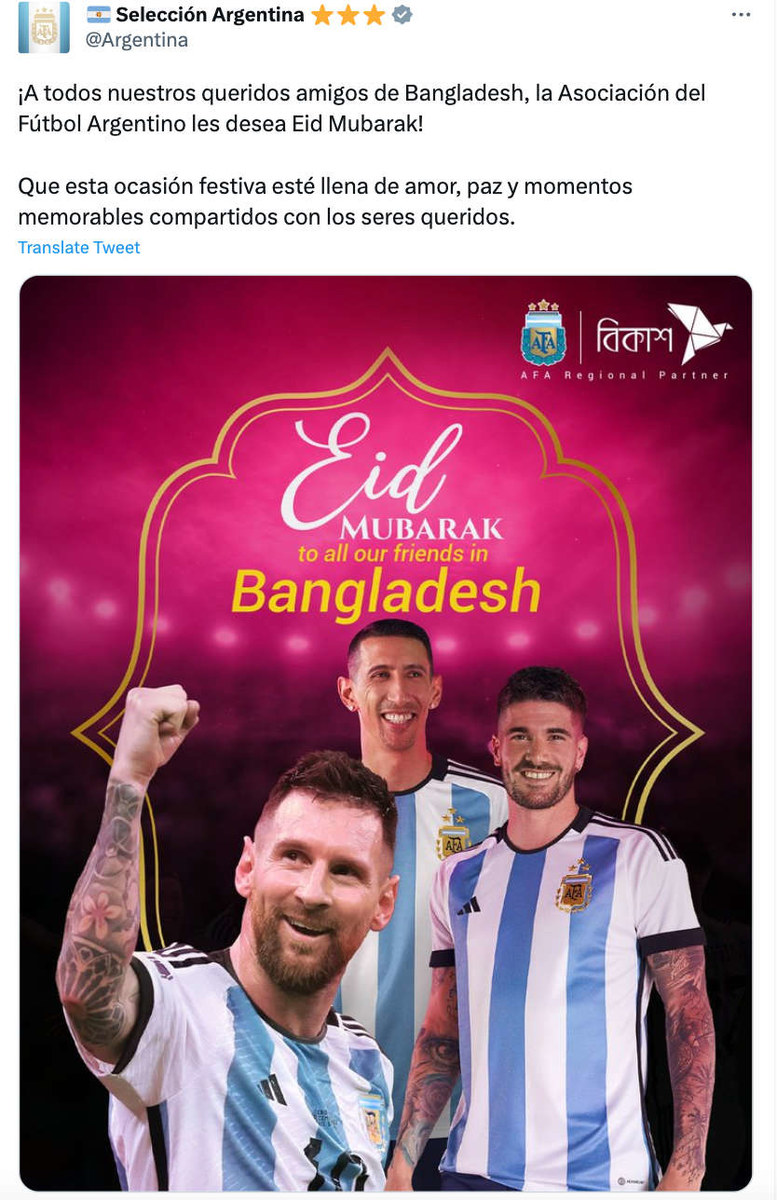


Eid Al-Adha wishes for Bangladeshis posted by the Argentinian national football team on its official Twitter account on June 28. (Supplied)

“It’s a matter of great recognition and respect for us. Since we have a special place in our hearts for Latin American football, now they reciprocated this love through Eid greetings,” Mohammed Aslam, former captain of the Bangladesh national football team, told Arab News.

“It’s a great moment for our football fans as well as the people of Bangladesh.”

For Rebeka Sultana Merry, a college teacher in Jamalpur, the fact that Argentinians remembered Bangladeshis on their religious holiday was also something to cherish as it showed that the affection was mutual.

“During the Qatar World Cup, our football fans showed their utmost love for the Argentina team, and now the whole world knows that after Argentina, Bangladesh is their second largest fan base,” she said.

“It’s a matter of great joy that the Argentine Football Association remembered us on this auspicious occasion of Eid Al-Adha. We feel proud of that. This sort of exchange of greetings will further strengthen the ties.”

When Argentina played the 2022 World Cup matches, hundreds of thousands of fans in the Muslim-majority South Asian country gathered in the team’s sky blue and white jerseys to watch matches on giant screens at key squares, roads and football grounds.

But Bangladeshi love for Argentine football is not new. It dates back to the 1986 World Cup in Mexico when Argentina won the tournament with a historic performance of its then-captain, Diego Maradona.

It was Maradona, the player widely regarded as one of the greatest in the history of the sport, who turned cricket-mad Bangladeshis into Argentine football fans.

“He was above everyone. He won the hearts of our football fans and became a popular name in every household across our country,” said Aslam who captained Bangladesh’s team in the 1980s.

“Maradona proved that football is art. After the World Cup of 1986, our football fans hung his posters in their living rooms. He was an icon.”

For decades, no other football player has charmed Bangladeshis like Maradona, until Messi came to the stage.

“I grew up watching the magical football skills of Messi. For Maradona and Messi, I will love Argentina forever,” said Shahriar Sourov, a 15-year-old fan and aspiring football player from Dhaka.

“On Eid day, it was a big surprise for me to see my football hero Messi greeting us. It was exciting as team Messi remembered us. It seems that the bond between the football fans from two different parts of the world will remain forever. It’s a kind of brotherhood.”


Iran war unsettles India’s packaged water makers as bottles, caps get pricey

Updated 55 min 10 sec ago
Follow

Iran war unsettles India’s packaged water makers as bottles, caps get pricey

  • Higher polymer ‌prices hurt bottled water industry
  • Industry worth $5 billion has big multinational players like Pepsi, Coca-Cola

NEW ​DELHI: The Iran war is rattling India’s $5 billion packaged water market just ahead of the sweltering summer season.
One of the world’s fastest growing bottled water markets is seeing some manufacturers hike prices for distributors, as supply disruptions linked to the war fuel higher costs in everything from plastic bottles to caps, labels and cardboard boxes.
Though retail prices are yet to feel the heat and bigger companies are absorbing the pain, about 2,000 smaller bottled water makers have increased rates for their resellers by around 1 rupee per ‌bottle, a ‌5 percent hike, which will rise by a further 10 percent in ​coming ‌days, ⁠according ​to the ⁠Federation of All India Packaged Drinking Water Manufacturers’ Association.
Consumers usually pay less than 20 rupees, or around 20 US cents, for a one-liter bottle.
“There is chaos and within the next 4-5 days, this will start impacting customer prices,” said Apurva Doshi, the federation’s secretary general.
Rising oil prices have increased the cost of polymer, which is made from crude oil and is a key material for the industry’s plastic bottles. The cost of material used in making ⁠plastic bottles has risen by 50 percent to 170 rupees per kilogram, ‌while the price of the caps has more than ‌doubled to 0.45 rupees apiece. Even corrugated boxes, labels and ​adhesive tape are costing much more, ‌industry letters showed.
Clean water is a privilege in the country of 1.4 billion people where ‌researchers say 70 percent of the groundwater is contaminated, leaving people reliant on bottled water. Companies including Bisleri, Coca-Cola’s Kinley, Pepsi’s Aquafina, billionaire Mukesh Ambani’s Reliance and Tata all compete for a share of the $5 billion market. The companies did not respond to Reuters request for comment.
PREMIUM WATER FACES HEAT ‌TOO
Within the broad bottled water market, natural mineral water is a $400 million business in India and a new, fast-growing wellness product for ⁠India’s wealthy.
The premium ⁠water segment accounted for 8 percent of the bottled water market last year in India, compared to just 1 percent in 2021, Euromonitor says.
Aava, which sells mineral water sourced from the foothills of the Aravalli mountains, has increased prices of its water bottles by 18 percent for resellers, Shiroy Mehta, CEO of the company, told Reuters.
“Most manufacturers are absorbing 40-50 percent of the cost to ensure that they don’t lose clients. It’s a poor situation for the beverage industry ahead of the summer season,” he said.
The mass market, however, is dominated by companies that produce “drinking water” to be sold in 1-liter bottles to customers. Clear Premium Water, a brand of India’s Energy Beverages, said in a notice to its distributors there ​had been an “unprecedented and continuous surge” in ​prices of key raw materials used in packaging and production.
“It is no longer possible for us to absorb the escalating costs while maintaining existing product prices,” the notice said.