

Messi team’s Eid message sends waves of pride across Bangladesh

A young fan of Argentina tries a jersey from a street shop ahead of the FIFA World Cup, in Dhaka, Bangladesh, Nov. 16, 2022. (Reuters)
Short Url
Updated 30 June 2023
Follow

Messi team’s Eid message sends waves of pride across Bangladesh

  • Bangladesh’s support for Argentina made international headlines during Qatar World Cup
  • Diego Maradona turned cricket-mad Bangladeshis into Argentine football fans in the 1980s

DHAKA: As they woke up to observe the second of Islam’s most important holidays, Bangladeshi football fans saw a photo of Argentinian captain Lionel Messi, midfielder Rodrigo De Paul, and forward Angel Di Maria with the words: “Eid Mubarak to all our friends in Bangladesh.”  

Posted on the official Twitter account of the Argentinian national football team on Eid Al-Adha, the wishes from the Argentine Football Association immediately went viral and drew gratitude from Bangladeshis, whose love for La Albiceleste had a special display during the FIFA World Cup in Qatar last year.  

With the outpouring of Bangladeshi support for Messi’s team becoming an international sensation and leading to the reopening of the Argentinian Embassy in Dhaka in February, it came as no surprise that the Eid wishes from La Albiceleste represented a special gesture not just for football fans, but for all.
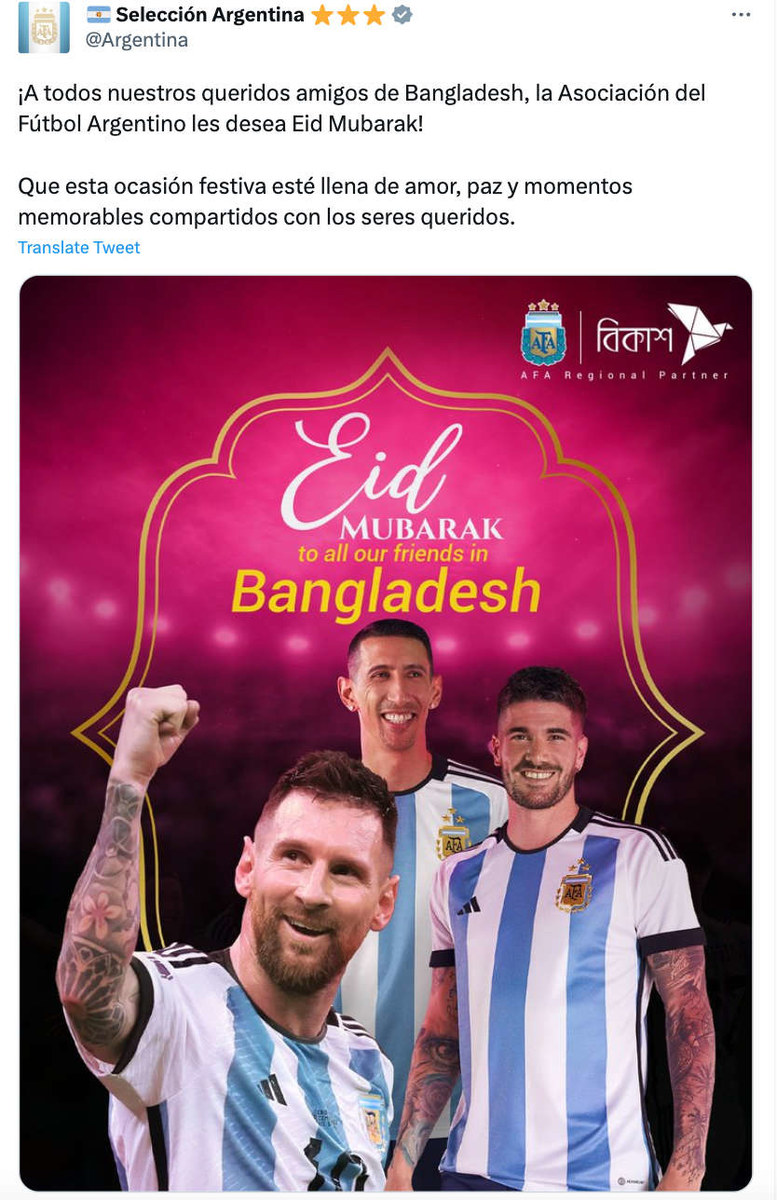


Eid Al-Adha wishes for Bangladeshis posted by the Argentinian national football team on its official Twitter account on June 28. (Supplied)

“It’s a matter of great recognition and respect for us. Since we have a special place in our hearts for Latin American football, now they reciprocated this love through Eid greetings,” Mohammed Aslam, former captain of the Bangladesh national football team, told Arab News.

“It’s a great moment for our football fans as well as the people of Bangladesh.”

For Rebeka Sultana Merry, a college teacher in Jamalpur, the fact that Argentinians remembered Bangladeshis on their religious holiday was also something to cherish as it showed that the affection was mutual.

“During the Qatar World Cup, our football fans showed their utmost love for the Argentina team, and now the whole world knows that after Argentina, Bangladesh is their second largest fan base,” she said.

“It’s a matter of great joy that the Argentine Football Association remembered us on this auspicious occasion of Eid Al-Adha. We feel proud of that. This sort of exchange of greetings will further strengthen the ties.”

When Argentina played the 2022 World Cup matches, hundreds of thousands of fans in the Muslim-majority South Asian country gathered in the team’s sky blue and white jerseys to watch matches on giant screens at key squares, roads and football grounds.

But Bangladeshi love for Argentine football is not new. It dates back to the 1986 World Cup in Mexico when Argentina won the tournament with a historic performance of its then-captain, Diego Maradona.

It was Maradona, the player widely regarded as one of the greatest in the history of the sport, who turned cricket-mad Bangladeshis into Argentine football fans.

“He was above everyone. He won the hearts of our football fans and became a popular name in every household across our country,” said Aslam who captained Bangladesh’s team in the 1980s.

“Maradona proved that football is art. After the World Cup of 1986, our football fans hung his posters in their living rooms. He was an icon.”

For decades, no other football player has charmed Bangladeshis like Maradona, until Messi came to the stage.

“I grew up watching the magical football skills of Messi. For Maradona and Messi, I will love Argentina forever,” said Shahriar Sourov, a 15-year-old fan and aspiring football player from Dhaka.

“On Eid day, it was a big surprise for me to see my football hero Messi greeting us. It was exciting as team Messi remembered us. It seems that the bond between the football fans from two different parts of the world will remain forever. It’s a kind of brotherhood.”


Congo-Brazzaville president set to extend decades-long rule

Updated 2 sec ago
Follow

Congo-Brazzaville president set to extend decades-long rule

BRAZZAVILLE: At the age of 82 and after more than 40 years in power, Denis Sassou Nguesso is the clear favorite to win Sunday’s presidential election in Congo-Brazzaville.
With the opposition divided, sidelined and largely absent, observers say voter turnout could slump to a record low in the oil-rich but impoverished central African country.
Sassou Nguesso ranks as one of Africa’s longest-serving leaders, along with Equatorial Guinea’s Teodoro Obiang Nguema and Cameroonian President Paul Biya.
“Honestly, I don’t see the point of voting on March 15. Whether I vote or not, we’ll have the same winner,” said Cyril Massamba, who lives in the capital Brazzaville.
Sassou Nguesso, a career military officer, first led Congo under a one-party system from 1979 to 1992 before losing the first multi-party elections to former prime minister Pascal Lissouba, whom Sassou Nguesso then overthrew in a civil war in 1997.
He has maintained a firm grip over the former French colony, which gained independence in 1960 and has traditionally maintained close ties with both France and Russia.
Six candidates are bidding to unseat him but few have the resources to compete with the ruling Congolese Labour Party (PCT).
The party’s red Soviet-style flags and giant Sassou Nguesso portraits have filled city streets since the campaign began.
Lacking broad support, opposition candidates have been unable to rally behind a single challenger.
The two main opposition parties have chosen not to stand, one of them arguing that conditions for a free and transparent election have not been met, and urging supporters to vote “according to their conscience.”
“Denis Sassou Nguesso controls the entire electoral process,” said Clement Mierassa, an opposition figure, former minister and previous presidential candidate.
He argued that all those running against the president were just placeholders.
Two prominent candidates who challenged Sassou Nguesso in the disputed 2016 election remain in prison, serving 20-year sentences for “endangering state security.”

- Turnout fears, unemployment -

“I’ll go to a polling station the day my own child is a candidate,” joked shopkeeper Monique Ouollo.
Sassou Nguesso has urged his supporters to turn out and vote in Sunday’s first round, telling a rally in Pointe?Noire: “No abstention!” No date has yet been given for a second round of voting.
But many young people in the port city voiced frustration over chronic unemployment and the lack of economic prospects in a country rich in oil and gas.
Despite GDP growth of 2.9 percent in 2025, about half the population of six million lives below the poverty line, according to the World Bank.
Congo-Brazzaville depends heavily on hydrocarbons, which account for more than three-quarters of export earnings.
Authorities say proven oil reserves will last another 25 years at current production rates and aim to reach 500,000 barrels a day by 2030.
Gas production reached three million tons of LNG last year.
Although it has 10 million hectares of arable land, only about four percent is farmed, mostly for low-yield subsistence crops.
The country imports much of its food, leaving households exposed to swings in global prices, shipping costs and exchange rates.
Officials hope Congo’s location — between the Congo Basin and the Atlantic Ocean — will help turn it into a regional trading hub, tapping existing rail and road networks to boost links with neighbors.

- Diplomatic balancing act -

At Sassou Nguesso’s first campaign rally last month, foreign paramilitaries were spotted on rooftops nearby, including a sniper.
Their presence fueled speculation about Russian mercenaries providing security, mirroring arrangements in the Central African Republic.
A ruling party official confirmed to AFP that the men were Russian personnel, without detailing their mission.
Seen as a relatively stable hub in a volatile region, Congo-Brazzaville retains close ties with Paris, its largest development aid donor, and is home to around a hundred French companies.
But Russia is also a longstanding partner: Congo was allied with the Soviet bloc from 1968 to the early 1990s.
Though Sassou Nguesso maintains tight control over the security apparatus, some of his allies acknowledge that fears of a power grab remain.
The president told AFP in an interview in early March that he does not intend to “remain in power forever.”