

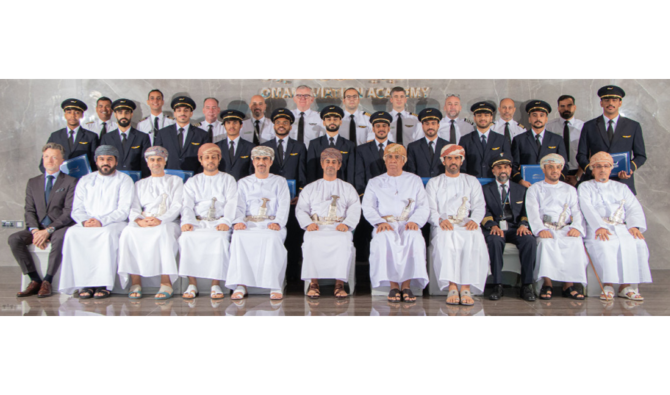
Oman Air marks graduation of 11 Omani cadets as part of training, recruitment drive

Oman Air benefits from highly experienced and qualified Omanis, not just at entry level but throughout the company. (Supplied)
Short Url
Updated 27 June 2023
Follow

Oman Air marks graduation of 11 Omani cadets as part of training, recruitment drive

Oman Air recently celebrated the graduation of its first batch of Omani cadets from the Airline Transport Pilot License program, an initiative it launched in 2018. 

The event was marked with a ceremony held under the auspices of Nayef Al-Abri, president of the Civil Aviation Authority Oman.

The 11 cadets, whose training was held at the Oman Aviation Academy in Sohar in partnership with CAE Oxford, will now join Oman Air as Second Officers. Meanwhile, the remaining batches are still engaged in their training with the next batch anticipated to graduate toward the end of this year.

 Committed to supporting Oman’s socio-economic development and empowering young Omanis, in the last few years Oman Air has ramped up its training and recruitment programs.

In conjunction with several government partnerships and to support its expanding operations, the airline has welcomed more than 260 Omani men and women into the company since 2022.

 “Oman’s aviation sector is fast becoming a value engine of the country’s growth. Oman Air’s strategy reflects national priorities and as such, we continue to develop a sustainable, highly skilled workforce that can support the advancement of the sector, meet the demands of an ever-evolving industry, and fortify our contribution to Oman’s 2040 Vision,” said Captain Moosa Al-Shidhani, senior vice president - flight operations at Oman Air. 

“We are proud to have an exceptional team of world-class pilots and crew that includes many nationalities and are committed to ensuring they have access to a wealth of opportunities for both professional and personal growth. Together, we foster an environment that nurtures their talents and aspirations and supports Oman Air in our relentless pursuit of excellence.”

 Oman Air’s latest training and recruitment initiatives also includes a partnership with The British School of Excellence and Muscat Hospitality Academy for Preparatory Cabin Crew Training for Omani students.

 Last November, the airline also launched “Future Leaders,” an intensive two-year commercial graduate training program that is training 11 Omanis with internationally recognized qualifications and exposing them to all Oman Air’s commercial functions, after which they will be offered roles within the company.

 Most recently, in cooperation with the Ministry of Labour, the airline launched an 18-month on-the-job intensive training program and internship scheme for engineers, with 80 Omanis currently being trained in its engineering department, in addition to 20 graduates that are currently being recruited for its call center.

 As the national carrier, Oman Air benefits from highly experienced and qualified Omanis, not just at entry level but throughout the company.

To date, its overall Omanization rate stands at approximately 75 percent, which is as high as 81 percent pilots, 90 percent  engineers, 100 percent male cabin crew, and 93 percent support functions.


25,000 attend Social Development Bank’s DeveGO25 forum

Updated 27 December 2025
Follow

25,000 attend Social Development Bank’s DeveGO25 forum

The Social Development Bank concluded the second edition of the Entrepreneurship and Modern Business Practices Forum — DeveGo 2025 — announcing the achievement of high-impact outcomes that further reinforced the forum’s position as the largest national platform in the region dedicated to entrepreneurship, innovation, and freelance work in Saudi Arabia and beyond. 

The forum witnessed broad participation from local and international experts, investors, entrepreneurs, and representatives of local, regional, and international institutions.

Over three days at the King Abdulaziz International Conference Center, the forum drew 25,000 participants and visitors, who benefited from over 45 specialized workshops and over 2500 advisory sessions delivered by more than 70 consultants and experts. 

The sessions covered key areas including entrepreneurial planning, business models, venture capital, digital platforms, freelancing, and emerging technologies. 

The forum also featured 20 panel discussions with leading local and international speakers, addressing major global trends in entrepreneurship, including the future of artificial intelligence, the creative economy, digital transformation, and venture investment. 

The forum saw the launch of the Saudi Empretec Fellowship, in the presence of Rebeca Grynspan, secretary-general of the UN Conference on Trade and Development. 

The partners in success within the Social Responsibility Portfolio supporting entrepreneurs were honored. 

It also saw the honoring of 13 winners of the Handicrafts Competition, representing various regions of the Kingdom, the announcement of winners of the Salam Award for Promising Projects, and the recognition of leading entrepreneurial projects fund under the Enterprises Track. 

In addition, the NEXT UP Challenge concluded on the third day of the forum with 20 startups presenting their projects to more than 500 investors, enhancing opportunities for networking and partnership building.

As part of efforts to strengthen the support ecosystem, the forum witnessed the signing of 51 agreements, along with the launch of a suite of new financing products. These included the Capital Expansion Product with a ceiling of up to SR10 million, the Payroll Product with a ceiling of SR2 million, and the Rental Product with a ceiling of SR1.5 million, aimed at supporting enterprises in asset development and covering operational costs. 

This reflects the bank’s direction toward offering more specialized financing tools that respond effectively to market needs.

The forum concluded by reaffirming its role as a unifying national platform for entrepreneurship, where accompanying activities and events provided direct engagement opportunities between entrepreneurs, investors, and experts. 

The forum also highlighted success stories and practical experiences that reflect the scale of entrepreneurial momentum in the Kingdom and the growing role of the Social Development Bank in supporting a national economy driven by innovation and knowledge.