

Pakistan learned to respond with 'iron hands' after deadly political violence — law minister

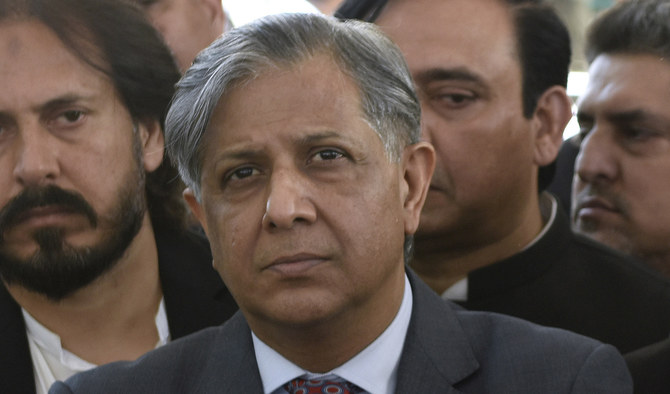
Law Minister Azam Nazeer Tarar speaks to media outside the Supreme Court in Islamabad, Pakistan, on April 4, 2023. (AP/File)
Short Url
Updated 27 June 2023
Follow

Pakistan learned to respond with 'iron hands' after deadly political violence — law minister

  • Azam Nazeer Tarar issues some most extensive comments from Pakistan on the fiery protests over the detention of ex-PM Khan
  • PM Sharif’s government and army are now defending their actions in pursuing both civilian and military trials for at least 102 protesters

WASHINGTON: Pakistan’s law minister says he expects a tougher armed response in the event of any repeat of political violence in the country, accusing followers of former Prime Minister Imran Khan of exploiting the initial “motherly” response to fiery rampages last month. 

In an interview with The Associated Press during a visit to Washington, Minister Azam Nazeer Tarar issued some of the most extensive comments from Pakistan's government on its response to the fiery protests last month against the detention of charismatic former premier Imran Khan. Prime Minister Shahbaz Sharif’s government and army are now defending their actions in pursuing both civilian and military trials for at least 102 civilian protesters. 

“The state’s reaction was like a motherly reaction towards the citizens,” Tarar told the AP, adding, "that is why the government has decided to deal with iron hands and to make it an example, to ensure that no such incidents take place in the future.” 

In the interview late last week, Tarar also defended law enforcement and military officials against criticism they didn’t do enough at the time to stop the violence. Any military response to restore law and order would have required prior authorization from the civilian government, he said. 

He described a military and civilian leadership taken by surprise by the attacks on military installations and other sites. The leaders opted to refrain from harming civilians, the minister said. But now, the response is tougher. 

“I would say we have learned a lesson,” from the incident, he said, “that if you don’t exercise enough authority and force, you may end up with these kinds of incidents, which ... was very painful.” 

Tarar also said that legal authorities would not be deterred from prosecuting Khan if investigators determine he appeared to play a criminal role in the attacks, despite concerns that could unleash a fresh wave of violence. 

Khan and his followers have been working for his return to political power, alleging that Americans were behind the 2022 no-confidence vote that cost him the premiership. 

The demonstrations erupted among supporters of Khan’s Pakistan Tehreek-e-Insaf party after authorities arrested Khan in a graft case, dragging him from a courthouse in the capital, Islamabad. 

Thousands of demonstrators attacked the military headquarters in the garrison city of Rawalpindi, stormed an air base in Mianwali in the eastern Punjab province and torched a building housing state-run Radio Pakistan in the northwest. 

The violence subsided only after Khan was released on an order from Pakistan’s Supreme Court. 

At least 10 people were killed in clashes between Khan’s supporters and police and since then, and police have arrested more than 5,000 people in connection with the riots. Most have been freed on bail pending trial. 

Pakistan’s military said Monday that it has fired three senior army officers over their failure to prevent the attacks. 

In additional to prosecutions in civilian court, Pakistan’s military says it has received cases of 102 civilians for their trials in the military courts over their involvement and the accused persons will get the right of a fair trial. Asked how many civilians he expects to ultimately be tried in military courts in connection with the May 9 violence, Tarar said he did not expect the 102 figure to increase “many fold.” 

When asked why the military didn’t do more to stop the attacks as they were happening, Tarar said nobody in the military thought people would breach military installations, “because military protect the homeland.” 

The same, he said, goes for the attacks on public monuments to national heroes, saying such a thing is "unheard of in our history.” 

Amnesty International has objected to the Pakistan military’s plans, saying that trying civilians in military courts is a violation of international law. 

The rights group said it had documented numerous rights violations in Pakistani military courts’ past trials of civilians, including lack of due process and transparency, coerced confessions, and executions after “grossly unfair” proceedings. 


Pakistan, Iraq agree on tighter coordination over pilgrims under new regulated travel system

Updated 4 sec ago
Follow

Pakistan, Iraq agree on tighter coordination over pilgrims under new regulated travel system

  • New system requires all Iraq-Iran pilgrimages to be organized by licensed groups under state oversight
  • Long-running “Salar” model relied on informal caravan leaders, leading to overstays and missing pilgrims

ISLAMABAD: Pakistan and Iraq this week agreed to closely coordinate on the management and security of Pakistani pilgrims, as Islamabad rolls out a new, tightly regulated travel system aimed at preventing overstays, undocumented migration and security breaches during religious visits to Iraq and Iran.

The understanding was reached during a meeting between Pakistan’s Interior and Narcotics Control Minister Mohsin Naqvi and Iraq’s Interior Minister General Abdul Amir Al-Shammari on Thursday evening, where both sides discussed measures to facilitate pilgrims while strengthening oversight, Pakistan’s interior ministry said.

The agreement comes as Pakistan dismantles its decades-old pilgrim travel model and replaces it with a centralized, licensed system after authorities confirmed that tens of thousands of Pakistani pilgrims had overstayed or gone missing abroad over the past decade, triggering concerns from host governments.

“You have, for the first time during your tenure, taken effective measures to organize pilgrim groups, which are commendable,” Al-Shammari told Naqvi, according to Pakistan’s interior ministry.

“All pilgrims included in the list provided by Pakistan’s Ministry of Interior will be allowed to enter Iraq,” he added, making clear that only travelers cleared under the new system would be permitted.

Naqvi said Pakistan would strictly enforce return timelines under the revised framework.

“Pilgrims traveling to Iraq will not be allowed to stay beyond the designated period,” he said, adding that relevant authorities in both countries would remain in close coordination.

Both interior ministers also agreed to strengthen information-sharing and joint mechanisms on security cooperation, counterterrorism and the prevention of human smuggling, officials said.

“The safety, dignity, and facilitation of Pakistani pilgrims is the top priority of the Government of Pakistan,” Naqvi said.

Al-Shammari said he would visit Pakistan soon to finalize a joint roadmap to further improve pilgrim facilitation, security coordination and broader bilateral cooperation, according to the interior ministry.

Pakistan’s government has overhauled its pilgrim travel regime this year, abolishing the long-running “Salar” system under which informal caravan leaders managed pilgrimages. The move followed official confirmation that around 40,000 Pakistani pilgrims had overstayed or disappeared in Iran, Iraq and Syria over the past ten years.

Under the new Ziyarat Management Policy, only licensed Ziyarat Group Organizers (ZGOs) are allowed to arrange pilgrimages, with companies held directly responsible for ensuring pilgrims return on time. Authorities have completed security clearance for 585 companies seeking registration, while scrutiny of applications remains ongoing.

Islamabad has also barred overland travel for major pilgrimages, including Arbaeen, citing security risks in Pakistan’s southwestern Balochistan province, meaning all travel to Iraq and Iran is now restricted to regulated air routes.

Tens of thousands of Pakistani pilgrims travel each year to Iraq and Iran to visit some of the most revered shrines in Shia Islam, including the mausoleums of Imam Ali in Najaf and Imam Hussain in Karbala in Iraq, and major religious sites in Mashhad and Qom in Iran. Pilgrimages peak during religious occasions such as Arbaeen, when millions of worshippers converge on Karbala from across the region. The scale of travel, often involving long stays and cross-border movements, has long posed logistical, security and migration-management challenges for Pakistani authorities and host governments alike.