

Inflation puts brakes on Egyptians’ Eid outings

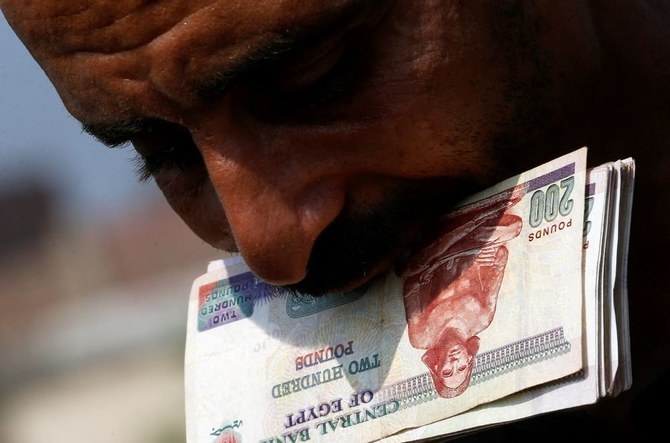
An Egyptian cattle trader counts money at Al-Manashi livestock market, ahead of the Muslim festival of Eid Al-Adha, Embama district, outskirts of Giza, Egypt, June 22, 2023. (Reuters)
Short Url
Updated 28 June 2023
Follow

Inflation puts brakes on Egyptians’ Eid outings

  • Previously such a lengthy break would have meant an all-but-deserted Cairo, with people packing their bags and heading to vacation spots
  • Entertainment activities and Eid travel plans have taken a back seat while Egyptians struggle to pay for basic necessities

CAIRO: Soaring inflation and rising entertainment costs have left many Egyptians worried they will have to forgo their usual Eid celebrations along with visits to favorite vacation locations.

This year’s Eid El-Adha holiday coincides with a six-day break that will run from Tuesday to Sunday.

Previously such a lengthy break would have meant an all-but-deserted Cairo, with people packing their bags and heading to vacation spots, such as the North Coast, to enjoy around-the-clock entertainment activities and events for all age groups. 

However, this year is a little different.

Annual headline inflation jumped to 32.7 percent last month, up from the 30.6 percent in April.

Entertainment activities and Eid travel plans have taken a back seat while Egyptians struggle to pay for basic necessities. 

The luxuries of traveling and going out have stripped Eid of what it is all about: family.

Eid El-Adha usually includes a small feast featuring traditional fatteh — a dish composed of fried flatbread, rice, tomato salsa and beef — and extended family gatherings, where children get to wear new outfits and receive their long-awaited edeya. 

“This Eid we are sticking to Cairo, and maybe take the family out to the nearby park where we can play cards and kick a ball around,” said Karim Ezzat, a father of two.

“Our usual Eid plan of heading to the North Coast for a few days is no longer feasible seeing the increasing prices of everything,” he told Arab News.

“We will spend time with the family, maybe go to the sporting club, where the children can swim and soak up some sun, and stick to budget-friendly outings and activities.”

Amid the change in mindset, people are creating new traditions in line with the economic challenges.

Some have opted for dish parties instead of inviting friends and relatives for a meal. Each of those invited brings along a dish, easing the financial burden for the host. 

Recent university graduate Malak Walid said: “Rather than road tripping with my friends, we decided to do some cost-effective activities instead.

“We plan to go to the cinema, maybe try some new restaurants or check and see what affordable events are happening during the Eid break.”

He added: “In a worst-case scenario, we may just hang out at one of our houses.

Walid said there are usually music events with affordable tickets, while art galleries with free entry offer a nice break from the usual hangout spots.

Private tutor Dina Mourad said: “The six-day break is exactly what is needed to relax following an intense period of work. I don’t have much planned.

“I will see the extended family, but other than that I will mostly relax and catch up on some of my favorite TV shows.”


PIF-backed EV maker Lucid hits 16k 2025 deliveries, sets sights on robotaxi deployment

Updated 8 sec ago
Follow

PIF-backed EV maker Lucid hits 16k 2025 deliveries, sets sights on robotaxi deployment

RIYADH: Electric vehicle manufacturer Lucid Group, majority-owned by Saudi Arabia’s Public Investment Fund, announced a surge in deliveries in 2025 with volumes reaching 15,841 units, a 55 percent increase year-on-year.

According to a statement, the EV maker also provided an optimistic production outlook for 2026, signaling confidence in its operational turnaround and strategic shift toward autonomy.

In September 2023, the group opened its first-ever international car manufacturing facility in the Kingdom. The hub serves as the company’s second Advanced Manufacturing Plant and its first outside of the US.

According to the earnings report, the company delivered 5,345 vehicles in the fourth quarter of 2025, up 72 percent from the same period in the previous year, marking its eighth consecutive quarter of record deliveries.

Interim CEO Marc Winterhoff said that 2025 “was all about execution and strategy adjustment to set Lucid up for long-term success. Against a challenging macro backdrop, we nearly doubled production, gained market share, reduced unit costs, and strengthened our financial position.”

This commercial momentum translated directly into financial gains. Lucid’s fourth-quarter revenue soared 123 percent to $522.7 million, while full-year 2025 earnings climbed 68 percent to $1.35 billion. The company ended the quarter with a robust liquidity position of approximately $4.6 billion.

A key driver of the improved performance was the ramp-up of production, including the launch of the Lucid Gravity SUV. Despite facing supply chain and tariff headwinds, Lucid nearly doubled its total production for the year.

The company clarified its final production figures for 2025, reporting a total of 17,840 vehicles. This aligns with its previous guidance of approximately 18,000 units.

Lucid explained that a preliminary estimate of 18,378 units, announced in early January, was revised after 538 vehicles were found not to have completed the final internal validation procedures required to be classified as “produced.”

These vehicles are expected to be finalized in 2026, and the company stressed the revision does not impact previously reported financial results.

The manufacturer expects to produce between 25,000 and 27,000 vehicles in 2026, representing growth of up to 51 percent compared with 2025.

Chief Financial Officer Taoufiq Boussaid said: “Q4 marked a clear step-change in production and unit economics. The progress we made is structural, creating a more repeatable and stable operating cadence heading into 2026.”

Beyond the production numbers, Lucid outlined a pivot toward software and autonomy. Winterhoff highlighted the company’s ambition to become an “early mover in the emerging robotaxi market” by leveraging its industry-leading EV technology and strategic partnerships.

To fund these future growth platforms while maintaining financial discipline, the company is making targeted adjustments to its workforce.

“As we prepare for the next stage of our product and volume expansion, we are making targeted adjustments to our US-based, non-manufacturing workforce to reallocate resources to support the next stage of our growth and margin progression,” Boussaid added.

He reiterated the company’s commitment to “financial rigor, operational efficiency, and thoughtful capital allocation.”

In January 2025, the EV maker became the first global automotive company to join the Kingdom’s “Made in Saudi” program, granting it the right to use the “Saudi Made” label on its products, symbolizing the nation’s focus on quality and innovation.

Lucid’s facility, located in King Abdullah Economic City, can currently assemble 5,000 vehicles annually during its first phase. Once fully operational, the complete manufacturing plant, including the assembly line, is expected to produce up to 155,000 electric cars per year. 

This comes as the Kingdom is promoting the adoption of electric vehicles as part of its Vision 2030 strategy, which aims to achieve net-zero carbon emissions by 2060.
A critical target of the initiative is for 30 percent of all vehicles in Riyadh to be electric by 2030, contributing to a broader goal of reducing emissions in the capital by 50 percent.