

Pakistan Cricket Board delays election of new chairman after court challenge

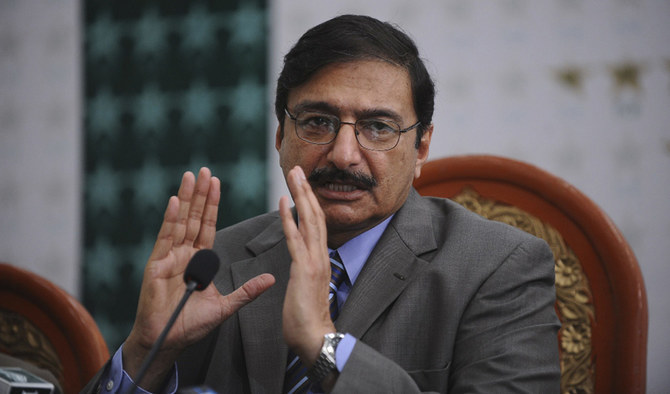
Pakistan's former cricket chief Zaka Ashraf gestures during a press conference in Lahore on April 18, 2012. (AFP/File)
Short Url
Updated 27 June 2023
Follow

Pakistan Cricket Board delays election of new chairman after court challenge

  • With Najam Sethi out, favored next PCB chairman is PM's nominee Zaka Ashraf
  • Last week Najam Sethi pulled himself out of race to become next board chairman

ISLAMABAD: The Pakistan Cricket Board was forced to postpone the election of a chairman scheduled for Tuesday after the formation of its board of governors was challenged in court.

The Balochistan High Court on Monday accepted the petition of Gul Mohammad Kakar, a former member of the PCB management committee, and set a hearing for July 17.

“Following the interim order of the honorable High Court of Balochistan, Tuesday afternoon’s election of the PCB chairman has been postponed,” the PCB said in a statement.

Before former chairman Najam Sethi dropped out of the election, he formed a 10-member board of governors that also included two direct nominees from Prime Minister Shehbaz Sharif, the PCB patron.

Acting chairman Ahmed Shehzad Farooq Rana, who is also the election commissioner, then changed several of the board of governors, prompting Kakar's court challenge.

Representatives of bigger cities such as Lahore, Karachi, Rawalpindi and Peshawar were replaced by men from smaller cities such as Dera Murad Jamali, Hyderabad, Larkana and Bahawalpur. The governors elect the new chairman.

Two of the four departmental representatives were also changed.

With Sethi out, the favored next chairman is a former holder of the office, Zaka Ashraf.

Ashraf was a direct nominee of the prime minister.


Pakistan, Egypt discuss regional situation, resolve to promote peace and stability

Updated 7 sec ago
Follow

Pakistan, Egypt discuss regional situation, resolve to promote peace and stability

  • Pakistan and Egyptian foreign ministers share views on the situation in Somalia and Yemen
  • It follows Israel’s recognition of Somaliland, a Houthi-government deal on prisoner exchange

ISLAMABAD: Pakistan and Egyptian foreign ministers on Sunday discussed the situation in Yemen and Somalia and resolved to promote regional peace and stability, the Pakistani foreign office said.

The development comes days after Israel announced recognizing Somaliland, a self-declared region that broke away from Somalia in 1991 but had not previously been recognized by any United Nations (UN) member state.

Pakistan on Sunday joined the Organization of Islamic Cooperation (OIC) and other Arab and Islamic nations in condemning the Israeli move, which it called a violation of international law. Islamabad has also voiced its support for Saudi Arabia’s diplomatic efforts for peace in Yemen, where the Houthi group and the government recently reached a deal to exchange nearly 3,000 prisoners.

Pakistan’s Foreign Minister Ishaq Dar and his Egyptian counterpart Badr Ahmed Mohamed Abdelatty discussed the regional and global developments during their telephonic conversation on Sunday, according to the Pakistani foreign office.

“They shared views on regional and global developments, especially Somalia and Yemen,” it said in a statement. “They reaffirmed their shared commitment to promoting regional peace, stability and development.”

Pakistan’s foreign office on Saturday issued a separate statement condemning Israel’s recognition of Somaliland.

“Pakistan strongly condemns any attempts to undermine the sovereignty, unity, and territorial integrity of Somalia, and rejects, in this regard, the announcement made by Israel recognizing the independence of the so-called Somaliland region of the Federal Republic of Somalia,” it said.

Somalia’s government has said Israel’s recognition of Somaliland violates its sovereignty, while the African Union has opposed unilateral recognition of breakaway regions on the continent.

The Pakistani foreign office this week also underscored the need to uphold unity and territorial integrity of Yemen.

It expressed hope that Yemeni stakeholders will avoid any unilateral steps and urged all parties to engage constructively toward an inclusive, negotiated political solution of the conflict, following the prisoner exchange deal between the Houthis and the government.