

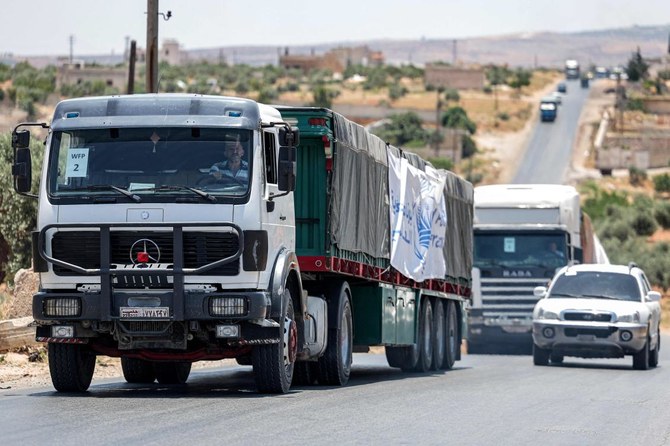
UN convoy crosses from Syria regime areas to rebel-held Idlib

Trucks move in a United Nations aid convoy en route to Syria’s rebel-held northwestern city of Idlib on June 23, 2023. (AFP)
Short Url
Updated 24 June 2023
Follow

UN convoy crosses from Syria regime areas to rebel-held Idlib

  • First relief since devastating twin earthquakes hit northwest Syria in February

JEDDAH: A UN aid convoy aid crossed from Assad regime-controlled northwest Syria to rebel-held areas on Friday for the first time since two devastating earthquakes in February.

The 10-truck convoy reached rebel-held Al-Nayrab in Idlib province from the direction of regime-held Saraqib, headed for storage facilities near the Turkish border.
The trucks were covered with banners bearing the name and logo of the UN World Food Programme. The last such convoy was in January.
The UN Office for the Coordination of Humanitarian Affairs said: “The cross-line convoy is underway, carrying UN humanitarian supplies.” 
Two earthquakes on Feb. 6 devastated parts of Turkiye and Syria, including areas of the Idlib region that are controlled by jihadist group Hayat Tahrir Al-Sham. About three million people, most of whom have been displaced by Syria’s war, live in militants-controlled parts of the Idlib region.
Bashar Assad’s regime said in February it had approved the delivery of humanitarian aid directly from government-held territory to rebel areas, but militant chief Abu Mohammed Al-Jolani refused assistance through such a route.
The UN largely delivers relief to Syria's northwest via Turkiye through the Bab al-Hawa crossing,  the only way for aid to enter without Damascus’s involvement.
The number of UN-approved crossings has shrunk from four in 2014 after years of pressure from regime allies China and Russia at the UN Security Council.
The UN chief said in February that Assad had agreed to open the Bab Al-Salama and Al-Rai crossings from Turkiye to allow aid to enter rebel-held areas for an initial period of three months.
Syria in May extended access for those two crossings, which are operated by Turkish-backed rebels, for another three months.
Syria's war has killed more than half a million people and displaced millions since erupting in 2011 with a brutal crackdown on anti-government protests. Despite periodic exchanges of deadly fire, including some in recent days, a ceasefire deal brokered by Moscow and Ankara has largely held in the northwest since March 2020.


The West Bank soccer field slated for demolition by Israel

Updated 13 sec ago
Follow

The West Bank soccer field slated for demolition by Israel

  • The move is likely to eliminate one of the few ​spaces where Palestinian children are able to run and play
BETHLEHEM: Israeli authorities have ordered the demolition of a soccer field in a crowded refugee camp in the occupied West Bank, eliminating one of the few ​spaces where Palestinian children are able to run and play.
“If the field gets demolished, this will destroy our dreams and our future. We cannot play any other place but this field, the camp does not have spaces,” said Rital Sarhan, 13, who plays on a girls’ soccer team in the Aida refugee camp near Bethlehem.
The Israeli military ‌issued a demolition ‌order for the soccer field on ‌December ⁠31, ​saying ‌it was built illegally in an area that abuts the concrete barrier wall that Israel built in the West Bank.
“Along the security fence, a seizure order and a construction prohibition order are in effect; therefore, the construction in the area was carried out unlawfully,” the Israeli military said in a statement.
Mohammad Abu ⁠Srour, an administrator at Aida Youth Center, which manages the field, said the ‌military gave them seven days to demolish ‍the field.
The Israeli military ‍often orders Palestinians to carry out demolitions themselves. If they ‍do not act, the military steps in to destroy the structure in question and then sends the Palestinians a bill for the costs.
According to Abu Srour, Israel’s military told residents when delivering ​the demolition order that the soccer field represented a threat to the separation wall and to Israelis.
“I ⁠do not know how this is possible,” he said.
Israeli demolitions have drawn widespread international criticism and coincide with heightened fears among Palestinians of an organized effort by Israel to formally annex the West Bank, the area seized by Israel in the 1967 Middle East war. Israel accelerated demolitions in Palestinian refugee camps in early 2025, leading to the displacement of 32,000 residents of camps in the central and northern West Bank. Human Rights Watch has called the demolitions a war crime. ‌Israel has said they are intended to disrupt militant activity.