

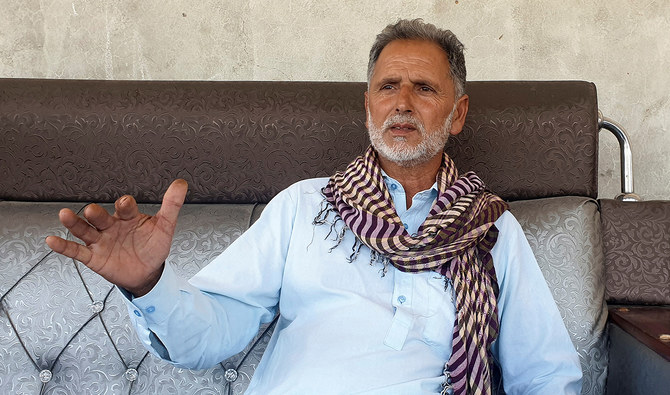
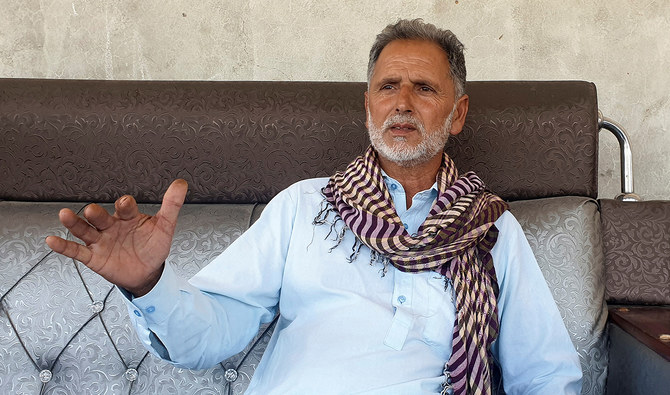
KHUIRATTA, Pakistan-administered Kashmir: Hameed Iqbal Bhatti had prospered over two decades working in Saudi Arabia, but after returning to Pakistan three years ago, he was getting desperate.
The economy had suffered in the pandemic and his restaurant business closed. With work avenues drying up and sky-high inflation blowing a hole in his budget, the 47-year-old cobbled together $7,600 for a trafficker to smuggle him into Europe, where he hoped to rebuild the life he once had, his brother Muhammad Sarwar Bhatti, 53, told Reuters.
"He told me that he would start afresh for his children's future and the life he wanted for them," the elder Bhatti said at the family home in Pakistan-administered Kashmir.
A boat that left Libya carrying the younger Bhatti and hundreds of others sank off Greece last week, in one of the deadliest migrant disasters of recent years. He is missing and presumed dead, according to his brother, highlighting the perils faced by people who seek to enter Europe illegally.
Pakistanis have been making these journeys in increasing numbers in recent months because of the country's economic crisis, according to more than a dozen migrants and their relatives, experts and data reviewed by Reuters.
Cash-strapped Pakistan's $350 billion economy is in a meltdown, with inflation at a record 38%. A rapidly depreciating currency and external deficit led the government to adopt drastic measures over the past year to avoid default.
But with that came a huge hit to growth and jobs. The industrial sector, Pakistan's economic engine, provisionally contracted almost 3% in the current financial year - troubling for a nation of 230 million with more than 2 million new entrants to the labour force annually.
Official unemployment data have not been published in two years. Hafeez Pasha, a former finance minister and an economist renowned for his work on Pakistan's labour force, put the jobless rate at a record "11-12%, conservatively".
Pakistan's information ministry did not respond to questions from Reuters about economic factors fuelling migration.
PUSHED TO THE BRINK
The 102,000 detections of irregular migrants at the European Union's external border between January and May was 12% higher than the previous year and the most since 2016, according to Frontex, the bloc's border and coast guard agency.
Crossings of the central Mediterranean via Libya, mainly to Italy and Greece, nearly doubled, accounting for about half of the total. Currently, Pakistanis are the No. 3 nationality registered in Italy coming from Libya, after Egyptians and Bangladeshis, a Frontex spokesperson told Reuters in an email.
Of the detections this year through May, 4,971 were from Pakistan, a record for the country on the central Mediterranean route in a single year, according to Frontex data that go back to 2009.
Pakistan on Monday observed a day of mourning after the latest boat disaster. At least 209 Pakistanis were believed to be on board, according to official data based on information provided by relatives.
Even before last week's sinking, numerous Pakistanis had perished in the Mediterranean this year.
Muhammad Nadeem, 38, was aboard a boat that sank off Libya in February, killing more than 70.
Nadeem, from the eastern city of Gujrat, had three children and also supported his younger sister and mother. He worked as a salesman at a furniture store, but his wages were modest and rising inflation had made their situation precarious, according to his mother, Kosar Bibi.
"We used to make ends meet, he could feed his family. But it had become impossible", she told Reuters in their cramped three-room home where seven people live.
Bibi said her son paid someone he knew to arrange the trip to Italy, via Libya.
"He said, 'Mother, our conditions will improve'. He said he would send me to do Hajj, he would get his sister married," Bibi recalled.
Most who make the journey are unskilled or labourers and it is difficult for them to obtain work visas, Pakistan's Federal Investigation Agency (FIA) told Reuters. But by living frugally in Europe they are able to save and send money home - a prospect made more attractive by the Pakistan rupee's 35% depreciation against the euro and dollar in the past 18 months.
"The way the situation is here right now, people think that foreign currency is going up in value, so whatever they earn it will multiply when they send it back," said Sarwar Warraich, an FIA official based in Gujrat.
LURE OF WORK ABROAD
Nadeem only had to look around his local area to see what Europe could offer.
"He saw friends and people in his neighbourhood had gone. He saw that they were successful, and hoped god would make him successful too," said Nadeem's cousin, Muhammad Zubair.
A few kilometres from Nadeem's home, Muhammad Nazim was building a multi-storey vacation home in Gujrat when Reuters visited in the spring. Nazim, 54, said he lived in the Italian city of Ferrara, running a construction business, but was visiting Pakistan.
"Our houses are built (in Italy) too, we stay there, but the reason for building them in Pakistan is that we come here with our children after a year or two to spend a few months and relax," said Nazim.
"Here in Gujrat, at least one person from every household is abroad, either Europe or Arab countries."
Nazim, who said he entered Europe illegally via Turkey in the 1990s and eventually obtained residency, said he understood why people wanted to leave Pakistan. "What can a poor man do," he said. "The conditions of the country are now like this."
Also among the dead on Nadeem's ill-fated vessel was Muhammad Ali, 21, from Bhojpur, in Gujrat district.
"Even the educated class are having lots of trouble getting jobs" in Pakistan, Ali's cousin Anish Raza told Reuters at their family home. "A person's desires make one desperate."
Across the lane, Haji Ilyas, 70, was building a palatial home. Ilyas, who owns four vehicles, including an imported SUV and two tractors, said three of his sons had gone abroad illegally, two to Spain.
"Those who are getting money from abroad, they are able to survive," Ilyas said, puffing on his hookah.
The FIA said it had clamped down on unauthorised crossings of Pakistan's borders but noted that many who seek to enter Europe illegally depart with valid visas for Turkey or Libya before venturing onward.
Limited data the agency shared with Reuters showed that 401 people were caught crossing Pakistan's borders illegally in the first four months of 2023, up about 50% from a year earlier, while 15,371 deportees were repatriated in the same period, mostly from Turkey and Greece.
'BACK TO SQUARE ONE'
With foreign exchange reserves to cover less than a month's imports, Pakistan risks running out of money. An International Monetary Fund program expires this month, and the government would need to get into a new programme within the calendar year or face likely default.
Pakistan is a top exporter of labour, and remittances have helped keep the country afloat. Nearly 830,000 people registered as overseas workers last year, the highest since 2016, official data show.
But legal migration opportunities are limited, and many migrants make arrangements through agents who often present irregular migration as a quicker, cheaper, or the only way to reach Europe, according to the Migrant Resource Centre, an EU-funded organisation that provides information and counselling to migrants.
One who took this route was Israr Mirza, 29, who said he was desperate enough to risk the journey to the West after he was laid off last year from his job at a textile factory in Lahore.
"Local jobs when available didn't pay me enough to support my wife, three kids and father, who has cancer," he said.
College-educated Mirza took a loan, bought a plane ticket to Turkey and paid a smuggler who arranged his passage by land into Greece in September. He made it, but was caught and sent back to Turkey, then detained and ultimately deported to Pakistan, where he recounted the ordeal to Reuters at Islamabad airport in March.
"I don't know if I'm happy to have returned alive," he said. "I am back to square one, with no income and now loans to pay."


