

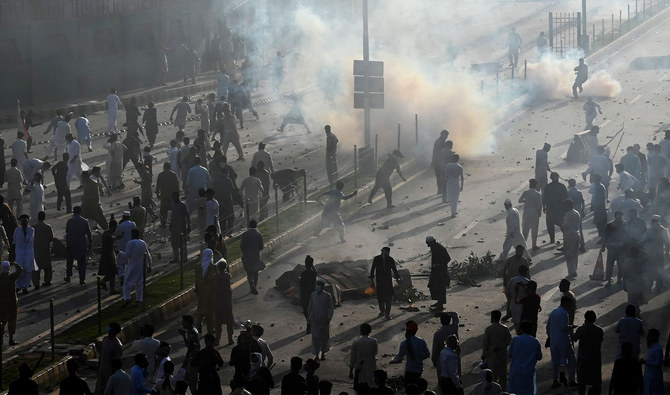

ISLAMABAD: A seven-member bench of the Supreme Court, headed by Chief Justice Umar Ata Bandial on Thursday sought details of all individuals, including women and juveniles, arrested after violent riots broke out in many parts of the country on May 9, local media reported.
Pakistan’s government and army have said they will try in military courts suspects accused of attacking army installations in countrywide protests in the wake of former Prime Minister Imran Khan's arrest last month.
Military courts operate under a separate system from the civilian legal system. Trials are closed to outsiders, and no media is allowed. Rights groups have criticized the secretive nature of the process.
Four petitions have been filed against the use of military courts to try civilians by, namely, former Chief Justice Jawwad S. Khawaja, prominent lawyer and politician Aitzaz Ahsan, Pakistan Institute of Labour Education and Research Chief Executive Karamat Ali, and former PM Khan.
"We want details as to how many individuals, including women and juveniles, are detained by civilians and military authorities", The Express Tribune quoted Chief Justice Bandial as saying while he resumed hearing of the petitions.
The chief justice, according to the report, noted that several objections had been raised regarding military courts holding trials of civilians, “which include no public hearing, no representation of counsel, no concept of independence of the judiciary, and lack of a location for court premises.”
The hearing was adjourned till Friday.
Speaking to the media following after the hearing, Latif Khosa, petitioner Ahsan's lawyer, confirmed during the hearing that the chief justice asked the attorney general of Pakistan to provide a list of all the people who are currently in jail on charges related to the May 9 violence. The chief justice also wanted to know how many of them had been transferred to military courts.
“We have argued that there is no legal justification for hearing civilian cases in military courts. This practice creates a parallel judicial system and goes against basic human rights,” Khosa said.
Khosa said that initially, a nine-member bench was formed to hear the petitions. However, two judges, including Justice Qazi Faez Isa, recused themselves from hearing the petitions.
He added that nevertheless, the petitioners were satisfied with Thursday’s proceedings as the chief justice raised “valid points regarding the structure of military courts and the representation of accused individuals by lawyers.”
A bruising year-long standoff between Khan, arguably Pakistan’s most popular leader, and the army came to a head when military buildings and property were ransacked last month, allegedly by Khan supporters, following his arrest in a graft case. Khan was later released on bail but hundreds of his followers were arrested in the aftermath and the military said it would punish all those who had damaged military properties or instigated people to do so.
Many of the top members of Khan’s party have since jumped ship and the government of Prime Minister Shehbaz Sharif has threatened to ban his Pakistan Tehreek-e-Insaf party.
Meanwhile, authorities have begun the process of trying dozens of people, including members of Khan’s party, suspected of involvement in the protests in military courts, usually reserved for service members or those categorized as enemies of the state. Khan says the purpose of military courts, in this case, is to put him in prison and dismantle his party.
Pakistan’s Army Act of 1952 established military courts primarily to try members of the military or enemies of the state. Civilians can only be tried there under a federal government order.
Civilians accused of offenses such as waging war against the armed forces or law enforcement agencies, attacking military installations, or inciting mutiny, can be tried at military courts.


