

Increased US Air Force presence in Middle East is show of force and deterrence, says commander

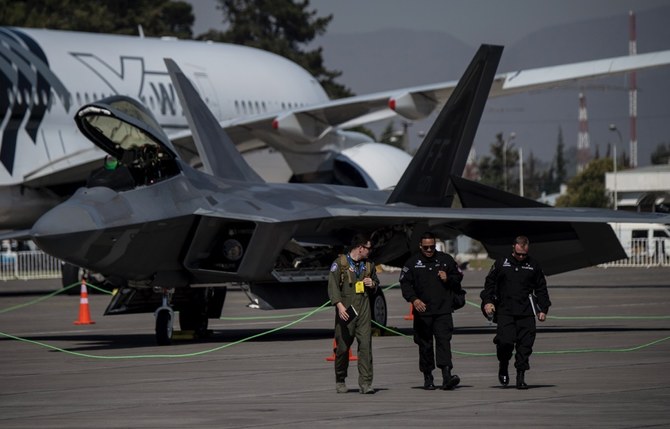
US F-22 Raptor fighters were deployed to the region this month. (AFP/File)
Short Url
Updated 22 June 2023
Follow

Increased US Air Force presence in Middle East is show of force and deterrence, says commander

  • Lt. Gen. Alexus Grynkewich said deployment this month of US F-22 Raptors provided extra strength in face of potential threats from Iran or Russia
  • It demonstrates ‘our commitment to our partners’ and the ability ‘to bring in overwhelming combat power at a moment’s notice,’ he added

WASHINGTON: The US Air Force has stepped up its presence in the Middle East to help combat the growing challenges arising from the activities of regional and international adversaries in the region, according to an American military chief.

Lt. Gen. Alexus Grynkewich, commander of the Ninth Air Force, said during a briefing on Wednesday, attended by Arab News, that the deployment this month of US F-22 Raptor fighters to the region was intended to provide extra strength in the face of any potential threats from Iran or Russia in Syria or elsewhere.

The Raptors, from the 94th Fighter Squadron based in Virginia, will integrate with existing coalition forces on the ground and in the air, he added.

“This deployment is intended, from the US side, to demonstrate our commitment to our partners and demonstrate the ability of the United States to bring in overwhelming combat power at a moment’s notice,” said Grynkewich.

It is also a show of force and deterrence in response to the Russian Air Force, which currently operates in Syrian airspace, he added.

Raptors escort many US regional partners during airborne missions, Grynkewich said. The US recently updated its National Defense Strategy in the Middle East, which has undergone a “paradigm shift” and now focuses on “interoperability, complex joint exercises and integration of weapons and values,” he added.

The Ninth Air Force is part of US Central Command, which counts the Middle East as part of its area of responsibility. Central Command and the Saudi Armed Forces recently conducted a multilateral military exercise, “Eagle Resolve,” along with the armed forces of other Gulf Cooperation Council member states.

Grynkewich described the US-Saudi military relationship as “strong.” He said he often meets his counterparts from the Kingdom to discuss ways in which military ties and regional coordination can be enhanced.

He described the recent agreement between Saudi Arabia and Iran to normalize diplomatic relations as a “positive” development in efforts to defuse tensions in the region.

“I think there is a lot of good when countries are talking to each other and when they have diplomatic relations; it will provide avenues to resolve their differences,” said Grynkewich. “That sort of rapprochement and reconciliation, in my view, is always welcome.”

As part of US efforts to integrate military forces in the region with its own missions and weapons systems, he said American forces have conducted important exercises that used Join Direct Attack Munition GBU-38 heavy bombs and, for the first time in live training missions with partners, the AGM-158 Joint Air-to-Surface Standoff Missile, a long-range, 1,000lb cruise missile.

Grynkewich added that US forces remain committed to the fight against Daesh in the region, as the group still has operational capabilities in some parts of Syria and Iraq.

The F-22 Raptor is one of the most advanced fifth-generation tactical fighters, which combines stealth and bombing capabilities.


Hamas to hold leadership elections in coming months: sources

Updated 4 sec ago
Follow

Hamas to hold leadership elections in coming months: sources

  • A Hamas member in Gaza said Hayya is a strong contender due to his relations with other Palestinian factions, including rival Fatah, which dominates the Palestinian Authority, as well as his regional standing

GAZA CITY, Palestinian Territories: Hamas is preparing to hold internal elections to rebuild its leadership following Israel’s killing of several of the group’s top figures during the war in Gaza, sources in the movement said on Monday.
“Internal preparations are still ongoing in order to hold the elections at the appropriate time in areas where conditions on the ground allow it,” a Hamas leader told AFP.
The vote is expected to take place “in the first months of 2026.”
Much of the group’s top leadership has been decimated during the war, which was sparked by Hamas’s unprecedented attack on Israel in October 2023.
The war has also devastated the Gaza Strip, leaving its more than two million residents in dire humanitarian conditions.
The leadership renewal process includes the formation of a new 50-member Shoura Council, a consultative body dominated by religious figures.
Its members are selected every four years by Hamas’ three branches: the Gaza Strip, the occupied West Bank and the movement’s external leadership.
Hamas prisoners in Israeli prisons are also eligible to vote.
During previous elections, held before the war, members across Gaza and the West Bank used to gather at different locations including mosques to choose the Shoura Council.
That council is responsible, every four years, for electing the 18-member political bureau and its chief, who serves as Hamas’s overall leader.
Another Hamas source close to the process said the timing of the political bureau elections remains uncertain “given the circumstances our people are going through.”
After Israel killed former Hamas chief Ismail Haniyeh in Tehran in July 2024, the group chose its then-Gaza chief Yahya Sinwar as his successor.
Israel accused Sinwar of masterminding the October 7 attack.
He too was killed by Israeli forces in the southern Gaza city of Rafah, three months after Haniyeh’s assassination.
Hamas then opted for an interim five-member leadership committee based in Qatar, postponing the appointment of a single leader until elections are held and given the risk of being targeted by Israel.
According to sources, two figures have now emerged as frontrunners to be the head of the political bureau: Khalil Al-Hayya and Khaled Meshaal.
Hayya, 65, a Gaza native and Hamas’s chief negotiator in ceasefire talks, has held senior roles since at least 2006, according to the US-based NGO the Counter-Extremism Project (CEP).
Meshaal, who led the Political Bureau from 2004 to 2017, has never lived in Gaza. He was born in the West Bank in 1956.
He joined Hamas in Kuwait and later lived in Jordan, Syria and Qatar. The CEP says he oversaw Hamas’s evolution into a political-military hybrid.
He currently heads the movement’s diaspora office.
A Hamas member in Gaza said Hayya is a strong contender due to his relations with other Palestinian factions, including rival Fatah, which dominates the Palestinian Authority, as well as his regional standing.
Hayya also enjoys backing from both the Shoura Council and Hamas’s military wing, the Ezzedine Al-Qassam Brigades.
Another source said other potential candidates include West Bank Hamas leader Zaher Jabarin and Shoura Council head Nizar Awadallah.