AMMAN: As Jordan steps up efforts to prepare for a voluntary return of Syrian refugees, a UNHCR study found that only 0.8 percent of them are willing to go back home.
According to the recently published survey by the UN refugee agency, the majority of Syrian refugees in Jordan prefer to stay in the resource-poor kingdom.
The survey revealed that around 97 percent of Syrian refugees in Jordan have no intention of going back home in the coming 12 months, attributing the reasons to security and economic concerns, including a lack of housing and basic amenities in Syria.
A total of 2,984 refugees were polled in the survey, which found that only 0.8 percent of them would be interested in returning to Syria, while 2.4 percent remained divided.
The study was conducted by the UNHCR between January and February this year, surveying Syrian refugees in Egypt, Lebanon, Jordan and Iraq. It revealed that 96.8 percent of Syrian refugees residing in Jordan refuse to return to Syria in the next year (the highest percentage), compared with 95 percent in Egypt, 94 percent in Iraq and 91 percent in Lebanon.
The study revealed that a quarter of refugees who said they had no intention to return within the next year answered that they still wish to return to Syria within the next five years.
The publication of the study, however, coincides with Jordan’s move to begin coordinating with the Syrian government and relevant UN organizations to organize the voluntary return of some 1,000 Syrian refugees.
The decision was announced on May 1 following a landmark meeting in Amman of foreign ministers from Saudi Arabia, Egypt, Iraq and Jordan, also attended by Syrian Foreign Minister Faisal Mekdad.
The Syrian government pledged to ensure the conditions and requirements for the return of the 1,000 refugees, a statement following the meeting said.
According to official figures, a total of 3,325 Syrian refugees returned to their war-torn country from Jordan in 2022.
From 2016 until the end of September 2022, a total of 341,500 Syrian refugees returned to Syria, of whom 64,278 came from Jordan, UNHCR said. The UN refugee agency announced the return of 38,379 refugees to Syria from Jordan, Lebanon, Turkey, Iraq and Egypt in 2022.
Jordan said it is providing refuge to about 1.3 million Syrians, including some 670,000 officially registered with the UNHCR as refugees, making the kingdom host to the world’s second-largest population of Syrian refugees per capita after Lebanon. Turkey has accepted 3.6 million Syrian refugees, while Lebanon hosts almost 1 million, according to the UNHCR.
Jordan’s Foreign Minister Ayman Safadi recently said that a total of 200,000 Syrian refugees were born in Jordan since the outbreak of the Syrian conflict in 2011.
Around 155,000 Syrian students are enrolled in public schools, he said, adding that Jordan will suggest the establishment of a fund to provide a “secure environment for the return of refugees.”
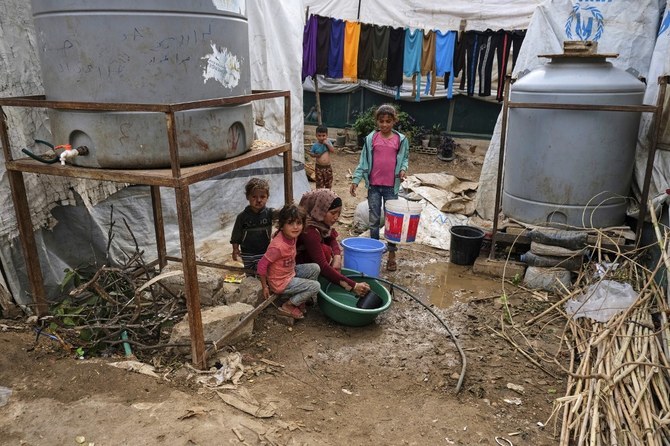
Jordan hosts two camps near the Syrian border: the Zaatari camp, the largest in the Middle East, and the Azraq camp. Most Syrians in Jordan live in cities and urban centers, however, where they work in certain industries.
The UNHCR said that “a record 62,000 work permits were issued to Syrians” in 2021, amounting to “the highest annual number since work permits for Syrian refugees were introduced.”
Syrian refugees have been allowed to work in several sectors in Jordan since 2016, after donor countries pledged funding and expanded trade facilitation to the kingdom under the Jordan Response Plan for the Syria Crisis.
Jordan said that the deficit in the JRP amounted to around $1.60 billion in 2022.
The Ministry of Planning and International Cooperation said that the JRP’s deficit reached 70 percent of the annual budget of $2.276 billion allocated to support Syrian refugees in Jordan.
According to the ministry’s data, Germany was the top donor for the JRP, granting the plan around $211 million, followed by the US at approximately $166 million, then multi-agency funds at $86 million, the EU at $29 million and the UK at $29 million.


![]()

Fewer than 1 percent of Syrian refugees in Jordan want to return home: UNHCR study
Short Url
https://arab.news/cyue2
Fewer than 1 percent of Syrian refugees in Jordan want to return home: UNHCR study
- The survey revealed that around 97 percent of Syrian refugees in Jordan have no intention of going back home in the coming 12 months
- The study was conducted by the UNHCR between January and February this year, surveying Syrian refugees in Egypt, Lebanon, Jordan and Iraq


Latest updates


Recommended


© 2026 SAUDI RESEARCH & PUBLISHING COMPANY, All Rights Reserved And subject to Terms of Use Agreement.