Pakistan Hajj mission supervises food arrangement for pilgrims through 13 catering companies

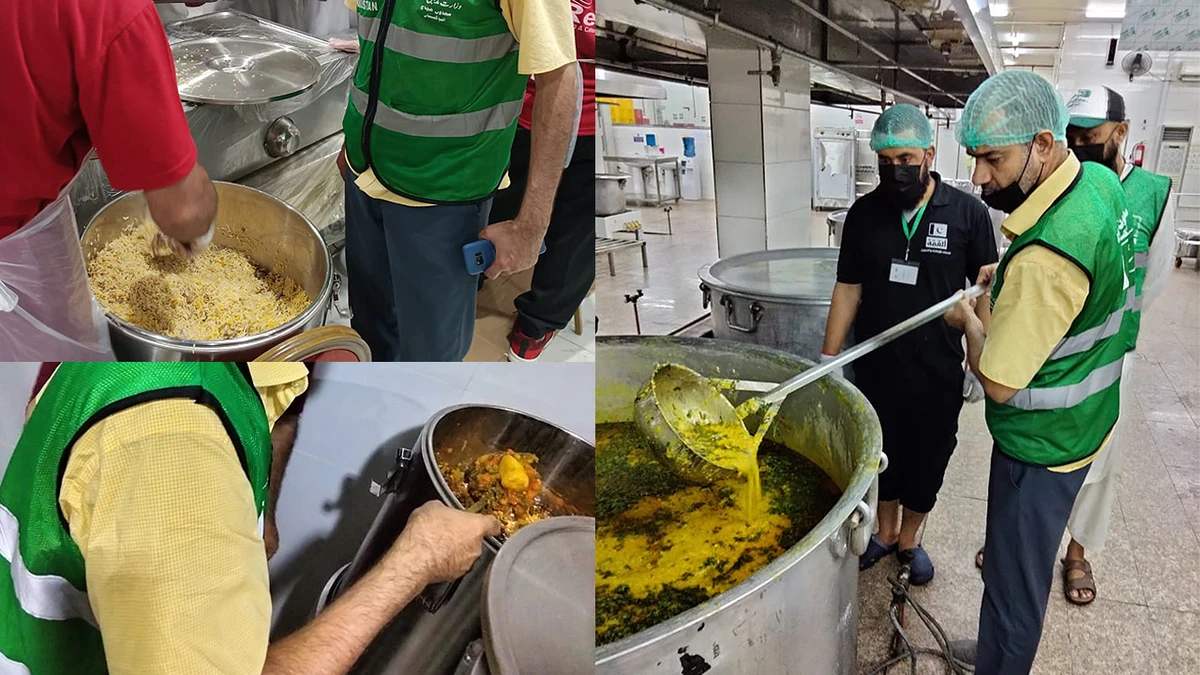
This combination of photos created on June 19, 2023, shows Pakistan’s chief food coordinator, Muhammad Farooq Haider, inspecting food quality provided at the Pakistani Hajj camp in Makkah, Saudi Arabia on June 16, 2023. (Photo courtesy: Pakistan Hajj Mission)
Short Url
Updated 19 June 2023
Follow

Pakistan Hajj mission supervises food arrangement for pilgrims through 13 catering companies

  • 67 Hajj volunteers run food sector and dedicated teams check food quality and quantity at all steps
  • Complaint resolution mechanism set up, surprise visits to kitchens and messes regularly carried out

ISLAMABAD: Under the supervision of the Pakistan Hajj mission, thirteen catering companies are providing food to pilgrims under a government scheme, ensuring quality and safety standards at every step, Pakistan’s chief food coordinator in Makkah said on Monday.

This year, Saudi Arabia reinstated Pakistan’s pre-pandemic Hajj quota of 179,210 pilgrims and scrapped the upper age limit of 65. About 80,000 Pakistani pilgrims are expected to perform the pilgrimage under the government scheme this year, while the rest will use private tour operators.

“Thirteen catering companies are providing meals to pilgrims under a government scheme,” Muhammad Farooq Haider, Pakistan’s chief food coordinator in Makkah, told Arab News in a phone interview.

“We have placed a highly effective mechanism to ensure the quality of the food, with continuous vigilance by Pakistani volunteers during food preparation and round-the-clock monitoring in the kitchens.”

“67 Hajj volunteers are running the food sector and dedicated teams check the quality of the food, including ingredients, spices, and all materials used in cooking,” Haider added.

Even after preparation, the quality and quantity of the food were rechecked once they arrived at the residential buildings and hotels where living arrangements for pilgrims have been made by the Hajj mission.

A complaint resolution mechanism had also been set up, Haider said, to incorporate feedback from pilgrims, and surprise visits to kitchens and mess areas of residential buildings were being regularly carried out.

In the event of violations, penalties were imposed on catering companies “without discrimination.”

“We have imposed a fine of 43,000 Saudi riyals on eight companies for various violations, such as delays in providing food, food shortages, serving undercooked and unripe food, and misconduct by catering staff,” Haider said.

To minimize issues faced by pilgrims due to insufficient dining space in residential buildings and hotels arranged by the Hajj mission, Haider said pilgrims were allowed to take food to their rooms to avoid long queues.

“We have made the food timings flexible to avoid rushes, and we have also provided food parcel facilities,” he said.

“Extraordinary efforts are made to reduce the number of complaints related to food. We have established a network for checking food in each sector through Pakistani helpers and volunteers, organizing clusters in sectors.”
Pakistan to sell excess gas in international markets from Jan.1— petroleum minister

Updated 4 sec ago
Follow

Pakistan to sell excess gas in international markets from Jan.1— petroleum minister

  • Pakistan was reportedly exploring ways to reduce $378 million in annual losses from supply glut caused by excess fuel imports 
  • Move to sell excess LNG in international markets will limit $3.56 billion losses caused since 2018-19, says petroleum minister

ISLAMABAD: Pakistan will sell its excess liquefied natural gas (LNG) in international markets from Jan. 1, Petroleum Minister Ali Pervaiz Malik said, revealing the move would limit losses caused from a years-long supply gut. 

Local and international media outlets had reported in July that Pakistan was exploring ways to sell excess LNG cargoes amid a gas supply glut that government officials said was costing domestic producers $378 million in annual losses. News reports had said Pakistan had at least three LNG cargoes in excess that it imported from Qatar and has no immediate use for.

Speaking to reporters during a press conference on Sunday, Malik said there was an excess of imported gas in Pakistan as the use of this fuel for power generation had reduced in the country during the past few months. He said Islamabad had been forced to sell the gas to local consumers, due to which the circular debt in the gas sector from 2018 till now had ballooned to around Rs1,000 billion [$3.56 billion]. 

“From Jan. 1 we will sell this excess fuel in international markets to reduce our burden and limit our losses of this Rs1,000 billion [$3.56 billion],” Malik said. 

He said this move would also allow Pakistan’s state-owned enterprises in the sector to operate on their full capacity and generate profits and employment. 

Malik also spoke of foreign oil companies that were ready to invest millions in the country in the near future. 

The minister cited the recent visit of Turkish energy minister to Pakistan which had resulted in the state-owned Turkish Petroleum signing deals to carry out onshore and offshore drilling activities in Pakistan. 

“Turkish Petroleum will also open its office in Islamabad, where 10 to 15 Turkish nationals will be working,” Malik said. 

He also said that a delegation of the State Oil Company of Azerbaijan Republic (SOCAR) visit Pakistan this week, adding that it was also expected to collaborate with local companies for oil and gas exploration.

The minister said SOCAR was also opening its office in Pakistan. 

“It will also invest millions of dollars in the construction of an oil pipeline from Machike to Thalian in collaboration with the PSO (Pakistan State Oil) and FWO (Frontier Works Organization),” Malik said.