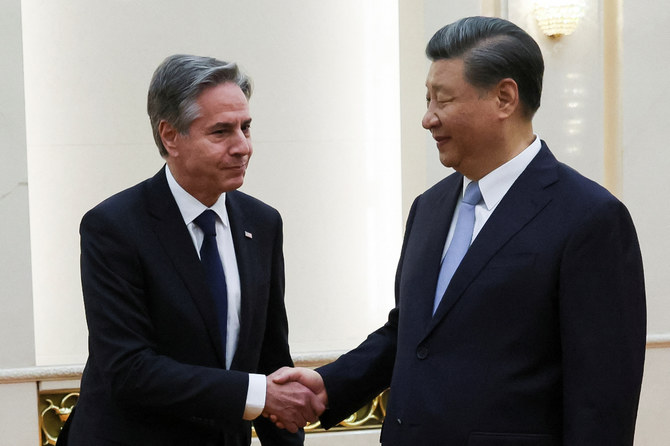
BEIJING: The United States and China have pledged to stabilize their badly deteriorated ties during a critical visit to Beijing by US Secretary of State Antony Blinken, who met Monday with Chinese President Xi Jinping.
It remains to be seen whether the two countries can resolve their most important disagreements, many of which have international financial, security and stability implications.
Apart from a willingness to talk, there was little sign that either were few indications is prepared to bend from hardened positions on issues ranging from trade, to Taiwan, to human rights conditions in China and Hong Kong, to Chinese military assertiveness in the South China Sea, to Russia’s war in Ukraine.
At the meeting with Blinken, Xi pronounced himself pleased with the outcome of Blinken’s earlier meetings with two top Chinese diplomats, and said the two countries had agreed to resume a program of understandings that he and President Joe Biden agreed to at a meeting in Bali last year.
“The Chinese side has made our decision clear, and the two sides have agreed to follow through the common understandings President Biden and I had reached in Bali,” Xi said.
That agenda had been thrown into jeopardy in recent months, notably after the US shot down a Chinese surveillance balloon over its airspace in February, and amid escalated military activity in the Taiwan Strait and the South China Sea. Combined with disputes over human rights, trade and opiate production, the list of problem areas is daunting.
But Xi suggested the worst could be over.
“The two sides have also made progress and reached agreement on some specific issues,” Xi said without elaborating, according to a transcript of the remarks released by the State Department. “This is very good.”
“I hope that through this visit, Mr. Secretary, you will make more positive contributions to stabilizing China-US relations,” Xi added.
In his remarks to Xi during the 35-minute session at the Great Hall of the People, which was not announced until an hour before it started, Blinken said “the United States and China have an obligation and responsibility to manage our relationship.”
“The United States is committed to doing that,” Blinken said. “It’s in the interest of the United States, in the interests of China, and in the interest of the world.”
Blinken described his earlier discussions with senior Chinese officials as “candid and constructive.”
Despite his presence in China, Blinken and other US officials had played down the prospects for any significant breakthroughs on the most vexing issues facing the planet’s two largest economies.
Instead, these officials have emphasized the importance of the two countries establishing and maintaining better lines of communication.
Blinken is the highest-level US official to visit China since President Joe Biden took office, and the first secretary of state to make the trip in five years. His visit is expected to usher in a new round of visits by senior US and Chinese officials, possibly including a meeting between Xi and Biden in the coming months.
Blinken met earlier Monday with China’s top diplomat Wang Yi for about three hours, according to a US official.
China’s Ministry of Foreign Affairs wrote in a statement that Blinken’s visit “coincides with a critical juncture in China-US relations, and it is necessary to make a choice between dialogue or confrontation, cooperation or conflict,” and blamed the “US side’s erroneous perception of China, leading to incorrect policies toward China” for the current “low point” in relations.
It said the US had a responsibility to halt “the spiraling decline of China-US relations to push it back to a healthy and stable track” and that Wang had “demanded that the US stop hyping up the ‘China threat theory,’ lift illegal unilateral sanctions against China, abandon suppression of China’s technological development, and refrain from arbitrary interference in China’s internal affairs.”
The State Department said Blinken “underscored the importance of responsibly managing the competition between the United States and the PRC through open channels of communication to ensure competition does not veer into conflict.”
In the first round of talks on Sunday, Blinken met for nearly six hours with Chinese Foreign Minister Qin Gang, after which both countries said they had agreed to continue high-level discussions. However, there was no sign that any of the most fractious issues between them were closer to resolution.
Both the US and China said Qin had accepted an invitation from Blinken to visit Washington but Beijing made clear that “the China-US relationship is at the lowest point since its establishment.” That sentiment is widely shared by US officials.
Blinken’s visit comes after his initial plans to travel to China were postponed in February after the shootdown of a Chinese surveillance balloon over the US
A snub by the Chinese leader would have been a major setback to the effort to restore and maintain communications at senior levels.
And Biden said over the weekend that he hoped to be able to meet with Xi in the coming months to take up the plethora of differences that divide them.
In his meetings on Sunday, Blinken also pressed the Chinese to release detained American citizens and to take steps to curb the production and export of fentanyl precursors that are fueling the opioid crisis in the United States.
Xi had offered a hint of a possible willingness to reduce tensions on Friday, saying in a meeting with Microsoft Corp. co-founder Bill Gates that the United States and China can cooperate to “benefit our two countries.”
Since the cancelation of Blinken’s trip in February, there have been some high-level engagements. CIA chief William Burns traveled to China in May, while China’s commerce minister traveled to the US And Biden’s national security adviser Jake Sullivan met with senior Chinese foreign policy adviser Wang Yi in Vienna in May.
But those have been punctuated by bursts of angry rhetoric from both countries over the Taiwan Strait, their broader intentions in the Indo-Pacific, China’s refusal to condemn Russia for its war against Ukraine, and US allegations from Washington that Beijing is attempting to boost its worldwide surveillance capabilities, including in Cuba.
And, earlier this month, China’s defense minister rebuffed a request from US Defense Secretary Lloyd Austin for a meeting on the sidelines of a security symposium in Singapore, a sign of continuing discontent.

US-China pledge to stabilize deteriorating ties, resume high-level talks after Blinken visit
Short Url
https://arab.news/mu5c9
US-China pledge to stabilize deteriorating ties, resume high-level talks after Blinken visit
- Blinken’s visit is the highest-level trip by a US official to China in nearly five years
- Visit is expected to usher in new round of visits by senior US and Chinese officials
Russia puts death toll from Ukrainian strike on occupied village at 27. Kyiv rejects accusation
Russian authorities said Friday that the death toll from a Ukrainian drone strike they said struck a café in a Russian-occupied village in Ukraine’s Kherson region rose to 27 people. Kyiv denied attacking civilian targets.
Svetlana Petrenko, spokeswoman of Russia’s main criminal investigation agency, the Investigative Committee, said in a statement that a Ukrainian drone strike on a café and hotel in the village of Khorly, where at least 100 civilians were celebrating New Year’s Eve overnight into Thursday, killed 27 people, including two minors. A total of 31, including five minors, were hospitalized with injuries.
A criminal probe on the charges of carrying out an act of terrorism has been opened, Petrenko said.
Kyiv denied attacking civilians. Spokesman of Ukraine’s General Staff, Dmytro Lykhovii, told Ukraine’s public broadcaster Suspilne on Thursday that Ukrainian forces “adhere to the norms of international humanitarian law” and “carry out strikes exclusively against Russian military targets, facilities of the Russian fuel and energy sector, and other lawful targets.”
Lykhovii said that General Staff has published an explicit list of targets that the Ukrainian army struck on the night of New Year’s Eve. The list did not include strikes on occupied parts of the Kherson region.
Lykhovii noted that Russia has repeatedly used disinformation and false statements to disrupt the ongoing peace negotiations.
The Associated Press could not independently verify claims made about the attack.
Russia’s accusations against Ukraine come amid a US-led diplomatic push to end the nearly four-year war in Ukraine. Earlier this week, Moscow alleged that Kyiv launched a long-range drone attack against a residence of Russian President Vladimir Putin in northwestern Russia overnight from Sunday to Monday.
Kyiv has called the allegations of an attack on Putin’s residence a ruse to derail ongoing peace negotiations, which have ramped up in recent weeks on both sides of the Atlantic.
In his New Year’s address, Ukrainian President Volodymyr Zelensky said that a peace deal was “90 percent ready” but warned that the remaining 10 percent, believed to include key sticking points such as territory, would “determine the fate of peace, the fate of Ukraine and Europe, how people will live.”
Trump’s special envoy Steve Witkoff said Wednesday that he, Secretary of State Marco Rubio and Trump’s son-in-law and adviser Jared Kushner had a “productive call” with the national security advisers of Britain, France, Germany and Ukraine “to discuss advancing the next steps in the European peace process.”
Elsewhere in Ukraine, Russia conducted what local authorities called “one of the most massive” drone attacks at Zaporizhzhia overnight.
At least nine Russian drones struck the city, damaging dozens of residential buildings and other civilian infrastructure, head of the regional administration, Ivan Fedorov, wrote on Telegram on Friday. There were no casualties, the official said.
Overall, Russia fired 116 long-range drones at Ukraine last night, according to Ukraine’s Air Force, which said that 86 drones were intercepted, while 27 more have reached their targets.
The Russian Defense Ministry reported Friday that its air defenses intercepted 64 Ukrainian drones overnight over multiple Russian regions.
Vyacheslav Gladkov, governor of Russia’s Belgorod region on the border with Ukraine, on Friday also accused Ukrainian forces of carrying out a missile strike on the city of Belgorod. Two women were hospitalized with injuries, Gladkov said. The strike shattered windows in multiple residential buildings and damaged an unspecified “commercial” facility and a number of cars, according to the official.
Svetlana Petrenko, spokeswoman of Russia’s main criminal investigation agency, the Investigative Committee, said in a statement that a Ukrainian drone strike on a café and hotel in the village of Khorly, where at least 100 civilians were celebrating New Year’s Eve overnight into Thursday, killed 27 people, including two minors. A total of 31, including five minors, were hospitalized with injuries.
A criminal probe on the charges of carrying out an act of terrorism has been opened, Petrenko said.
Kyiv denied attacking civilians. Spokesman of Ukraine’s General Staff, Dmytro Lykhovii, told Ukraine’s public broadcaster Suspilne on Thursday that Ukrainian forces “adhere to the norms of international humanitarian law” and “carry out strikes exclusively against Russian military targets, facilities of the Russian fuel and energy sector, and other lawful targets.”
Lykhovii said that General Staff has published an explicit list of targets that the Ukrainian army struck on the night of New Year’s Eve. The list did not include strikes on occupied parts of the Kherson region.
Lykhovii noted that Russia has repeatedly used disinformation and false statements to disrupt the ongoing peace negotiations.
The Associated Press could not independently verify claims made about the attack.
Russia’s accusations against Ukraine come amid a US-led diplomatic push to end the nearly four-year war in Ukraine. Earlier this week, Moscow alleged that Kyiv launched a long-range drone attack against a residence of Russian President Vladimir Putin in northwestern Russia overnight from Sunday to Monday.
Kyiv has called the allegations of an attack on Putin’s residence a ruse to derail ongoing peace negotiations, which have ramped up in recent weeks on both sides of the Atlantic.
In his New Year’s address, Ukrainian President Volodymyr Zelensky said that a peace deal was “90 percent ready” but warned that the remaining 10 percent, believed to include key sticking points such as territory, would “determine the fate of peace, the fate of Ukraine and Europe, how people will live.”
Trump’s special envoy Steve Witkoff said Wednesday that he, Secretary of State Marco Rubio and Trump’s son-in-law and adviser Jared Kushner had a “productive call” with the national security advisers of Britain, France, Germany and Ukraine “to discuss advancing the next steps in the European peace process.”
Elsewhere in Ukraine, Russia conducted what local authorities called “one of the most massive” drone attacks at Zaporizhzhia overnight.
At least nine Russian drones struck the city, damaging dozens of residential buildings and other civilian infrastructure, head of the regional administration, Ivan Fedorov, wrote on Telegram on Friday. There were no casualties, the official said.
Overall, Russia fired 116 long-range drones at Ukraine last night, according to Ukraine’s Air Force, which said that 86 drones were intercepted, while 27 more have reached their targets.
The Russian Defense Ministry reported Friday that its air defenses intercepted 64 Ukrainian drones overnight over multiple Russian regions.
Vyacheslav Gladkov, governor of Russia’s Belgorod region on the border with Ukraine, on Friday also accused Ukrainian forces of carrying out a missile strike on the city of Belgorod. Two women were hospitalized with injuries, Gladkov said. The strike shattered windows in multiple residential buildings and damaged an unspecified “commercial” facility and a number of cars, according to the official.
© 2026 SAUDI RESEARCH & PUBLISHING COMPANY, All Rights Reserved And subject to Terms of Use Agreement.


