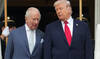
PARIS: Saudi Crown Prince Mohammed bin Salman attended the Kingdom’s official reception in Paris on Monday to present its candidacy to host Expo 2030.
Representatives of 179 member countries of the Bureau International des Expositions, which organizes the expo, also attended the event in the French capital.

The crown prince toured an exhibition held by the Royal Commission for the City of Riyadh that showcases Saudi Arabia’s rich heritage and culture, and the cultural depth of the Kingdom and its capital.
The exhibition takes visitors through a virtual journey in Riyadh in 2030, starting with arrival at King Salman International Airport and then a tour of the most prominent landmarks such as the Sports Boulevard, King Salman Park, Diriyah Gate and Qiddiya.

Monday’s reception was an important part of the nomination procedure for countries to host the expo. It will be followed by the General Assembly of the International Bureau of Exhibitions on Tuesday and Wednesday at its headquarters in the French capital.
The General Assembly will listen to the detailed candidature dossier submitted by four competing countries. Voting will take place next November to choose the host city.
In addition to Saudi Arabia, Italy, South Korea and Ukraine are competing to host the expo in Rome, Busan and Odesa.
The project examination phase for World Expo 2030 is currently underway. The host country will then be elected by BIE member states at a General Assembly in November.
Opinion
This section contains relevant reference points, placed in (Opinion field)
Monday’s reception was attended by a high-ranking Saudi delegation, members of the international diplomatic corps based in Paris, ambassadors of countries accredited to UNESCO, representatives of major participating entities and projects, representatives of member states of the Bureau International des Expositions, and senior French government and private sector officials.
Riyadh’s bid is already attracting widespread support in France. In an interview with Arab News en Français, influential French senator Natalie Goulet said holding the expo in the Saudi capital would be “the culmination of Vision 2030.”
Goulet said: “It is not a date chosen at random, but a date which corresponds to a project, to the culmination of what has been promised and which is in the process of being carried out under the impulse of the Crown Prince Mohammed bin Salman.

“People who don’t know Saudi Arabia don’t see the difference, but I, who have been going there for 20 years, can see it. Whether it is the role of women, the end of wearing the abaya for foreign women, modernization, music, openness, tourism. You can see it very well in the streets of Riyadh or Jeddah. All those sports shops, all that music, all the liberated youth. It is obvious.
“There are really only people of bad faith who do not see the difference, or who do not know the country or who remain on fixed ideas.”
Jack Lang, president of the Arab World Institute and France’s former minister of culture, told Arab News in another interview that Riyadh would be a “smart and visionary choice” to host expo.