Scolari comes out of retirement to coach Brazil’s Atletico Mineiro

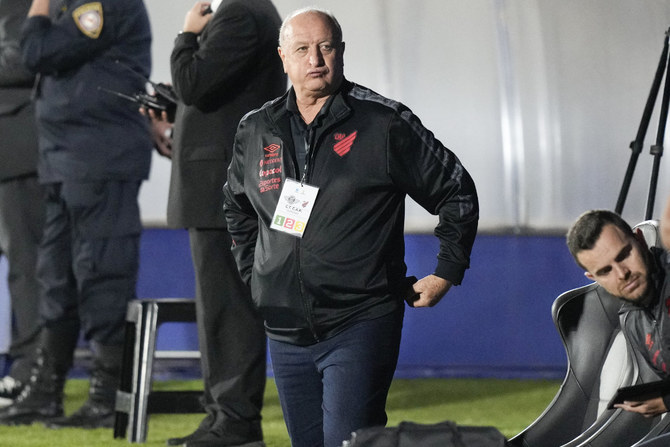
Brazil's Athletico Paranaense coach Luiz Felipe Scolari during a Copa Libertadores Group G soccer match, in Asuncion, Paraguay on May 4, 2023. Scolari came out of retirement on Friday to take charge of Atletico Mineiro. (AP File)
Short Url
Updated 17 June 2023
Follow

Scolari comes out of retirement to coach Brazil’s Atletico Mineiro

  • Scolari will take over at Atletico Mineiro from Argentine coach Eduardo Coudet
  • Last year, Scolari took Athletico Paranaense to the final of the Copa Libertadores, in which his team lost to Flamengo

SAO PAULO: Former Brazil and Portugal coach Luiz Felipe Scolari came out of retirement on Friday to take charge of Atletico Mineiro.

The 74-year-old Scolari announced the end of his coaching career in November but has contracted with the Brazilian club for 18 months.

Soon after Athletico Paranaense informed that Scolari was leaving his job there as technical director, Atletico announced the signing with the coach who won the 2002 World Cup.

Last year, Scolari took Athletico Paranaense to the final of the Copa Libertadores, in which his team lost to Flamengo. He worked at the club last year from May to November and said he achieved all of his goals in football.

Scolari will take over at Atletico Mineiro from Argentine coach Eduardo Coudet, who left the job this week after bad results and public disagreements with club executives.

Scolari told The Associated Press in October that he no longer thought of himself as a coach. He has yet to comment about the deal with Atletico Mineiro.

Atletico said in a statement they signed Scolari due to his “gregarious profile” and success. The team was fourth in the Brazilian championship after 10 matches, six points behind leader Botafogo.

Atletico were knocked out of the Brazilian Cup this month and was close to achieving a spot in the knockout stage of the Copa Libertadores.

As well as his World Cup title with Brazil and two Copa Libertadores trophies, Scolari took Portugal to the final of the 2004 European Championship. A career low point came when Germany humiliated tournament hosts Brazil 7-1 in the semifinals of the 2014 World Cup.


Morocco banish any doubts about ability to host World Cup 2030

Updated 19 January 2026
Follow

Morocco banish any doubts about ability to host World Cup 2030

  • Impressive stadiums, easy transportation links and a well-established tourism infrastructure ensured the 24-team tournament went off without any major hitch and will assuage any doubters about the World Cup in four years’ time

RABAT: Morocco’s successful staging of the Africa Cup of Nations means there should be no skepticism about its ability to co-host the World Cup with Portugal and Spain in 2030, even if Sunday’s final was clouded by a walk-off and defeat for the home team.

Impressive stadiums, easy transportation links and a well-established tourism infrastructure ensured the

24-team tournament went off without any major hitch and will assuage any doubters about the World Cup in four years’ time.

Morocco plans to use six venues in 2030 and five of them were used for the Cup of Nations, providing world-class playing surfaces and a spectacular backdrop.

The Grande Stade in Tangier with a 75,000 capacity is an impressive facility in the northern coastal city, less than an hour’s ferry ride from Spain.

Meanwhile, FIFA President Gianni Infantino condemned "some Senegal players" for the "unacceptable scenes" which overshadowed their victory in the final when they left the pitch in protest at a penalty awarded to Morocco.

African football's showpiece event was marred by most of the Senegal team walking off when, deep into injury time of normal play and with the match locked at 0-0, Morocco were awarded a spot-kick following a VAR check by referee Jean-Jacques Ndala for a challenge on Brahim Diaz.

security personnel at the other end of the stadium, Senegal's players eventually returned to the pitch to see Diaz shoot a soft penalty into the arms of their goalkeeper Edouard Mendy.

The match was played at the Stade Moulay Abdellah in the capital Rabat, which has a capacity of 69,500. The attendance for the final was 66,526.

Stadiums in Agadir, Fes and Marrakech were also more than adequate and will now be renovated over the next few years.

But the crowning glory is the proposed 115,000-capacity Stade Hassan II on ⁠the outskirts of Casablanca which Morocco hope will be chosen to host the final over Madrid’s Santiago Bernabeu Stadium.

In all, Morocco will spend $1.4 billion on the six stadiums. Also planned is extensive investment in airports, with some 10 Moroccan cities already running direct air links to Europe and many budget airlines offering flights to the country.

An extension of Africa’s only high-speed rail service, which already provides a comfortable three-hour ride from Tangier to Casablanca, further south to Agadir and Marrakech is also planned. Morocco hopes all of this will modernize its cities and boost the economy.

On the field, Morocco will hope to launch a credible challenge for a first African World Cup success, although on Sunday they continued their poor return in the Cup of Nations, where their only triumph came 50 years ago.

They surprised with a thrilling run to the last four at the Qatar 2022 World Cup as the first African nation to get that far and will hope for a similar impact at this year’s finals in North America. They are in Group C with Brazil, Scotland and Haiti.