Saudi medical team saves life of Iraqi Hajj pilgrim in Makkah

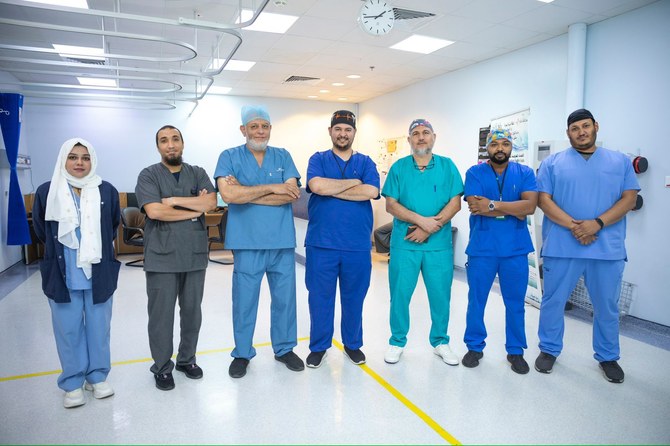
A specialist team from Makkah’s King Faisal Hospital has successfully performed an emergency procedure to save the life of an Iraqi pilgrim in her 70s. (Supplied)
Short Url
Updated 16 June 2023
Follow

Saudi medical team saves life of Iraqi Hajj pilgrim in Makkah

  • Woman recovering in intensive care after emergency surgery to remove diseased kidney
  • Up to 60 percent of patients with the condition die, statistics show

MAKKAH: A specialist team from Makkah’s King Faisal Hospital has successfully performed an emergency procedure to save the life of an Iraqi pilgrim in her 70s.
Hatem Al-Masoudi, spokesman for the Makkah Health Cluster, said that the pilgrim was taken to the hospital’s emergency department by Red Crescent after complaining of constipation, nausea and severe fatigue.
“It was found after conducting clinical, laboratory and radiological examinations that the pilgrim was suffering from a severe inflammation and inflation in the left kidney with an abscess that caused a high temperature and led to blood poisoning,” he said.
Specialists carried out emergency surgery to remove the patient’s left kidney.
Up to 60 percent of patients with the condition die, statistics show.
Al-Masoudi told Arab News that the six-hour operation was performed by an integrative team of urologists, surgeons and anesthetists.
After surgery, the patient was transferred to the intensive care unit, where her condition stabilized.
According to Al-Masoudi, the Iraqi pilgrim had been suffering from pain in the left kidney for almost a year, but the condition was not diagnosed.
“This type of specialized operation requires the presence of an integrated and specialized team, and this is what distinguishes the health sector in Makkah. The Saudi government has put at the service of its citizens, residents and visitors distinguished medical expertise and a myriad of state-of-the-art equipment to provide them with quality health care services comparable to the best countries in the world,” he said.


Saudi Arabia’s KAUST named FIFA’s first research institute in MENA

The canal in the King Abdullah University of Science and Technology campus. (Shutterstock)
Updated 10 February 2026
Follow

Saudi Arabia’s KAUST named FIFA’s first research institute in MENA

  • KAUST President Prof. Sir Edward Byrne said that the university’s selection as the fifth FIFA Research Institute in the world — and the first in the region — marks a significant achievement, reflecting Kingdom’s growing presence in international football

RIYADH: FIFA has designated the King Abdullah University of Science and Technology as its first research institute in the Middle East and Asia to support the development of innovative football research, the Saudi Press Agency reported on Tuesday.

The recognition highlights KAUST’s commitment to integrating sports, academic research and industry through advanced, high-level initiatives grounded in rigorous scientific methodologies, contributing to the advancement of football studies.

KAUST President Prof. Sir Edward Byrne said that the university’s selection as the fifth FIFA Research Institute in the world — and the first in the region — marks a significant achievement, reflecting Saudi Arabia’s growing presence in international football.

The accreditation aligns with national efforts to invest in research and development and promote the knowledge economy, supporting Saudi Vision 2030’s goals of building an advanced sports system based on innovation and sustainability.

The collaboration’s first project focuses on developing advanced AI algorithms to analyze historical FIFA World Cup broadcast footage, transforming decades of match videos into structured, searchable data, according to the KAUST website.

This work opens new opportunities to apply state-of-the-art computer vision techniques and deepen understanding of how football has evolved over time.

The second project uses player and ball tracking data from the FIFA World Cup 2022 in Qatar and the FIFA Women’s World Cup 2023 in Australia and New Zealand to compile comprehensive datasets capturing in-game dynamics.

These datasets provide deeper insights into human movement, playing techniques and performance dynamics through AI-driven analysis.