

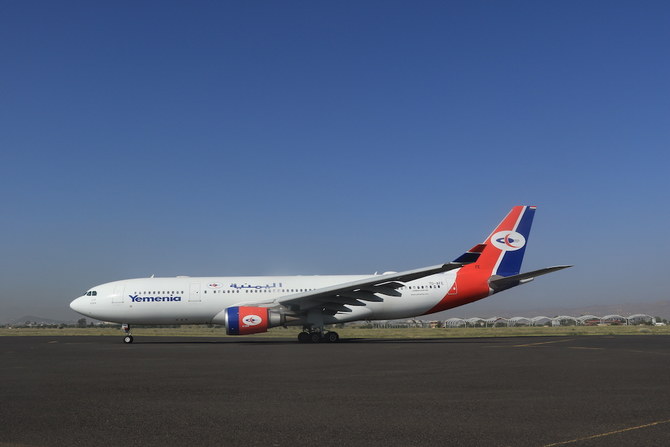
Yemenia restarts direct flights from Sanaa to Kingdom to help pilgrims

Yemenia said earlier it would double the number of its flights between Sanaa and Amman to six per week (Yemenia Website)
Short Url
Updated 16 June 2023
Follow

Yemenia restarts direct flights from Sanaa to Kingdom to help pilgrims

  • Flights will link Houthi-controlled city to Jeddah, Madinah
  • Govt doing all it can to ‘alleviate suffering’ of citizens, minister says

Al-Mukalla: Yemen’s national airline will recommence direct flights from Houthi-controlled Sanaa to Saudi Arabia on Saturday after a break of eight years to help Yemeni pilgrims travel to the Kingdom.

The flights will link Sanaa with Jeddah and Madinah, Yemenia Airways said.

Yemen’s Information Minister Moammar Al-Iryani said on Twitter on Thursday that the government, in cooperation with Saudi authorities, had restarted the flights to alleviate the suffering of Yemenis wishing to visit holy sites.

President Rashad Mohammad Al-Alimi was “making ceaseless efforts at multiple levels to alleviate the suffering of Yemeni citizens despite the difficult situation and the terrorist Houthi militia’s actions against Yemenis and harassment of them,” he said.

The Yemeni government said that 30,000 pilgrims had already entered Saudi Arabia, mostly through the Wadea border, with about 2,600 traveling by plane.

Yemenia said earlier it would double the number of its flights between Sanaa and Amman to six per week. The UN’s special envoy to Yemen, Hans Grundberg, applauded the decision and urged all parties to do more to facilitate the movement of Yemenis out of and within the country.

In exchange for the Houthis lifting their siege of Taiz and halting fighting on battlefields, the Yemeni government agreed to allow Yemenia to operate commercial flights from Sanaa and more fuel ships to enter Hodeidah port under a UN-brokered truce that went into force in April last year.

Despite drastically curtailing their military action, primarily outside Marib, the Houthis refused to lift their siege of Taiz or stop drone and missile attacks on oil facilities in government-controlled areas.

Meanwhile, the head of the Yemeni government’s delegation in the prisoner exchange discussions, Yahya Kazman, said on Wednesday that a new round of UN-sponsored consultations with the Houthis regarding forcibly disappeared people and detainees would start in the Jordanian capital Amman on Friday.

“In coordination with the Office of the UN Envoy, we will begin a round of consultations, not negotiations, in the Jordanian capital of Amman on Friday, June 16, to determine the fate of all the disappeared people, mainly the politician Mohammed Qahtan, as well as the remaining detainees and people who were forcibly disappeared by the Houthi militia,” Kazman said on Twitter.

By agreeing to the Amman meetings, the Yemeni government appears to have reneged on an earlier resolve to boycott talks with the Houthis until the militia disclosed Qahtan’s location and allowed his family to visit him.

The first round of prisoner swap negotiations in March resulted in the release of about 900 detainees. It was the second major exchange since the start of the war and boosted hopes for the release of thousands more prisoners.

On the ground, Yemen’s army said on Thursday that it had shot down two explosive-laden drones fired by the Houthis over army-controlled areas in the central province of Marib over the past 48 hours. It accused the militia of intensifying its drone and ground attacks in Marib and Taiz.


Syria’s Kurdish fighters agree to leave Aleppo after deadly clashes

Updated 3 sec ago
Follow

Syria’s Kurdish fighters agree to leave Aleppo after deadly clashes

  • Syria’s official SANA news agency reported that “buses carrying the last batch of members of the SDF organization have left the Sheikh Maqsud neighborhood in Aleppo, heading toward northeastern Syria”

ALEPPO: Syria’s Kurdish fighters said Sunday that they agreed under a ceasefire to withdraw from Aleppo after days of fighting government forces in the city.
Hours earlier, Syria’s military said it had finished operations in the Kurdish-held Sheikh Maqsud neighborhood with state television reporting that Kurdish fighters who surrendered were being bused to the north.
The military had already announced its seizure of Aleppo’s other Kurdish-held neighborhood, Ashrafiyeh.
Kurdish forces had controlled pockets of Syria’s second city Aleppo and operate a de facto autonomous administration across swathes of the north and northeast, much of it captured during the 14-year civil war.
The latest clashes erupted after negotiations to integrate the Kurds into the country’s new government stalled.
“We reached an understanding that led to a ceasefire and secured the evacuation of the martyrs, the wounded, the trapped civilians and the fighters from Ashrafiyeh and Sheikh Maqsud neighborhoods to northern and eastern Syria,” the Kurdish-led Syrian Democratic Forces (SDF) wrote in a statement.
Syria’s official SANA news agency reported that “buses carrying the last batch of members of the SDF organization have left the Sheikh Maqsud neighborhood in Aleppo, heading toward northeastern Syria.”
The SDF initially denied its fighters were leaving, describing the bus transfers as forced displacement of civilians.
An AFP correspondent saw at least five buses on Saturday carrying men out of Sheikh Maqsud, but could not independently verify their identities.
According to the SDF statement, the ceasefire was reached “through the mediation of international parties to stop the attacks and violations against our people in Aleppo.”
The United States and European Union both called for the Syrian government and Kurdish authorities to return to political dialogue.
The fighting, some of the most intense since the ousting of long-time ruler Bashar Assad in December 2024, has killed at least 21 civilians, according to figures from both sides, while Aleppo’s governor said 155,000 people fled their homes.
Both sides blamed the other for starting the clashes on Tuesday.

Children ‘still inside’

On the outskirts of Sheikh Maqsud, families who had been trapped by the fighting were leaving, accompanied by Syrian security forces.
An AFP correspondent saw men carrying children on their backs board buses headed to shelters.
Dozens of young men in civilian clothing were separated from the crowd, with security forces making them sit on the ground before transporting them to an unknown destination, according to the correspondent.
A Syrian security official told AFP on condition of anonymity that the young men were “fighters” being “transferred to Syrian detention centers.”
At the entrance to the district, 60-year-old Imad Al-Ahmad was heading in the opposite direction, trying to seek permission to return home.
“I left four days ago...I took refuge at my sister’s house,” he told AFP. “I don’t know if we’ll be able to return today.”
Nahed Mohammad Qassab, a 40-year-old widow also waiting to return, said she left before the fighting to attend a funeral.
“My three children are still inside, at my neighbor’s house. I want to get them out,” she said.
A flight suspension at Aleppo airport was extended until further notice.

‘Return to dialogue’

US envoy Tom Barrack met Syrian President Ahmed Al-Sharaa on Saturday, and afterwards called for a “return to dialogue” with the Kurds in accordance with the integration framework agreed in March.
The deal was meant to be implemented last year, but differences, including Kurdish demands for decentralized rule, stymied progress as Damascus repeatedly rejected the idea.
The fighting in Aleppo raised fears of a regional escalation, with neighboring Turkiye, a close ally of Syria’s new Islamist authorities, saying it was ready to intervene. Israel has sided with the Kurdish forces.
The clashes have also tested the Syrian authorities’ ability to reunify the country after the brutal civil war and commitment to protecting minorities, after sectarian bloodshed rocked the country’s Alawite and Druze communities last year.