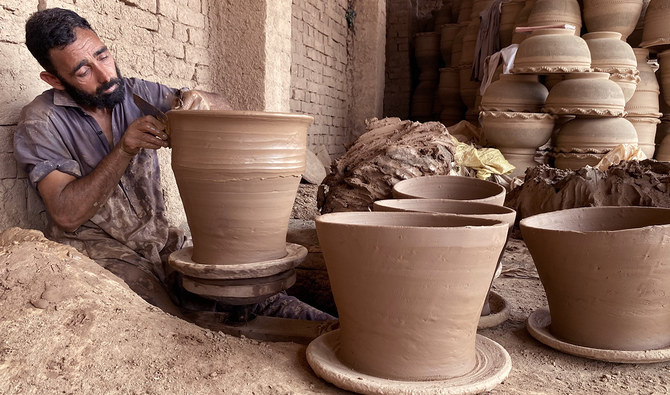

PESHAWAR: The whirring sound of a potter’s wheel and the sight of smoke billowing from large clay furnaces welcome visitors as they enter Surizai village via the Ring Road on the outskirts of the northwestern Pakistani city of Peshawar.
The village is one of three known hubs of pottery — Surizai, Masizai and Hazar Khani — where craftsmen have learnt the techniques and styles from their forefathers and continue to uphold the age-old tradition of using their hands to shape their wares. Around the world, pottery was displaced at the beginning of the 20th century by glass, aluminum, tin and plastic, materials all cheaper and better suited to most tasks than clay.
But the tradition lives on, both as a craft and as a way of life, in the three ‘Kolalano Kali,’ which translates into ‘potters villages’ in the native Pashto language.
Large clay pots line the streets in these villages, and men, both young and old, can be seen in the verandas of their homes spinning their pottery lathes. In all three villages, which comprise 300 households each, residents make clay pots around the year, except for the rainy season when the weather is humid and frequent rains drench the giant clay furnaces used to bake utensils.
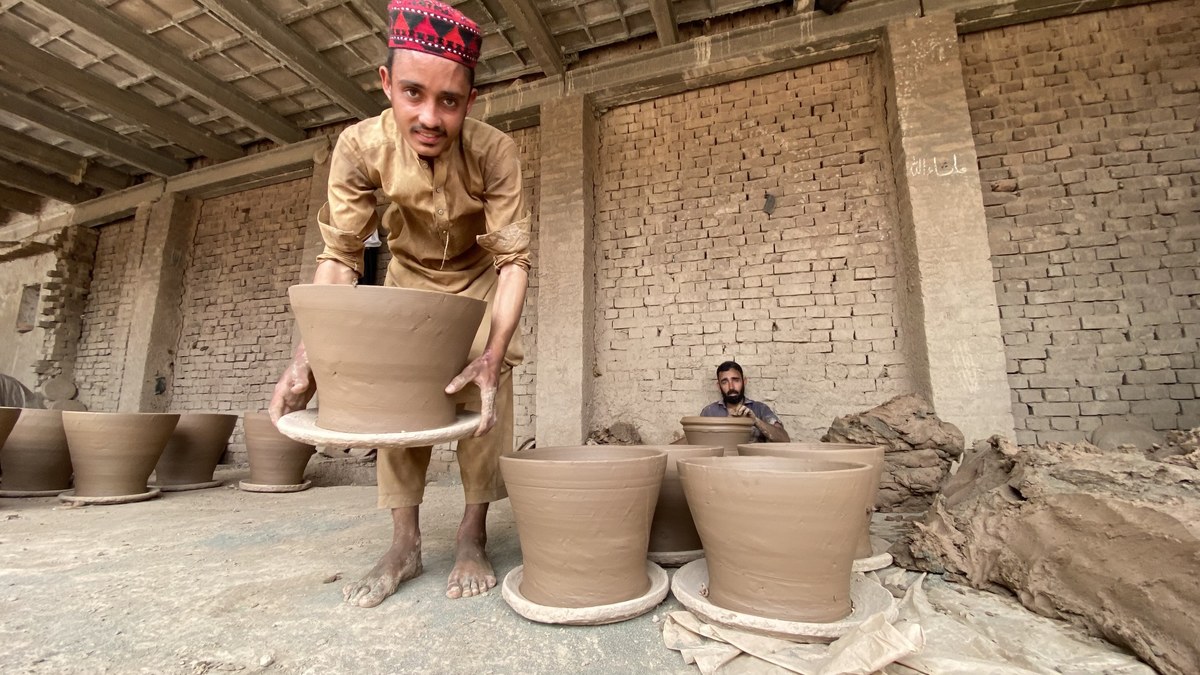
Adnan Ahmad helping his brother Anwar Ahmad to make large flower pot on June 11, 2023 in Peshawar, Pakistan. ( AN Photo)
The finished goods are sold in local markets as well as transported to wholesalers elsewhere in the northwestern Khyber Pakhtunkhwa province.
“The work we are doing now has been going on for centuries in our family, from the time of our ancestors,” Habibullah Khan, 30, a resident of Masizai village, told Arab News, saying he started working with his father when he was 15 and earns around Rs1300 ($4.5) a day.
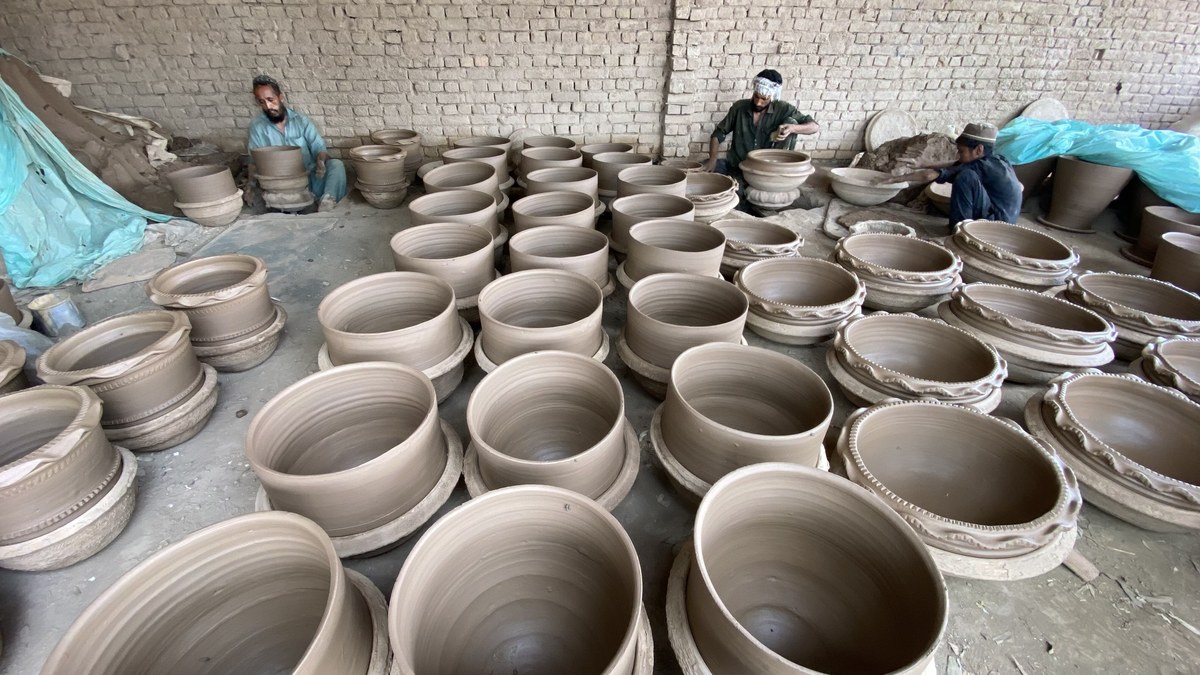
Potters busy in pottery on June 11, 2023 in Peshawar, Pakistan. ( AN Photo)
“The potters are happy and proud of doing their ancestral work. Thank God, we are free from [doing labor] for others.”
The young potter said craftsmen in the three villages used a special, fine-grained soil sourced from Sheikh Muhammado village in Peshawar’s suburban Badaber area.
But the job required hard labor, Khan said, with the craftsmen starting to knead the soil early in the morning, before taking it to their workplaces where they molded and baked it all day into different utensils in fire mounds.
“This work is hard, one person can’t do it,” 27-year-old Jalil Khan, who quit studying after high school and joined the family’s line of work, told Arab News.
Like Jalil, many children in the three villages started learning pottery-making at a very young age to lend a helping hand to their elders after school hours.
Many also drop out of school to take it up as a full-time job.
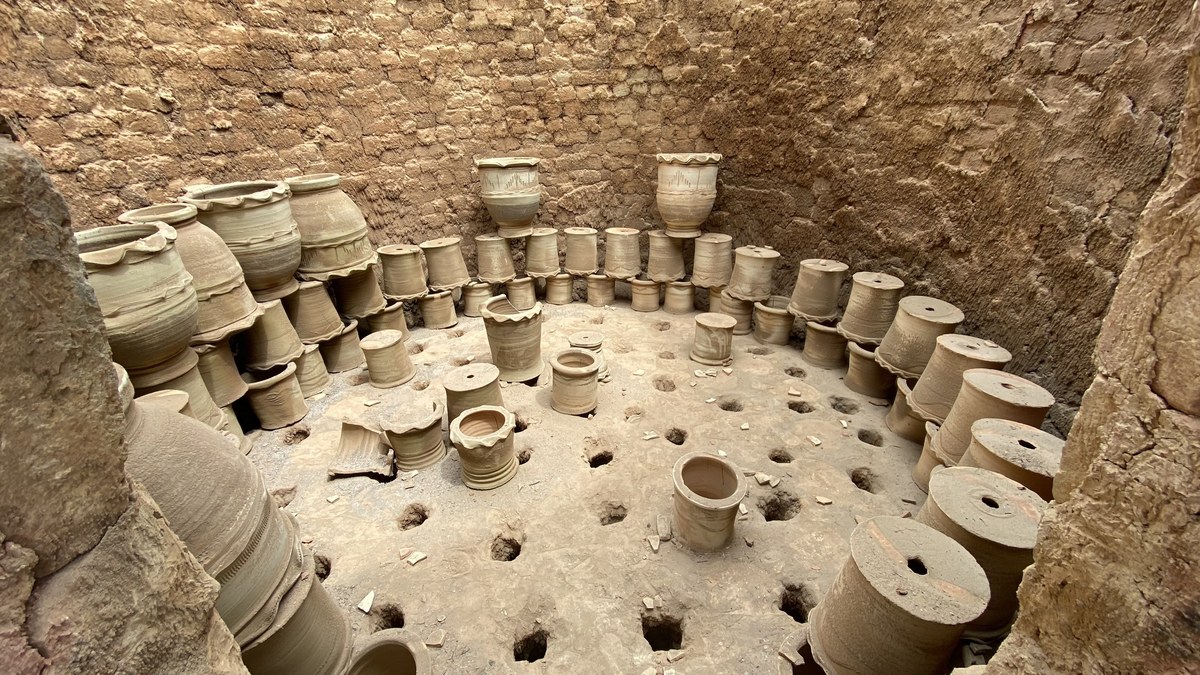
Recently cooked clay pots in the hot furnace on June 11, 2023 in Peshawar, Pakistan. ( AN Photo)
“My father could not do it alone, so I started working with him. Everyone works on [separate] orders,” said Jalil, who like others in the villages can make anything from pots for water and plants, large containers, water coolers, bowls, cooking utensils and large boxes used to store honey bees.
Salman Yousafzai, a 26-year-old regular customer from Peshawar, said he bought the clay pots out of an “affection” for traditional things.
“It is a traditional thing which is on the decline and I have an affection for it,” he told Arab News. “These pots look beautiful at home. They are like ornaments.”
Usman Danish, a businessperson in Mardan district, said he mainly acquired flower pots from Kolalano Kali since they were in high demand in Mardan.
“We order flowers pots because they are sold on a high scale. Water coolers and mud jug-glasses are also bought on a large scale in summers,” Danish said. “We rarely order clay pots because the customers rarely buy them.”
But while loyal customers do keep ordering, Khan said the pottery business had been impacted by inflation and high transportation rates, forcing many people to switch to other lines of work.
Pakistan reported record high inflation of 38 percent in May.
“The amount of work we get has not declined, but inflation is high,” Khan said.
“The pots are sent to different parts of the country, but the business is not as fruitful as it used to be due to expenses.”