

Over 60,000 people evacuated to safer places as Pakistan braces for Cyclone Biparjoy

Cyclone evacuees gather outside a temporary shelter set at a school in Badin district of Pakistan's Sindh province on June 14, 2023, ahead of cyclone Biporjoy landfall. (AFP)
Short Url
Updated 14 June 2023
Follow

Over 60,000 people evacuated to safer places as Pakistan braces for Cyclone Biparjoy

  • Biparjoy expected to make landfall near border of Pakistan and India in Kutch district of Gujarat on Thursday
  • Tropical cyclones like this one have become more frequent because of warming sea surface temperatures

LAHORE: Over 60,000 people have so far been evacuated to safer areas, Lt. Gen. Inam Haider Malik, the chairman of the National Disaster Management Authority said on Wednesday as a powerful cyclone, named Biparjoy, is inching closer to India and Pakistan.

The 'very severe cyclonic storm' developing over the northeast Arabian Sea is expected to make landfall between Mandvi in India's western state of Gujarat and Karachi in southern Pakistan by Thursday evening. The cyclone is expected to have maximum sustained wind speeds of between 125-135 km per hour (78-84 miles) gusting up to 150 km per hour.

The Pakistan Meteorological Department (PMD) said on Wednesday morning Biparjoy had nearly moved northward during the last six hours and was at a distance of 275 kilometers southwest of Keti Bandar, 340 kilometers south of Karachi, and 355 kilometers south of Thatta in Pakistan’s southern Sindh province.
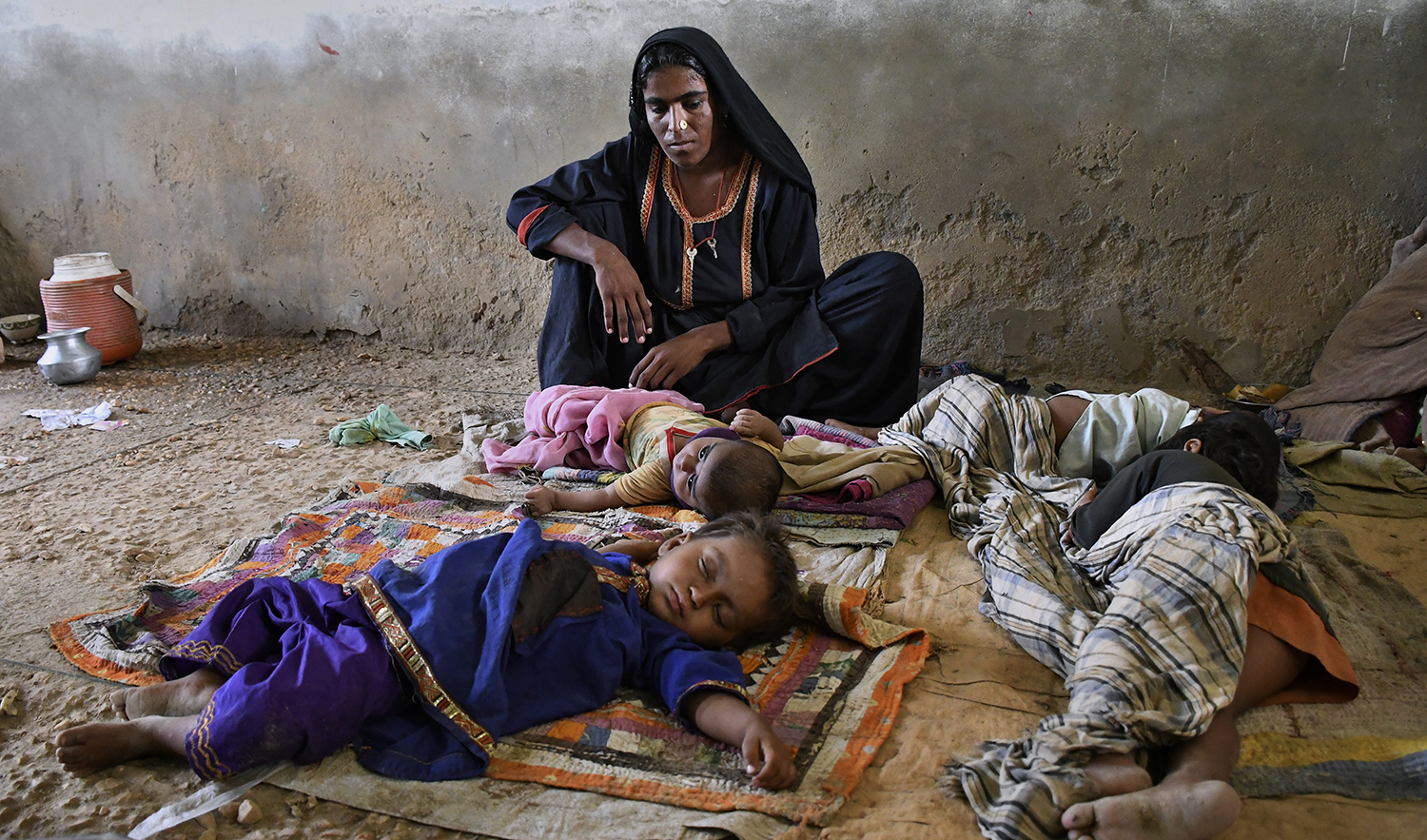


A woman takes care of her children as she with other families sheltering in a school building due to Cyclone Biparjoy approaching, in Golarchi near Badin, Pakistan's southern district in the Sindh province, on June 14, 2023. (AP)

“62,000 people have been evacuated to safer places,” Malik told reporters on Wednesday evening.

“According to reports we have received so far, around 75 relief camps have been established which have been set up by Pakistan army jointly with Rangers and the district administration.”

He said the Sindh government was taking a “clear lead” in the evacuations and all federal government departments would support them.
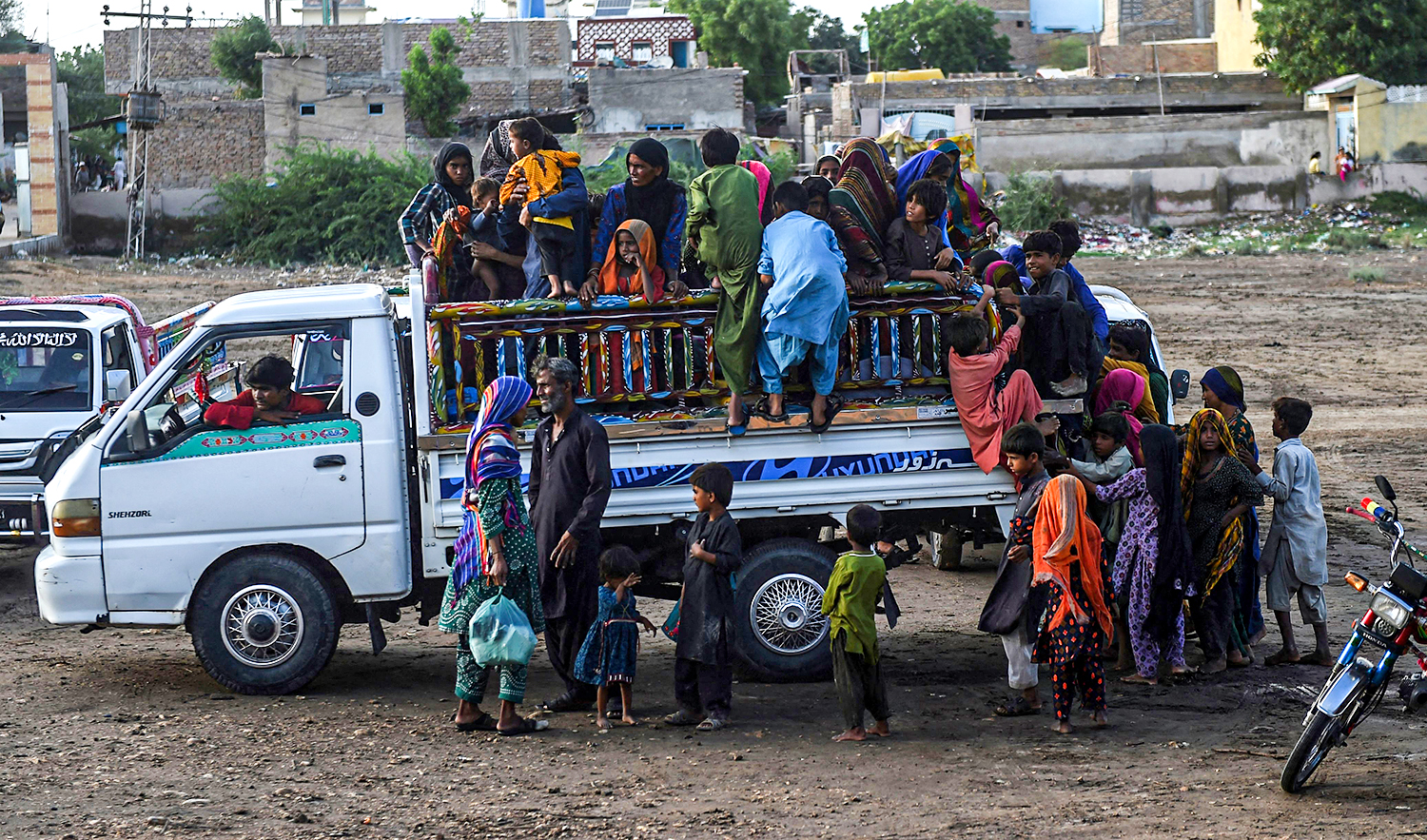


Cyclone evacuees arrive at a temporary shelter set at a school in Badin district of Pakistan's Sindh province on June 14, 2023, ahead of cyclone Biporjoy landfall. (AFP)

Earlier on Wednesday, Pakistani Prime Minister Shehbaz Sharif formed a climate committee to deal with a possible “emergency” arising from Biparjoy.

“I have constituted a committee under the chairmanship of the minister of climate change to deal with any possible emergency situation arising from Biparjoy,” PM Sharif wrote on Twitter, saying the committee would comprise relevant ministers and representatives of both federal and provincial institutions who would continuously monitor the storm.

“Due to the possibility of Biparjoy hitting Kati Bandar, all relevant government agencies have been instructed to ensure the early rescue of people and I have directed authorities to move more than 50,000 people living in the coastal areas to safe places where they will be provided with clean drinking water and food as well as comfortable accommodation and medical facilities until the storm abates.”

PMD’s chief meteorologist, Sardar Sarfraz, told Arab News on Wednesday morning the port city of Karachi was expected to receive heavy rainfall on Wednesday and Thursday as the storm inched closer to the coastline of the metropolis.

“Tonight and tomorrow, heavy rainfall is expected in some parts of Karachi, but the situation in the city will not be dangerous,” he said.

Meanwhile, authorities have warned people living near coastal areas to take precautionary measures and told fishermen not to venture into the sea. People have also been advised to avoid Karachi beaches.


Islamabad says surge in aircraft orders after India standoff could end IMF reliance

Updated 06 January 2026
Follow

Islamabad says surge in aircraft orders after India standoff could end IMF reliance

  • Pakistani jets came into the limelight after Islamabad claimed to have shot down six Indian aircraft during a standoff in May last year
  • Many countries have since stepped up engagement with Pakistan, while others have proposed learning from PAF’s multi-domain capabilities

ISLAMABAD: Defense Minister Khawaja Asif on Tuesday said Pakistan has witnessed a surge in aircraft orders after a four-day military standoff with India last year and, if materialized, they could end the country’s reliance on the International Monetary Fund (IMF).

The statement came hours after a high-level Bangladeshi defense delegation met Pakistan’s Air Chief Marshal Zaheer Ahmed Baber Sidhu to discuss a potential sale of JF-17 Thunder aircraft, a multi-role fighter jointly developed by China and Pakistan that has become the backbone of the Pakistan Air Force (PAF) over the past decade.

Fighter jets used by Pakistan came into the limelight after Islamabad claimed to have shot down six Indian aircraft, including French-made Rafale jets, during the military conflict with India in May last year. India acknowledged losses in the aerial combat but did not specify a number.

Many countries have since stepped up defense engagement with Pakistan, while delegations from multiple other nations have proposed learning from Pakistan Air Force’s multi-domain air warfare capabilities that successfully advanced Chinese military technology performs against Western hardware.

“Right now, the number of orders we are receiving after reaching this point is significant because our aircraft have been tested,” Defense Minister Asif told a Pakistan’s Geo News channel.

“We are receiving those orders, and it is possible that after six months we may not even need the IMF.”

Pakistan markets the Chinese co-developed JF-17 as a lower-cost multi-role fighter and has positioned itself as a supplier able to offer aircraft, training and maintenance outside Western supply chains.

“I am saying this to you with full confidence,” Asif continued. “If, after six months, all these orders materialize, we will not need the IMF.”

Pakistan has repeatedly turned to the IMF for financial assistance to stabilize its economy. These loans come with strict conditions including fiscal reforms, subsidy cuts and measures to increase revenue that Pakistan must implement to secure disbursements.

In Sept. 2024, the IMF approved a $7 billion bailout for Pakistan under its Extended Fund Facility (EFF) program and a separate $1.4 billion loan under its climate resilience fund in May 2025, aimed at strengthening the country’s economic and climate resilience.

Pakistan has long been striving to expand defense exports by leveraging its decades of counter-insurgency experience and a domestic industry that produces aircraft, armored vehicles, munitions and other equipment.

The South Asian country reached a deal worth over $4 billion to sell military equipment to the Libyan National Army, Reuters report last month, citing Pakistani officials. The deal, one of Pakistan’s largest-ever weapons sales, included the sale of 16 JF-17 fighter jets and 12 Super Mushak trainer aircraft for basic pilot training.