21 trucks of LPG from Uzbekistan and Turkmenistan reach Pakistan via Afghanistan

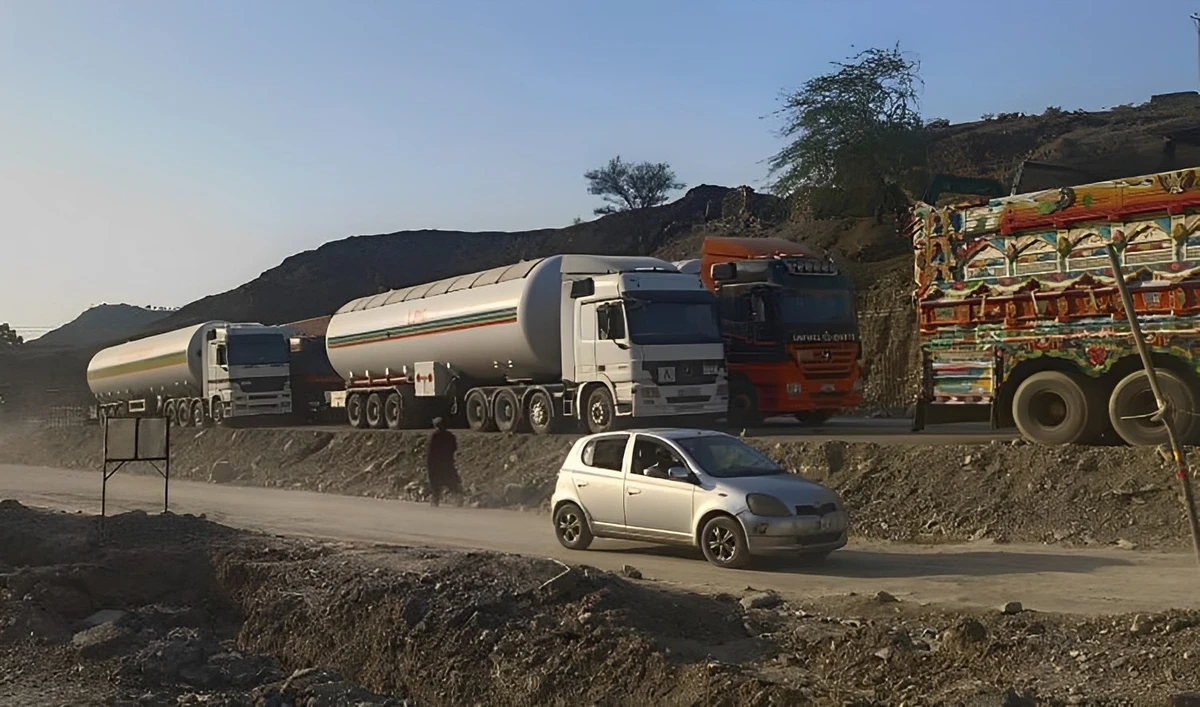
Trucks carrying liquefied petroleum gas (LPG) enter Pakistani territory through the Torkham crossing at the Pakistan-Afghan border on June 14, 2023. (Photo courtesy: Customs Office Torkham)
Short Url
Updated 14 June 2023
Follow

21 trucks of LPG from Uzbekistan and Turkmenistan reach Pakistan via Afghanistan

  • Trucks reached Pakistan through Torkham border between Pakistan and Afghanistan in Khyber Pakhtunkhwa province
  • LPG orders started arriving just days after the first cargo of discounted Russian crude oil arrived in Karachi

PESHAWAR: A consignment of 21 trucks carrying liquefied petroleum gas (LPG) from Uzbekistan and Turkmenistan have reached Pakistan through Torkham, a border crossing between Pakistan and Afghanistan in the northwestern Khyber Pakhtunkhwa province, a Pakistani customs official said on Wednesday.

The LPG orders started arriving just days after the first cargo of discounted Russian crude oil arranged under a new deal struck between Islamabad and Moscow arrived in Karachi on Sunday.

“At least 21 trucks have entered (Pakistan) so far,” Hammad Ali, a senior official at the Customs Department at the Torkham border, told Arab News, saying six of the trucks came from Uzbekistan and three containers arrived from Turkmenistan.

Goods Declarations (GDs) for the rest of the vehicles had not been filed yet, Ali said.

“Customs is waiting for the documents to be completed by the importers. Hopefully some consignments will be cleared today.”

Zarqeeb Shinwari, a Pakistani custom clearing agent at the Torkham border, said 15 LPG containers were parked at his terminal.

“Two or three tankers containing LPG have been entering the Pakistani side of the border on a daily basis since last one week. Custom clearing process is completed but some drivers of the trucks are said to have visa and travel documents’ issues, which could be resolved in a day or two,” Shinwari said.

A senior official at Epic Energy, a Lahore-based private Limited company engaged in the bulk supply of LPG and LPG transportation across Pakistan, said his company had imported ten tankers of LPG from Uzbekistan, which were pending custom clearing at the Torkham border. He declined to be named.

“We have imported ten containers with 5,000 metric tons LPG from Uzbekistan … We also have an arrangement with Turkmenistan to import another 5,000 LPG very soon. And importing of 10,000 metric tons LPG from Russia is in pipeline, which will soon be imported after clearing modalities,” the official said.

Asked when the Russian LPG was expected to arrive in Pakistan, he said: “I think it will come in due time as well.”

Irfan Khokar, chairman of the LPG Distributors Association, said the flow of LPG into Pakistan had now started via the shortest route, Afghanistan, which would stabilize its prices in the country.

“The flow of LPG imports into Pakistan has started primarily from central Asian states such as Uzbekistan and Turkmenistan. At a later stage, LPG can be imported from Russia also,” he added.


UN torture expert decries Pakistan ex-PM Khan’s detention

Updated 12 December 2025
Follow

UN torture expert decries Pakistan ex-PM Khan’s detention

  • Khan’s party alleges government is holding him in solitary confinement, barring prison visits
  • Pakistan’s government rejects allegations former premier is being denied basic rights in prison

GENEVA: Pakistan’s former prime minister Imran Khan is being held in conditions that could amount to torture and other inhuman or degrading treatment, the United Nations’ special rapporteur on torture warned Friday.

Alice Jill Edwards urged Pakistan to take immediate and effective action to address reports of the 73-year-old’s inhumane and undignified detention conditions.

“I call on Pakistani authorities to ensure that Khan’s conditions of detention fully comply with international norms and standards,” Edwards said in a statement.

“Since his transfer to Adiala Jail in Rawalpindi on September 26, 2023, Imran Khan has reportedly been held for excessive periods in solitary confinement, confined for 23 hours a day in his cell, and with highly restricted access to the outside world,” she said.

“His cell is reportedly under constant camera surveillance.”

Khan an all-rounder who captained Pakistan to victory in the 1992 Cricket World Cup, upended Pakistani politics by becoming the prime minister in 2018.

Edwards said prolonged or indefinite solitary confinement is prohibited under international human rights law and constitutes a form of psychological torture when it lasts longer than 15 days.

“Khan’s solitary confinement should be lifted without delay. Not only is it an unlawful measure, extended isolation can bring about very harmful consequences for his physical and mental health,” she said.

UN special rapporteurs are independent experts mandated by the Human Rights Council. They do not, therefore, speak for the United Nations itself.

Initially a strong backer of the country’s powerful military leadership, Khan was ousted in a no-confidence vote in 2022, and has since been jailed on a slew of corruption charges that he denies.

He has accused the military of orchestrating his downfall and pursuing his Tehreek-e-Insaf (PTI) party and its allies.

Khan’s supporters say he is being denied prison visits from lawyers and family after a fiery social media post this month accusing army leader Field Marshal Asim Munir of persecuting him.

According to information Edwards has received, visits from Khan’s lawyers and relatives are frequently interrupted or ended prematurely, while he is held in a small cell lacking natural light and adequate ventilation.

“Anyone deprived of liberty must be treated with humanity and dignity,” the UN expert said.

“Detention conditions must reflect the individual’s age and health situation, including appropriate sleeping arrangements, climatic protection, adequate space, lighting, heating, and ventilation.”

Edwards has raised Khan’s situation with the Pakistani government.