

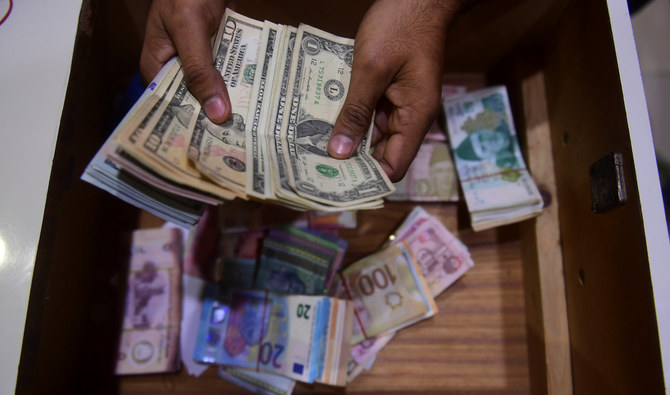

KARACHI: Pakistani financial experts and currency traders said on Wednesday the 12.8 percent decline in the country’s remittance inflows in the outgoing fiscal year was due to the preference of expatriates to utilize informal channels to send money amid a significant exchange rate disparity between the interbank and open markets.
According to official statistics, Pakistan witnessed a decline of 4.4 percent in remittance inflow in the last month, which stood at $2.1 billion. The data shared by Pakistan’s central bank on Tuesday indicated that the reduction in remittances in May amounted to 10.4 percent on an annual basis. This is despite the fact that the country needs improved remittance inflows since it desperately needs dollars amid a decline in its official reserves to a dangerously low level of $3.9 billion.
Pakistan received 12.8 percent less remittances in the outgoing fiscal year beginning in July 2022. The cumulative inflows of $24.8 billion were recorded during the first 11 months of FY23, according to the State Bank of Pakistan (SBP). In absolute terms, remittances have declined by $3.68 billion during the fiscal year compared to the previous year’s $28.48 billion inflows.
The major contributors to Pakistan’s remittance are Saudi Arabia and the United Arab Emirates (UAE), although the inflows from the kingdom have also declined by 16.3 percent to $5.9 billion since July 2022, while the inflows from the UAE dropped by over 19 percent to $4.3 billion, according to the official data.
“The decline in inflows can be attributed primarily to Pakistani expatriates opting for informal channels instead of banks when sending money to their families in the country,” said Faizan Munshey, senior consultant at One Investments, Dubai, speaking to Arab News.
“This shift is driven by illegal hawala-hundi operators in the black market offering more favorable exchange rates or rupee-dollar parity, leading a portion of non-resident Pakistanis to choose informal channels for fund transfers.”
Currency dealers said the demand in the unofficial market was higher as some importers rushed to arrange for payment in order to get their containers cleared from the country’s ports.
“Some importers have procured goods from abroad without opening letters of credit, and the government has asked them to arrange for payment on their own,” said Malik Bostan, president of the Exchange Companies Association of Pakistan (ECAP), while speaking to Arab News. “So, they are resorting to the hawala market to fulfill their requirements.”
Bostan said the situation would not improve unless the government resolved the issue of LCs.
Currency dealers also mentioned that the exchange rate was still above Rs300 per US dollar in the unofficial or hawala market, while the gap between the open and interbank market was beginning to narrow down.
On Wednesday, the open market was trading at Rs295 compared to Rs298 on Tuesday, while the currency in the interbank closed at Rs287.97 against the greenback on Tuesday.
Bostan said that the dealers’ request for the release of currency for exchange companies was accepted by the central bank authorities, which resulted in the appreciation of the Pakistani rupee in the open market.
“We had requested the State Bank governor to release the stuck-up amount of exchange companies,” he added. “They released $5 million yesterday, and we are expecting another $5 million today.”
Bostan said the efforts to narrow down the gap between the open and interbank markets were yielding positive results, as more appreciation of the Pakistani rupee was expected in the coming days.
“The gap reduction efforts will begin to encourage overseas Pakistanis to remit money through official channels,” he added.


