

Abu Dhabi doctors perform rare surgery on unborn child with spinal defect

1 / 2
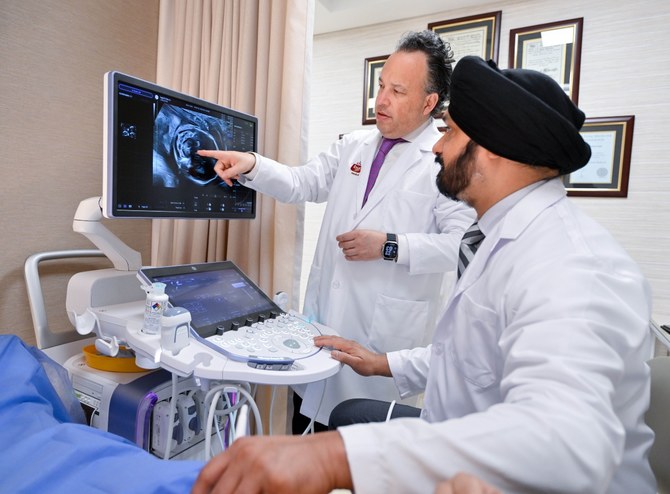
A baby born with spina bifida is at risk of developing complications ranging from orthopedic to issues with bowel and bladder control. (Supplied)
2 / 2
The procedure is not a cure, but will have an impact on the child’s life after birth. (Supplied)
Short Url
Updated 13 June 2023
Follow

Abu Dhabi doctors perform rare surgery on unborn child with spinal defect

  • The Colombian patient underwent the procedure at Burjeel Medical City in Abu Dhabi
  • A baby born with spina bifida is at risk of developing complications ranging from orthopedic to issues with bowel and bladder control

ABU DHABI: Surgeons in Abu Dhabi have operated on an unborn child with a spinal defect six months into the pregnancy, it was announced on Tuesday. 

The patient from Colombia underwent the rare spina bifida procedure at Burjeel Medical City’s Kypros Nicolaides Fetal Medicine and Therapy Center in Abu Dhabi.

Spina bifida is a birth defect that occurs when bones forming the spine do not develop leading to the spinal cord being left exposed to the amniotic fluid resulting in a permanent disability. 

In the operation, which took place earlier in June, known as in-utero fetal surgery, a small incision was made on the uterus and the back of the baby is exposed to allow the neurosurgeon to close the spina bifida defect.

The parents were referred to the Abu Dhabi center after doctors in Colombia told them their only other option was terminating the pregnancy. 

A baby born with spina bifida is at risk of developing complications ranging from orthopedic to issues with bowel and bladder control, Dr. Mandeep Singh, consultant in maternal & fetal medicine at Burjeel Medical City, said. 

“We use a synthetic patch to cover the defect. The amniotic fluid is then instilled back into the cavity and the uterus is closed back up. The baby will remain in the womb for the remainder of the pregnancy and will be delivered by caesarean section at 37 weeks' gestation,” said Dr Singh.

According to Singh, the procedure is not a cure, but will have an impact on the child’s life after birth. In cases where parents opt out of the surgery, the child will have difficulty walking and can even be wheelchair bound for the rest of their life. 

“In-utero repair of spina bifida reduces motor function loss of limbs and improves outcomes. After the delivery, the baby needs follow up and, in some cases, may need to undergo physiotherapy and all other medical assessments to ensure their well-being,” Singh said.

“We were shocked after our routine 20-week scan showed that our baby’s spinal cord was not forming correctly.”

It was not an easy decision to have the operation, said Liz Valentina Parra Rodriguez and Jason Mateo Moreno Gutierrez, who admitted to having considered all options available before committing to the surgery in Abu Dhabi.

“Our doctor suggested that our best course of action was to undergo spina bifida repair before the baby was born,” the Colombian couple who traveled to Abu Dhabi for the procedure explained.

The mother is stable and expected to deliver her baby in August.


Syria announces new currency framework, 2-zero redenomination

Updated 15 sec ago
Follow

Syria announces new currency framework, 2-zero redenomination

  • Under the plan, every 100 Syrian pounds will be converted into one unit of the new Syrian Arab Republic’s pound
  • Governor calls move ‘pivotal milestone within a comprehensive strategy’

DAMASCUS: Syria’s Central Bank announced executive instructions on Sunday to introduce a new Syrian currency, launching a monetary reform that includes removing two zeros from the pound and allowing a 90-day period of dual circulation.

The announcement was made during a press conference at the bank’s headquarters in Damascus.

Central Bank Gov. Abdulkader Husrieh said the step was part of a comprehensive institutional strategy to restore confidence and achieve sustainable economic stability.

He said: “The launch of the new currency is not a formal measure, but a pivotal milestone within a comprehensive strategy based on solid institutional foundations.”

Under the plan, every 100 Syrian pounds will be converted into one unit of the new Syrian Arab Republic’s pound. The old and new currencies will circulate together for 90 days, a period which may be extended.

All bank balances will be converted to the new currency at the beginning of next year, while the overall money supply will be maintained without increase or reduction.

Husrieh said the economic strategy was based on five pillars: monetary stability, a stable and transparent foreign-exchange market, effective and accountable financial institutions, secure digital transformation, and balanced international economic relations.

He said the move required updating financial laws and regulations, improving data systems, keeping pace with global digital developments, and ensuring sustainable financing and training for the financial sector.

The currency exchange will be provided free of charge, with no commissions, fees, or taxes.

All public and private entities must apply the official conversion standard to prices, salaries, wages, and financial obligations. Official exchange-rate bulletins will be issued in both currencies to ensure transparency and prevent speculation.

The governor said the central bank was closely monitoring markets to stabilize the exchange rate and would supply Syrian pounds if demand for foreign currency rises, adding that citizens will feel the impact more clearly after the exchange process is completed.

“Our policy is financial discipline, with no room for inflation,” Husrieh added.

He confirmed that the decree regulating the exchange limits the process to Syrian territory, and said the measures fell within the bank’s 2026-2030 strategy to align with international standards.

The new banknotes, he added, were being printed by leading international companies to prevent counterfeiting.