

Working with Pakistan to shape ‘multipolar world order,’ Russian foreign minister says

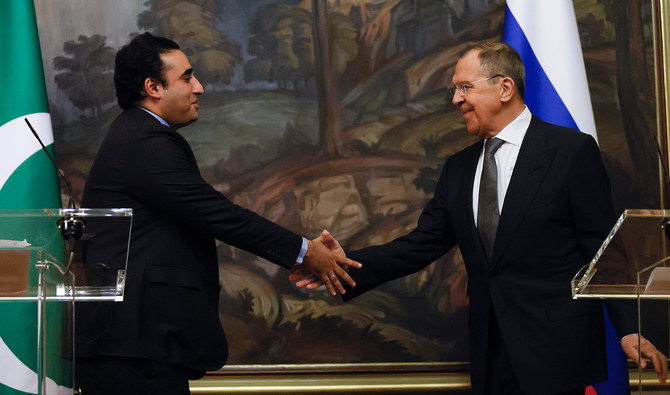
In this photograph, taken on January 30, 2023, Russian Foreign Minister Sergei Lavrov (R) and his Pakistani counterpart Bilawal Bhutto Zardari shake hands as they hold a joint press conference following their talks in Moscow. (AFP/File)
Short Url
Updated 13 June 2023
Follow

Working with Pakistan to shape ‘multipolar world order,’ Russian foreign minister says

  • First cargo of discounted Russian crude oil under deal between Islamabad and Moscow arrived in Karachi on Sunday
  • Discounted crude offers relief to Pakistan, which is facing a payments crisis and is at risk of defaulting on its debt

ISLAMABAD: Russian Foreign Minister Sergey Lavrov has said Moscow was interested in “expanding cooperation” with Pakistan and wanted to work with Islamabad to shape a “more just and democratic multipolar world order.”

Lavrov made the remarks in a video message to Pakistan on Monday on the occasion of the 75th anniversary of diplomatic relations between the two countries and days after the first cargo of discounted Russian crude oil arranged under a deal struck between Islamabad and Moscow arrived in Karachi.

“Our relations are advanced and based on trust,” Lavrov said. “They are founded on the concurrence or proximity of approaches to the key issues of the international agenda. Together with our Pakistani partners, we stand for shaping a more just and democratic multipolar world order.”

“There have been different periods in our relations over the past three quarters of a century. However, Russia has always been interested in expanding cooperation with Pakistan, and under no circumstances has abandoned its commitments.”

Lavrov spoke about the participation of Soviet specialists in the construction of the largest steel mill in Karachi, now called Pakistan Steel Mills, in the 1980s, despite the conflict raging in Afghanistan at the time, as well as the Guddu Thermal Power Plant, then the largest in Pakistan, which was also commissioned then.

The Russian foreign minister said the two countries had also in recent years succeeded in making significant progress in bilateral trade.

“Russia has become a major supplier of wheat to Pakistan, with shipments exceeding one million tons last year,” Lavrov said.

“Negotiations on launching a cooperation project in the oil sector are at their final stage. Together with our Pakistani partners, we stand for shaping a more just and democratic multipolar world order. We respect the cultural and civilizational diversity of peoples and their right to determine the avenues of their political, social and economic development themselves.”

Lavrov said Moscow considered Pakistan a key international partner in joint efforts to combat common security challenges and threats, including transborder crime and terrorism.

On Sunday, Pakistan celebrated the first Russian discounted crude oil cargo arriving in Karachi, which Prime Minister Shehbaz Sharif described as the “beginning of a new relationship between Pakistan and Russian Federation.”
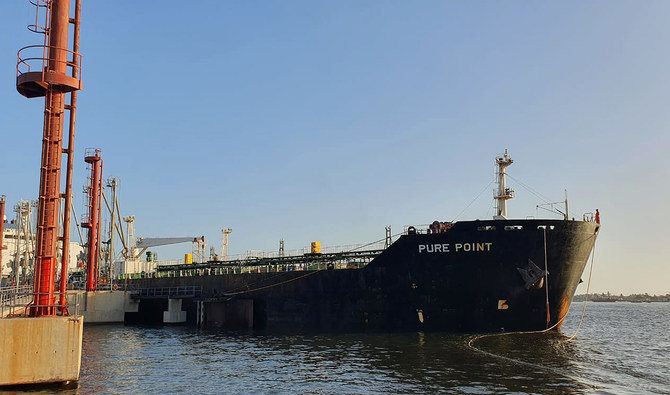


This handout photograph, taken and released by Karachi Port Trust, shows a Russian ship, Pure Point, anchored at the OP2 in Karachi on June 11, 2023, carrying 45,000 metric tons of crude oil. (Photo courtesy: KPT)

The discounted crude offers relief to Pakistan, which is facing a payments crisis and is at risk of defaulting on its debt.

Pakistan's purchase also gives Moscow a new outlet to add to growing sales to India and China, as it redirects oil from Western markets because of the Ukraine conflict.

Despite being a long-standing Western ally and the arch-rival of neighbouring India, which historically is closer to Moscow, analysts say the crude deal presents a new avenue for Pakistan at a time when its financing needs are great.

Islamabad earlier this month also outlined a process to open barter trade with Russia, Afghanistan and Iran, another sign of the South Asian economy seeking avenues to buy and sell commodities without trading in dollars, which analysts say could be a shift from West to East.


Pakistan downs drones near Kohat after Kabul accuses Islamabad of deadly airstrikes

Updated 6 sec ago
Follow

Pakistan downs drones near Kohat after Kabul accuses Islamabad of deadly airstrikes

  • The exchange marks a sharp escalation in a conflict that began last month when Islamabad launched aerial campaign inside Afghanistan
  • Pakistani official says there is just one consistent demand from the Afghan side: ‘stop supporting terrorists, harboring their leadership’

ISLAMABAD: Pakistan on Friday said it had conducted “precision strikes” against militant camps and support infrastructure inside Afghanistan, with the Taliban authorities saying the strikes had hit civilians and damaged infrastructure in capital Kabul and other border provinces. 

The latest exchange marks a sharp escalation in a conflict that began last month when Islamabad launched a sustained aerial campaign inside Afghanistan, saying it was targeting sanctuaries of the Tehreek-e-Taliban Pakistan (TTP), a militant group responsible for a surge in attacks within Pakistan. The Afghan government denies the allegations.

A Pakistani security official confirmed on Friday that the strikes were carried out last night, destroying “four key locations,” including infrastructure of a corps headquarters and an ammunition dump in Kabul, a militant training camp in Kandahar, an oil storage facility in Kandahar, and a militant camp in Paktia. 

“The message is clear: no let-up, no negotiations, and no delegation sent by Pakistan,” the official, who requested anonymity, told Arab News. “There is just one consistent demand from the Afghan Taliban regime: stop supporting terrorists and harboring terrorist leadership or face the consequences.” 

However, the Taliban government said the strikes had hit non-military targets, with Taliban spokesman Zabihullah Mujahid stating on X that the bombardment hit Kabul, Kandahar, Paktia, and Paktika provinces. 

“With the continued airstrikes and crimes, once again the Pakistani military regime has bombed Kabul, Kandahar, Paktia, Paktika, and some other areas, destroying civilian homes in some places, which martyred women and children,” Mujahid said, adding that in some instances, the strikes hit “empty deserts and vacant spots.” 

In Kabul, police spokesman Khalil Zadran told AFP that the strikes killed four people and wounded 15 others, noting that residential homes were among the buildings hit. 

The Taliban further alleged that a strategic fuel depot in the southern city of Kandahar was destroyed.

“The Pakistani military regime’s aircraft set fire to the fuel storage of Kam Air, a private airline company, near Kandahar International Airport. This company supplies fuel to civilian airlines and United Nations aircraft,” Mujahid stated, adding that the “oppression will not go unanswered.” 

In response, the Afghan Ministry of National Defense claimed its Air Force targeted strategic Pakistani military centers in the Kohat area of Khyber Pakhtunkhwa on Friday morning. 

“During the strikes, the Kohat military fort was hit. Additionally, the command center for Durand Line combat operations and the office of the fort’s commander were precisely targeted,” the Afghan Ministry of National Defense said, adding that the strikes caused “heavy human casualties.” 

However, Pakistani security officials disputed the Taliban’s account of a successful strike, stating that the attack involved “rudimentary drones” that were effectively intercepted. 

“Afghan Taliban-backed FAK (TTP) terrorists tried to use three rudimentary drones in Kohat; however, the drones were effectively brought down,” said one official. “Due to falling debris, two civilians were injured.” 

Afghan and Pakistani forces have also clashed repeatedly at the border in recent weeks, hampering trade and forcing nearby residents to leave their homes. Casualty claims from both sides are difficult to verify independently.