

Chinese delegates see Riyadh conference as an opportunity to enhance ties

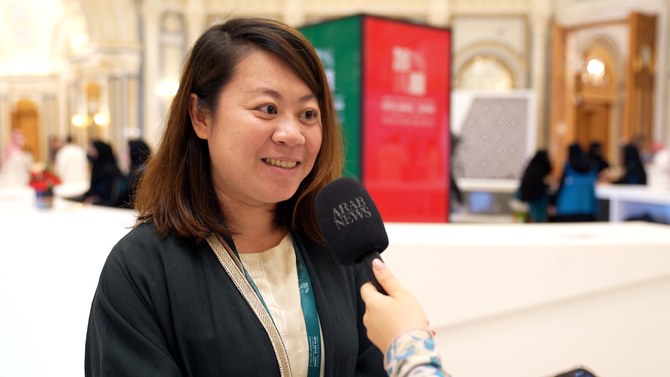
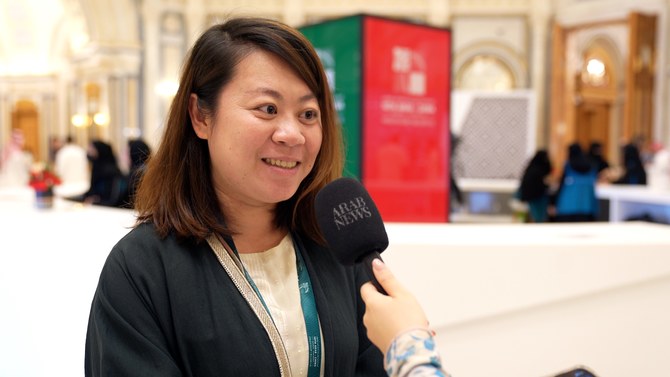
Jessica Wong, managing partner of eWTP Arabia Capital, speaks with Arab News.
Short Url
Updated 11 June 2023
Follow

Chinese delegates see Riyadh conference as an opportunity to enhance ties

RIYADH: Business professionals from China are optimistic that events like the Arab-China Business Conference will help strengthen economic ties between the world’s second-largest economy and the region.

They urged Chinese companies to explore opportunities in the Arab world particularly Saudi Arabia, as the Kingdom is rapidly transforming into an economic powerhouse.

Lin Shunjie, chairman of China International Exhibition Center Group, told Arab News that his visit to the Kingdom had opened doors of new business opportunities between his country and the Arab world.

Lin is among several Chinese businessmen who are in Riyadh to take part in the 10th Arab-China Business Conference that began on Sunday. The two-day event aims to bring China and the Arab world closer by showcasing investment opportunities in the region and serve as a platform to help members of the business communities from both sides meet and share ideas.

Talking to Arab News, Lin said the trade volume between China and the Arab world is steadily increasing. He said strategies should be devised to “encourage Chinese companies to make more investments in the Arab world, particularly in Saudi Arabia.”

The businessman called on both sides to increase cooperation to improve the global supply chain as China and Saudi Arabia and other Arab countries are key global players.

Lin also called on Chinese investors to invest in industrial parks that are being developed in the Kingdom. He said that Chinese companies should take advantage of the privileges being offered at these facilities.

He also emphasized the importance of energy transition and the use of clean energy. Lin was of the view that China and the Arab world can also increase cooperation on renewables as it is a fast-growing sector with huge investment potential.

“The other thing is clean energy. Saudi Arabia and other Arab countries are always on the upstream of the gas and oil supply chain in the world. But I think you can do more with China to improve the added value from the upstream to the middle stream at least, and even to the downstream, which means we should move more production facilities from China to Arab countries.”

Talking to Arab News, Jessica Wong, managing partner of eWTP Arabia Capital, said the number of Chinese companies is rising in the Kingdom.

“In the last three and a half years we successfully brought 18 companies into this market. Most of them actually have already achieved quite successful benchmarks here.”

She added: “We believe that by having a commitment to the local market, by building our trust with our local partners step by step, we will definitely be able to understand what kind of governance (is needed), what kind of structure each of us will be able to develop” for smooth business operations in future.

The eWTP Arabia Capital official stressed the need to make joint efforts and share experiences for a fruitful outcome. “Venture capital, actually, always has been considered as ‘smart money,’” she said.


Free trade negotiations between GCC, India mark new phase of partnership, says sec-gen

Updated 24 February 2026
Follow

Free trade negotiations between GCC, India mark new phase of partnership, says sec-gen

RIYADH: The Gulf Cooperation Council’s secretary-general affirmed that the negotiations for a free trade agreement between the GCC and India, and the signing of the joint statement, represents a new phase of strategic partnership.

Jasem Mohamed Al-Budaiwi said that this contributes to enhancing close cooperation and strengthening economic and trade ties, according to the Saudi Press Agency.

This came during the signing ceremony of the joint statement on launching the free trade agreement negotiations between the Al-Budaiwi and India’s Minister of Commerce and Industry, Piyush Goyal, which took place in New Delhi, on Tuesday.

During the signing ceremony, Al-Budaiwi said that the Terms of Reference, signed on Feb. 5, provide a comprehensive and clear framework for these negotiations. The two nations agreed to discuss enhancing cooperation in vital strategic areas, including trade in goods, customs procedures, and services.

Additionally, the framework covers Sanitary and Phytosanitary measures, intellectual property rights, cooperation on Micro, Small, and Medium Enterprises, along with other topics of mutual interest. This reflects the comprehensive nature of the agreement and its ability to keep pace with the future economy.

Al-Budaiwi expressed hope that these negotiations would lead to a comprehensive and ambitious free trade agreement that works to remove customs and non-customs barriers, enhance the flow of quality investments in both directions, and achieve further liberalization in trade and investment cooperation between the GCC and India for mutual benefit. 

This would provide a stimulating economic environment and an investment climate that opens broad horizons for the business sector, supports supply chains, and accelerates the pace of economic growth in line with the ambitious developmental visions of the GCC states. 

The top official affirmed the full readiness of the General Secretariat to host the first round of negotiations at its headquarters in Riyadh during the second half of this year.

The two sides held a meeting during which they reviewed the existing cooperation relations between the GCC and India and discussed ways to develop and elevate them to broader horizons, serving mutual interests and enhancing opportunities for strategic partnership between the two sides, particularly in the economic, investment, and trade fields.

They praised the role undertaken by the negotiating teams from both sides, appreciating the efforts contributing to reaching a comprehensive agreement that enhances economic integration and supports the smooth flow of trade between the two nations.