

Saudi Arabia wants collaboration not competition with China, says energy minister 

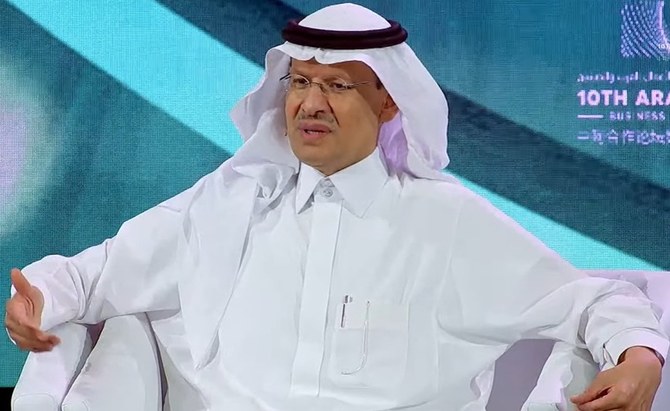
Saudi Energy Minister Prince Abdulaziz bin Salman said the Kingdom seeks collaboration with the world’s second-largest economy instead of competition. (AN Photos)
Short Url
Updated 11 June 2023
Follow

Saudi Arabia wants collaboration not competition with China, says energy minister 

RIYADH: Affirming Saudi Arabia’s existing trade and economic relationship with China, Energy Minister Prince Abdulaziz bin Salman said the Kingdom seeks collaboration with the world’s second-largest economy instead of competition. 

Speaking at the 10th Arab-China Business Conference in Riyadh on Sunday, he said: “I would not be surprised if you will hear more announcements soon on Saudi-Chinese investment.” 

Prince Abdulaziz said there are synergies between the two countries, as the Kingdom is progressing steadily with its Vision 2030 plan, while China is pursuing its Belt and Road Initiative.  

“We do not have to be in a place where we set ourselves in competition with China. We have to set ourselves in a place where we collaborate with China. There are so many things that we want to do with them (China), but equally, they want to do with us. There is a great deal of synergies between the two countries,” the top minister said.  

He categorically said: “I actually ignore” criticism regarding the growing ties between Saudi Arabia and China. 

Prince Abdulaziz said that Saudi Arabia’s business environment is suitable for investors, as it is steadily diversifying its economy.  

“We believe that there are so many global opportunities, as Saudi Arabia is in a pivotal geographical position that could enable us to reach out to so many parties, be engaged, and be involved with everybody. Those who would like to invest with them, we are here. Those who would like to invest with us here, we are also here,” he added.  

During a panel discussion at the two-day event, the energy minister said that the latest agreement of the Organization of the Petroleum Exporting Countries, and its allies, known as OPEC+, included comprehensive reforms.

He added that the alliance is also working against uncertainties within the market.  

“We are working against something called uncertainties and sentiments. And I believe, it is a matter of being in a state of readiness. And that is why we are taking these precautionary measures. It is part of what we call proactive and precautionary (measures),” he said.  

The Saudi minister said: “We and OPEC+ are more interested in doing a regulator’s job.” 

Earlier this month, Saudi Arabia pledged to make a deep cut to its output in July on top of a broader OPEC+ deal to limit supply into 2024 as the group eyes to boost flagging oil prices. 

Saudi Energy Ministry said that the Kingdom’s output would drop to 9 million barrels per day in July from around 10 million bpd in May.  

The minister said the new OPEC+ deal would be rewarding for those who were investing to grow their production capacity. 

“In the final analysis what this agreement will achieve for all of us is that those who invest, not this year, but in the years to come, 2024 and 2025 and moving forward, there will be a recognition for their investment because they will be given higher production allocations.” 


PIF-backed AviLease achieves revenue of $664m and 19% growth in 2025

Updated 27 February 2026
Follow

PIF-backed AviLease achieves revenue of $664m and 19% growth in 2025

RIYADH: Saudi Arabia’s Public Investment Fund-backed AviLease achieved exceptional performance and sustainable business growth during 2025, supported by the strategic expansion of its global platform.

According to its financial results for 2025, AviLease recorded total revenues of $664 million, an annual increase of 19 percent, driven by disciplined growth in its asset portfolio and strong performance in aircraft remarketing amid sustained global demand for modern, fuel-efficient aircraft, the Saudi Press Agency reported.

Profit before tax doubled compared to the previous year, reaching $122 million. The year witnessed an expansion in AviLease’s portfolio, reaching 202 owned and managed aircraft, leased to over 50 airline companies in more than 30 countries. 

The total value of the company’s assets stabilized at $9.3 billion. AviLease maintained a 100 percent fleet utilization rate, reflecting the resilience of its business model, the efficiency of its asset management, and the strength of its strategic relationships with airlines around the world.

AviLease concluded purchase agreements for aircraft from Airbus, including the A320neo family and A350F, and Boeing 737 aircraft, aiming to enhance its future asset portfolio with modern, fuel-efficient aircraft. This step will contribute to supporting future growth and meeting increasing customer demand for the latest aircraft, aligning with the Kingdom’s ambitions to become a leading global aviation hub.

AviLease strengthened its prestigious credit standing by obtaining a strong Baa2 credit ratings from Moody’s and BBB from Fitch, reflecting its financial solidity, managerial discipline, and efficiency in managing leverage. The company also successfully issued senior unsecured bonds worth $850 million last November under Regulation 144A/RegS. This issuance contributed to diversifying its funding sources and enhancing its financial flexibility.

Commenting on the results, AviLease CEO Edward O’Byrne said: “This exceptional performance reflects the quality of the company’s investment portfolio, the strength of its partnerships with airlines, and its strategic focus on responsibly deploying capital into highly sought-after, efficient, modern aircraft assets.”

He added: “As aviation markets continue to grow, AviLease is strategically positioned to continue its expansion plans and deliver sustainable long-term value for shareholders, contributing to the Kingdom’s ambitions.”

Throughout 2025, AviLease continued to play a pivotal role in the Kingdom’s growing aviation sector and contributed directly to the launch and scaling of the new national carrier, Riyadh Air, by completing a sale and leaseback transaction for a Boeing 787-9 aircraft, which thereby became the first aircraft to join the airline’s fleet.

AviLease also established a strategic partnership with Hassana Investment Co. This partnership aims to provide an opportunity for local and international investors to enter the aircraft financing asset class and benefit from AviLease’s technical expertise and operational capabilities to support partnership growth and enhance performance. 

Hassana Investment Co. has agreed to acquire an initial portfolio of 10 modern aircraft from AviLease.