Pakistan army hasn’t yet requested military court trial of ex-PM Khan — law minister

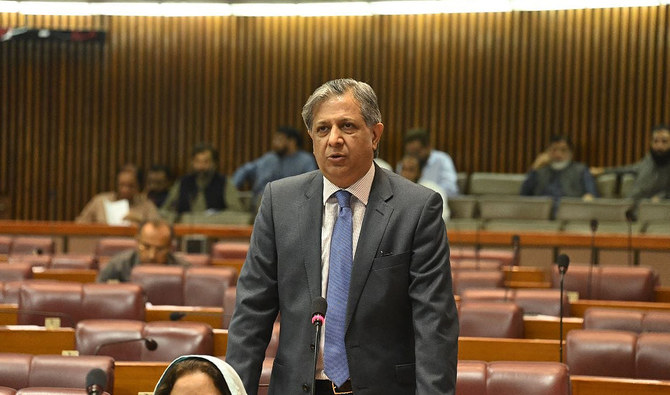
In this handout photograph, taken on May 9, 2023, Pakistan Law Minister Azam Nazeer Tarar gestures during his address at the National Assembly in Islamabad. (Photo courtesy: Twitter/NAofPakistan)
Short Url
Updated 09 June 2023
Follow

Pakistan army hasn’t yet requested military court trial of ex-PM Khan — law minister

  • Law Minister Tarrar says army has so far asked for 70 people for trial by military courts
  • When asked if Khan was among those 70 suspects, law minister said, “Not until today”

ISLAMABAD: Pakistani law minister Azam Nazeer Tarar said in an interview broadcast on Friday that the army had so far not requested that former prime minister Imran Khan be handed to them for a military trial in any of the cases related to attacks on army properties last month.

Since being ousted from the PM’s office in a no-trust vote in April last year, Khan has launched an unprecedented campaign of defiance against the military, which independent analysts say helped him rise and fall from power.

His tensions with the military reached a crescendo last month when Khan was arrested in a land fraud case on May 9, prompting violent nationwide protests in which rioters attacked an air base, military properties, including the army’s headquarters, and burnt a top general’s home. Khan was released on bail four days later but the military has since said it will punish the enactors and masterminds of the violence, including by trying them in military courts under the Army Act and the Official Secrets Act.

In an interview to Urdu News, Law Minister Tarrar said the army had so far asked for 70 people to be handed over for trial before military courts.

When asked if Khan was among these 70 suspects, the law minister said: “Not until today.”

“The decision of where the trial will be held, that is made by the law, this decision will not be the decision of the federal government, it’s not the decision of provincial governments.”

He said cases against Khan related to the violence of May 9 were ongoing, including under the anti-terrorism act.

In a strongly-worded statement released this week and widely seen as a reference to Khan, the army said it was time to tighten the “noose of law” against those who had masterminded the attacks of May 9.

“While the legal trials of perpetrators and instigators have commenced, it is time that noose of law is also tightened around the planners and masterminds who mounted the hate ripened and politically driven rebellion against the state and state institutions to achieve their nefarious design of creating chaos in the country,” the army’s media wing, ISPR, said on Wednesday.

Responding for the first time to widespread accusations that the army was behind a crackdown against Khan, his party and its supporters and carrying out human rights violations, the military called this “fake news and propaganda” that it would defeat with the support of the Pakistani public:

“Unfounded and baseless allegations on Law Enforcement Agencies and Security Forces for custodial torture, human rights abuses and stifling of political activities are meant to mislead the people and malign Armed Forces in order to achieve trivial vested political interests.”


Pakistan’s president defends ongoing strikes in Afghanistan, urges Kabul to dismantle militants

Updated 02 March 2026
Follow

Pakistan’s president defends ongoing strikes in Afghanistan, urges Kabul to dismantle militants

  • Afghanistan on Thursday launched attacks in retaliation for Pakistani airstrikes the previous Sunday
  • Pakistan’s military says it is only targeting Afghan military installations to avoid civilian casualties

ISLAMABAD: Pakistan’s president on Monday defended his country’s ongoing military strikes in neighboring Afghanistan, saying Islamabad tried all forms of diplomacy before targeting militants operating from Afghan territory, and called on the Taliban government in Kabul to disarm groups responsible for attacks in Pakistan.

Pakistan earlier said it is in “open war” with Afghanistan, alarming the international community. The border area remains a stronghold for militant organizations including Al-Qaeda and the Daesh (Islamic State) group.

“(The Afghan Taliban) must choose to dismantle the terror groups that survive on conflict and its war economy,” Asif Ali Zardari said during a speech to lawmakers, adding that “no state accepts serial attacks on its soil.”

Afghanistan on Thursday launched attacks in retaliation for Pakistani airstrikes the previous Sunday. Since then, Pakistan has carried out operations along the border, with Information Minister Attaullah Tarar claiming the killing of 435 Afghan forces and the capture of 31 Afghan positions.

Kabul has denied such claims.

In Afghanistan, the deputy government spokesman Hamdullah Fitrat said Pakistan’s military fired mortar shells at a refugee camp in eastern Kunar province, killing three children and injuring three others.

Afghanistan’s defense ministry said Afghan forces carried out strikes targeting a Pakistani military facility near Paktia province, causing “substantial losses and heavy casualties.”

Pakistan’s military did not respond to questions. It has said Pakistan is only targeting Afghan military installations to avoid civilian casualties.

Pakistan has witnessed a surge of violence in recent months and blames it on the outlawed Pakistani Taliban, known as Tehreek-e-Taliban Pakistan or TTP. It operates both inside Pakistan and from Afghan territory.
Islamabad accuses Afghanistan’s Taliban government of providing safe havens for the TTP, which Kabul denies.

The latest cross-border fighting ended a ceasefire brokered by Qatar and Turkiye in October. The two sides failed to reach a permanent agreement during talks in Istanbul.

Zardari reiterated Pakistan’s call for talks, saying, “We have never walked away from dialogue.”

The Pakistani leader again accused Afghanistan of acting as a proxy for India by sheltering militant groups.

“Stop being used by another country as a battlefield for their ambitions,” he said.

Zardari cited a recent report from the United Nations Security Council’s monitoring team that described the presence of militant groups in Afghanistan as an extra-regional threat.