

Amid attacks on vaccinators, health authorities detect poliovirus in Pakistani megacity

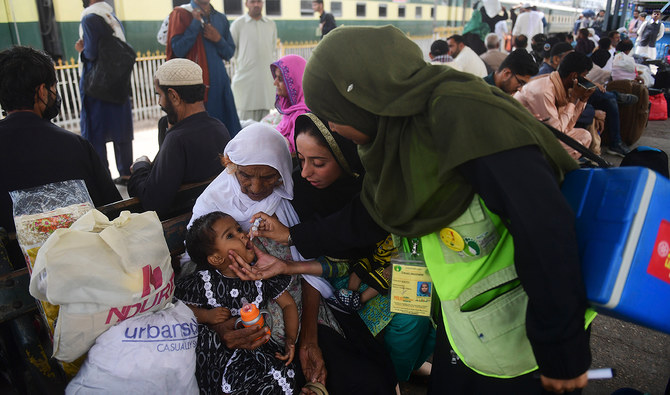
A health worker administers polio vaccine drops to a child at a railway station during a vaccination campaign in Karachi on March 14, 2023. (Photo courtesy: AFP)
Short Url
Updated 09 June 2023
Follow

Amid attacks on vaccinators, health authorities detect poliovirus in Pakistani megacity

  • Polio has no cure, repeated vaccination is most effective remedy against it
  • Pakistan and Afghanistan remain the only two endemic countries in the world

ISLAMABAD: Officials have detected poliovirus in an environmental sample collected from the southern Pakistani city of Karachi, health authorities said on Thursday, amid attacks targeting anti-polio vaccinators in the South Asian country.

Polio is a highly infectious and incurable disease caused by the poliovirus, which mainly affects children under the age of five. The virus invades the nervous system and can cause paralysis or even death in some cases.

Pakistan’s National Polio Laboratory at the National Institute of Health (NIH) in Islamabad confirmed the detection of Type-1 Wild Poliovirus (WPV1) in an environmental sample collected from Karachi’s East district in May 2023.

“The environmental (sewage) sample was collected on 15th May 2023 from the ‘Sohrab Goth” environmental sample collection site. This is the first positive environmental sample from Karachi Division this year,” the NIH said in a statement.

Previous positive sample from Karachi Division was collected in August 2022 (from “Landhi” environmental sample collection site in District Malir). The last Wild Poliovirus case from Karachi East was reported in September 2018.”

The genetic sequencing results of the sample are under process, while a polio vaccination campaign in the district was conducted on 15– 21 May, according to the statement.

Attempts to eradicate polio in Pakistan have been hit by attacks targeting inoculation teams that have claimed hundreds of lives in over a decade.

Late last month, a Pakistani soldier was killed when militants opened fire on a polio vaccination team, while a policeman guarding vaccinators was shot dead in the country’s southwest on May 19.

The crippling disease has no cure and repeated vaccination is the most effective way to protect children against it. To date, the polio vaccine has protected millions of children, allowing almost all countries in the world to become polio-free.

Pakistan and Afghanistan remain the only two endemic countries in the world.


World Bank approves $700 million for Pakistan’s economic stability

Updated 6 sec ago
Follow

World Bank approves $700 million for Pakistan’s economic stability

  • Of this, $600 million will go for federal programs and $100 million will ⁠support a provincial program in Sindh
  • The results-based design ensures that resources are only disbursed once program objectives are achieved

ISLAMABAD: The World Bank has approved $700 million in ​financing for Pakistan under a multi-year initiative aimed at supporting the country’s macroeconomic stability and service delivery, the bank said on Friday.

The funds will be released under the bank’s Public ‌Resources for Inclusive ‌Development — Multiphase ‌Programmatic ⁠Approach (PRID-MPA) that ‌could provide up to $1.35 billion in total financing, according to the lender.

Of this amount, $600 million will go for federal programs and $100 million will ⁠support a provincial program in ‌the southern Sindh province. The results-based design ensures that resources are only disbursed once program objectives are achieved.

“Pakistan’s path to inclusive, sustainable growth requires mobilizing more domestic resources and ensuring they are used efficiently and transparently to deliver results for people,” World Bank country director Bolormaa Amgaabazar said in a statement.

“Through this MPA, we are working with the Federal and Sindh governments to deliver tangible impacts— more predictable funding for schools and clinics, fairer tax systems, and stronger data for decision‑making— while safeguarding priority social and climate investments and strengthening public trust.”

The approval ‍follows a $47.9 ‍million World Bank grant ‍in August to improve primary education in Pakistan’s most populous Punjab province.

In November, an IMF-World Bank ​report, uploaded by Pakistan’s finance ministry, said Pakistan’s fragmented ⁠regulation, opaque budgeting and political capture are curbing investment and weakening revenue.

Regional tensions may surface over international financing for Pakistan. In May, Reuters reported that India would oppose World Bank funding for Pakistan, citing a senior government ‌source in New Delhi.

“Strengthening Pakistan’s fiscal foundations is essential to restoring macroeconomic stability, delivering results and strengthening institutions,” said Tobias Akhtar Haque, Lead Country Economist for the World Bank in Pakistan.

“Through the PRID‑MPA, we are launching a coherent nationwide approach to support reforms that expand fiscal space, bolster investments in human capital and climate resilience, and strengthen revenue administration, budget execution, and statistical systems. These reforms will ensure that resources reach the frontline and deliver better outcomes for people across Pakistan with greater efficiency and accountability.”

In Sindh, the program is expected to increase provincial revenues, enhance the speed and transparency of payments, and broaden the use of data to guide provincial decision making. The program will directly support the increase of public resources for inclusive development, including more equitable and responsive financing for primary health care facilities and more funding for schools.