

Palestinian journalist seriously wounded by rubber bullet

Short Url
Updated 09 June 2023
Follow

Palestinian journalist seriously wounded by rubber bullet

RAMALLAH: Moamen Sumreen, 22, a Palestinian journalist who was covering the Israeli raid, was seriously wounded after being hit in the head by a rubber bullet, his family told AFP.

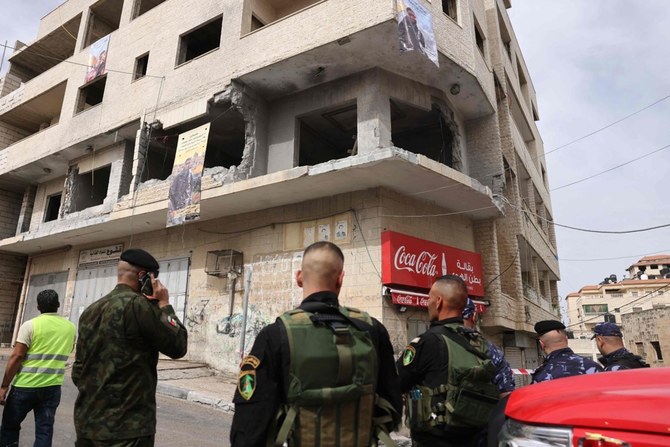
Israeli troops on Thursday demolished the West Bank home of a Palestinian accused of carrying out twin bombings in Jerusalem last November that killed two Israelis, including a teenager.
His uncle Mohammed Sumreen, also a journalist, said they had been among a group of reporters watching events unfold from the roof of a nearby building.
“Throughout the coverage, the soldiers were shining laser lights on us, targeting us with gas bombs and firing live bullets in our direction,” he said.
“Moamen wanted to change his position, he stood up and was directly hit by a bullet in the area under the ear,” he said, noting that Sumreen was wearing a jacket marked “press” when he came under fire.
The Israeli army said that the incident was “under review.”

The army used explosives to make the first floor apartment in Ramallah where Aslam Faroukh lived uninhabitable, an AFP journalist reported.
Faroukh was arrested in December and accused of carrying out the November 23 bombings at Jerusalem bus stops that killed a 15-year-old Israeli-Canadian and an Israeli in his 50s. They were the first bombings to have targeted Israeli civilians since 2016.

“The home was demolished after an appeal to the Supreme Court against the demolition was rejected,” the army said in a statement.

Originally from Israeli-annexed east Jerusalem, where he held an Israeli residency permit, Faroukh had lived in Ramallah for some years.
According to the army, he is alleged to have acted alone, “identifying with the Daesh (Daesh group) organization.”
Israel, which has occupied the West Bank since 1967, routinely demolishes the homes of individuals it blames for deadly attacks on Israelis.
Human rights activists say the policy amounts to collective punishment, as it can render non-combatants, including children, homeless.
But Israel says the practice is effective in deterring some Palestinians from carrying out attacks.
Faroukh’s mother, Um Aslam, told AFP that the demolition would only “increase their hatred and (desire for) revenge.”


Israel arrests 2 Turkish CNN journalists over live broadcast outside IDF HQ

Updated 03 March 2026
Follow

Israel arrests 2 Turkish CNN journalists over live broadcast outside IDF HQ

  • Police said reporter Emrah Cakmak and cameraman Halil Kahraman were detained on suspicion of filming a sensitive security facility
  • Since the Gaza war began, restrictions have expanded significantly, including tighter limits on filming soldiers on duty and sensitive or strategic sites

LONDON: Israeli police have arrested two Turkish CNN journalists who were broadcasting live outside the Israel Defense Forces’ headquarters in Tel Aviv.

Police said the pair were detained on suspicion of filming a sensitive security facility, according to the Israel Police Spokesperson’s Unit.

Reporter Emrah Cakmak and cameraman Halil Kahraman, from the network’s Turkish-language channel, had been reporting near the IDF’s Kirya military headquarters on Tuesday after Iran launched another missile barrage at Tel Aviv and other parts of central Israel.

During the live broadcast, two men believed to be soldiers approached the crew and seized the reporter’s phone, according to initial reports and a video circulating online that could not be independently verified.

Police said officers were dispatched after receiving reports of two people carrying cameras and allegedly broadcasting in real time for a foreign outlet.

Israel’s long-standing military censorship system, overseen by the IDF Military Censor, has long barred journalists and civilians from publishing material deemed harmful to national security.

Since the Gaza war began, restrictions have expanded significantly, including tighter limits on filming soldiers on duty and sensitive or strategic sites.

After a series of similar incidents involving foreign media — most of them Palestinian citizens of Israel working for Arab-language and international media, along with foreign journalists — during the 12-Day War, Israeli police halted live international broadcasts from missile impact sites, citing concerns that exact locations were being revealed.

The Government Press Office later imposed a blanket ban on live coverage from crash and impact areas.

Communications Minister Shlomo Karhi and National Security Minister Itamar Ben-Gvir subsequently ordered that all foreign journalists obtain prior written approval from the military censor before broadcasting — live or recorded — from combat zones or missile strike locations.

Police said that when officers asked the CNN Turk crew to identify themselves, they presented expired press cards and were taken in for questioning.

Burhanettin Duran, head of Turkiye’s Directorate of Communications, condemned the arrests as an attack on the press and said Ankara is working to secure the journalists’ release.