

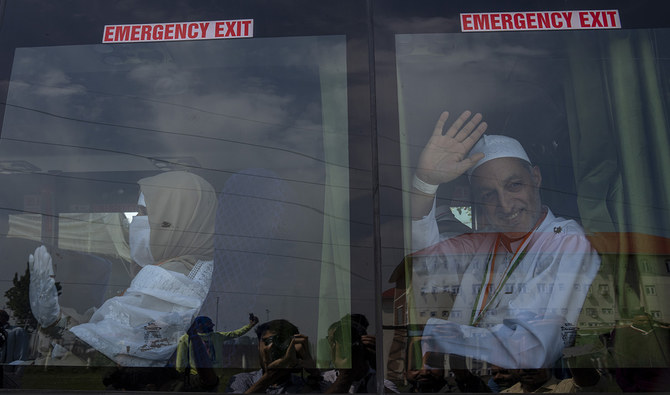
First batch of 630 pilgrims from Indian-administered Kashmir leaves for Hajj

Kashmiri Muslim pilgrims wave from a bus as they depart for Saudi Arabia to perform the annual hajj pilgrimage, in Srinagar on June 7, 2022. (AP)
Short Url
Updated 07 June 2023
Follow

First batch of 630 pilgrims from Indian-administered Kashmir leaves for Hajj

  • Out of India’s Hajj quota of 1,75,025 pilgrims, 12,000 departing from Kashmir region
  • This year’s contingent is the region’s largest-ever embarking on the spiritual journey

NEW DELHI: The first batch of 630 pilgrims from Indian-administered Kashmir performing Hajj this year left for Saudi Arabia on Wednesday from Srinagar airport, an official from the region’s Hajj authority said.

Out of India’s annual Hajj quota of 1,75,025 pilgrims, 12,000 will be departing from the Himalayan region, nearly double Kashmir’s Hajj contingent last year and the region’s largest-ever group embarking on the spiritual journey that is one of the five pillars of Islam.

Special Hajj flights from India started in the last week of May.

“We have the highest quota this year,” Safina Baig, chairperson of the Jammu and Kashmir Haj Committee, told Arab News after 630 pilgrims departed for Jeddah from Kashmir’s main airport in Srinagar.

“It was an emotional scene with many feeling overwhelmed by the opportunity to perform Hajj in their lifetime.”

Most pilgrims were selected through a draw, except for the elderly and women traveling without a mahram, or male guardian.

“Generally, the selection process happens through draw but as a special gesture we are allowing single women and people above 70 to apply directly without going through the process of draw,” Baig said.

Special arrangements had been made by the Indian government for women traveling without a mahram, she said, including separate accommodation and women helpers.

“By Allah’s grace, I got the opportunity to travel alone to perform Hajj,” said Shamima Akhter, 56, a widow from the southern Pulwama district of Kashmir, who is among 120 Kashmiri women pilgrims traveling to Saudi Arabia alone.

“This is a good decision to allow single women to travel.”

Akhter’s three daughters helped her raise about $5,000 to pay for her Hajj package, which is around $1,000 more expensive for Kashmir compared with other regions of India.

Baig said she had raised the issue of the higher cost with the Ministry of Minority Affairs and the Haj Committee of India.

“What I understand is that the rise in the total expenses is due to higher prices of air fare from Kashmir,” she said. 

“Kashmir is a Muslim majority region, and the government should be more considerate … I feel that the government should provide some relief to the Kashmiri Hajis. It sends a good message.”


Terror at Friday prayers: Witnesses describe blast rocking Islamabad mosque

Updated 40 min 15 sec ago
Follow

Terror at Friday prayers: Witnesses describe blast rocking Islamabad mosque

  • The Daesh group has claimed responsibility for the attack, according to the SITE Intelligence Group, which monitors jihadist communications

ISLAMABAD: A worshipper at the Shiite mosque in Islamabad where dozens of people were killed in a suicide blast on Friday described an “extremely powerful” explosion ripping through the building just after prayers started.
Muhammad Kazim, 52, told AFP he arrived at the Imam Bargah Qasr-e-Khadijatul Kubra mosque shortly after 1:00 p.m. (0800 GMT) on Friday and took up a place around seven or eight rows from the Imam.
“During the first bow of the Namaz (prayer ritual), we heard gunfire,” he told AFP outside the Pakistan Institute of Medical Sciences (PIMS) hospital, where many of the wounded were brought for treatment.
“And while we were still in the bowing position, an explosion occurred,” he said.
Kazim, who is from Gilgit-Baltistan in northern Pakistan and lives in Islamabad, escaped unharmed, but accompanied his wounded friend to the PIMS hospital for treatment.
“It was unclear whether it was a suicide bombing, but the explosion was extremely powerful and caused numerous casualties,” Kazim said.
“Debris fell from the roof, and windows were shattered,” he added. “When I got outside, many bodies were scattered... Many people lost their lives.”

People mourn the death of their relatives following a suicide bombing at a Shiite mosque, outside a hospital in Islamabad on February 6, 2026. (AFP)

The Daesh group has claimed responsibility for the attack, according to the SITE Intelligence Group, which monitors jihadist communications.
Another worshipper, Imran Mahmood, described a gunfight between the suicide bomber, a possible accomplice and volunteer security personnel at the mosque.
“The suicide attacker was trying to move forward, but one of our injured volunteers fired at him from behind, hitting him in the thigh,” Mahmood, in his fifties, told AFP.
“He fell but got up again. Another man accompanying him opened fire on our volunteers,” he said, adding the attacker “then jumped onto the gate and detonated the explosives.”
As of Saturday morning, the death toll stood at 31, with at least 169 wounded.
The attack was the deadliest in the Pakistani capital since September 2008, when 60 people were killed in a suicide truck bomb blast that destroyed part of the five-star Marriott hotel.

Shiite Muslims demand adequate security from the government during an impromptu protest outside a hospital following a suicide bombing at a Shiite mosque in Islamabad on February 6, 2026. (AFP)

Lax security

Describing the aftermath of the attack, Kazim said unhurt worshippers went to the aid of those wounded.
“People tried to help on their own, carrying two or three bodies in the trunks of their vehicles, while ambulances arrived about 20 to 25 minutes later,” he told AFP.
“No one was allowed near the mosque afterwards.”
Kazim, who has performed Friday prayers at the mosque “for the past three to four weeks,” said security had been lax.
“I have never seen proper security in place,” he told AFP.
“Volunteers manage security on their own, but they lack the necessary equipment to do it effectively,” he said.
“Shiite mosques are always under threat, and the government should take this seriously and provide adequate security,” he added.