

Pakistan Hajj flight operation to Madinah ends, flights to Jeddah continue

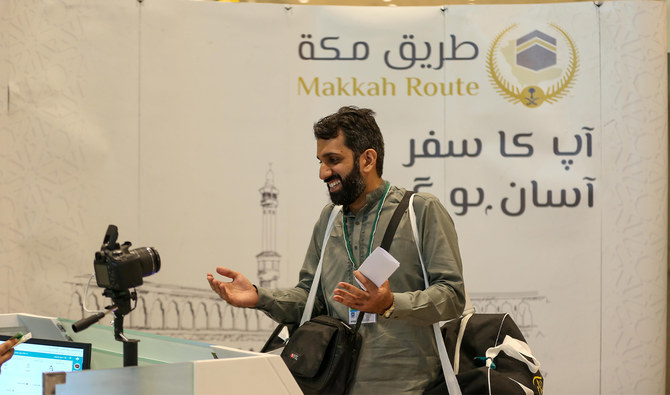
The picture posted on June 7, 2023 shows a Pakistani pilgrim at the immigration counter under Route to Makkah initiative at Islamabad International Airport. (SPA)
Short Url
Updated 07 June 2023
Follow

Pakistan Hajj flight operation to Madinah ends, flights to Jeddah continue

  • Over 46,000 Pakistanis pilgrims have reached Saudi Arabia since May 22
  • 30,000 Pakistani pilgrims are in Makkah while 16,000 are in Madinah

ISLAMABAD: Pakistan’s religious affairs ministry said on Wednesday the country’s Hajj flight operations to Madinah had ended, while flights carrying pilgrims to Jeddah en route to Makkah would continue until June 21. 

Pakistan launched a special flight operation for aspiring Hajjis on May 22. The first group of flights were directed to Madinah, where people performing Hajj under the government scheme spent approximately eight days before traveling onwards to Makkah. Flights to Jeddah started this week.

This January, Saudi Arabia reinstated Pakistan’s pre-pandemic Hajj quota, allowing 179,210 pilgrims from the South Asian country to participate in the annual Islamic religious ritual. The kingdom also removed the upper age limit of 65 years.

Out of Pakistan’s total Hajj quota, approximately 80,000 pilgrims will undertake the spiritual journey through a government scheme, while the remaining are using private tour operators.

“The series of flights from Pakistan to Madinah has ended,” the religious affairs ministry said in a statement released on Wednesday. “All government Hajj flights will now land in Jeddah until June 21.”

“The arrival of private Hajj scheme pilgrims has also begun, with more than 3,000 pilgrims reaching Makkah.” 

So far, over 46,000 Pakistani pilgrims have already arrived in the kingdom, with approximately 30,000 of them in Makkah and 16,000 in Madinah.

On Tuesday, the government announced the establishment of a central control room in Makkah, overseen by its Hajj mission.

“The control room will manage transportation from Jeddah airport to Makkah, as well as other logistics in Makkah and Madinah such as residence management, medical facilities, food, and other necessities,” Muhammad Umer Butt, a ministry spokesperson, told Arab News from Saudi Arabia.

The government has also made other special arrangements, including the establishment of two hospitals and twelve dispensaries in Makkah and Madinah, to ensure the well-being of pilgrims.


Pakistan urges pilgrims to complete Saudi biometrics as Hajj preparations gain pace

Updated 30 January 2026
Follow

Pakistan urges pilgrims to complete Saudi biometrics as Hajj preparations gain pace

  • Government warns pilgrims biometric verification is required for Hajj visas
  • Step follows tighter oversight after last year’s Hajj travel disruptions

ISLAMABAD: Pakistan’s government on Friday urged aspiring pilgrims to complete mandatory Saudi biometric verification for Hajj visas, as preparations for the 2026 pilgrimage gather pace following stricter oversight of the Hajj process.

The announcement comes only a day after Pakistan’s Religious Affairs Minister Sardar Muhammad Yousuf said regulations for private Hajj operators had been tightened, reducing their quota following widespread complaints last year, when tens of thousands of pilgrims were unable to travel under the private Hajj scheme.

“Saudi biometric verification is mandatory for the issuance of Hajj visas,” the Ministry of Religious Affairs said in a statement, urging pilgrims to complete the process promptly to avoid delays.

“Hajj pilgrims should complete their biometric verification at home using the ‘Saudi Visa Bio’ app as soon as possible,” it added.

The statement said the pilgrims who were unable to complete biometric verification through the mobile application should visit designated Saudi Tasheer centers before Feb. 8, adding that details of the centers were available on Pakistan’s official Hajj mobile application.

Pakistan has been steadily implementing digital and procedural requirements for pilgrims ahead of Hajj 2026, including mandatory training sessions, biometric checks and greater use of mobile applications, as part of efforts to reduce mismanagement.

Saudi Arabia has allocated Pakistan a quota of 179,210 pilgrims for Hajj 2026, with the majority of seats reserved under the government scheme and the remainder allocated to private tour operators.
