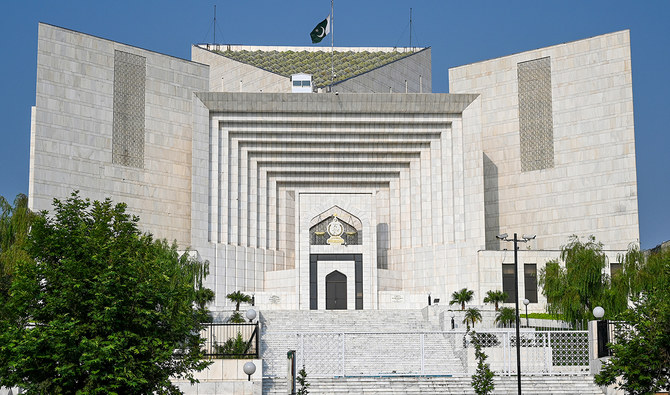

ISLAMABAD: Pakistan’s top court has ruled this week that discrimination against people on the basis of their gender at the workplace is also a form of harassment as the relevant law is not just confined to sexual behavior.
Cases related to harassment of women at the workplace are common in Pakistan, and according to the Islamabad-based non-profit organization, Alliance Against Sexual Harassment, about 93 percent of Pakistani working women, in both private and public sectors, acknowledge facing some kind of harassment in professional settings.
Moreover, the 2022 report of Pakistan’s Federal Ombudsman Secretariat for Protection Against Harassment at Workplace states that from 2018 to 2022, there were 2,169 complaints of harassment filed in the government sector, 582 lodged by women and 148 by men. In the private sector, there were 994 complaints from women and 445 by men.
The Pakistani parliament ratified the Protection against Harassment of Women at the Workplace (Amendment) Act, 2022 as a law in January 2022. The amended law expanded the definition of workplace harassment, giving protection to informal workers, students, and freelancers, and redefining the workplace, among others.
Based on the upgraded law, a three-member Supreme Court bench, led by Justice Yahya Afridi and comprising Justices Muhammad Ali Mazhar and Ayesha Malik, heard a review petition against a 2021 judgment related to workplace harassment which had been passed by the court in 2019.
“The purpose of harassment laws is to address gender-based discrimination at the workplace and not to limit it to sexual forms of harassment,” a 14-page judgment, authored by Justice Malik and uploaded on the website of the top court on Tuesday, said.
The judgment added that the law included a broad range of conduct and behavior that results in workplace-related problems with serious consequences, one of the main being gender inequality.
“Being an issue grounded in equal opportunity and equal treatment of men and women in matters of employment, sexual harassment in any form violates the dignity of a person as it is a demeaning practice that aims to reduce the dignity of an employee who has been forced to endure such conduct,” it said.
“Sexual harassment as gender-based discrimination is gender-based hostility, which creates a hostile work environment. It is a reflection of the unequal power relations between men and women which translates into a form of abuse exploitation and intimidation at the workplace which makes it a violation of a basic human right.”
In view of the definition of workplace harassment, the court ruled that a 2021 judgment of the Islamabad High Court appeared to have “an error” owing to the interpretation of harassment displayed by the court, the definition of which was “patently against the Act and its statement of objects.”
“Both the president [of the country] and the Islamabad High Court decided the case of [complainant] Nadia Naz on the understanding that harassment means sexual harassment having a sexual nature and form and did not examine the facts in the context of Nadia Naz’s perspective and her understanding of the injury caused,” the judgment read.
The court observed that in cases of harassment, the victim’s perspective on the issue was relevant.
“The standard of a reasonable woman should be considered to determine whether there was harassment, which rendered the workplace hostile and all relevant factors should be viewed objectively and subjectively,” it added.
“In doing so, the order of the president and the judgment of the high court had failed to give due emphasis on the injury claimed and the harmful nature of the events to the complainant.”
Under the circumstances, since harassment was understood in a limited context, it said, both the order as well as the judgment decided the cases on a mistaken understanding of the law,” the verdict said while setting aside the previous orders.