

FM Bhutto-Zardari calls for transforming Pakistan, Iraq ties into partnership

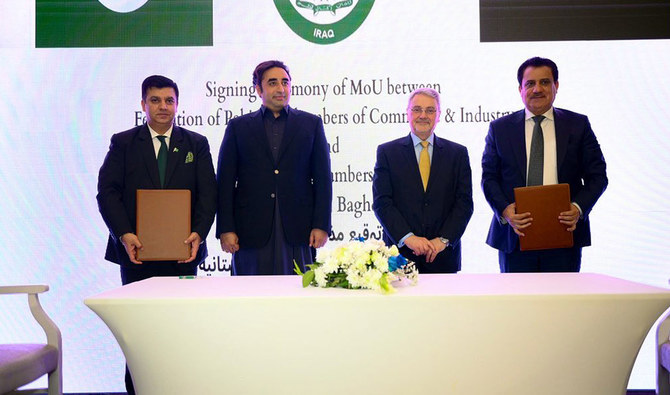
Pakistan’s Foreign Minister Bilawal Bhutto-Zardari (2nd left) attending the MoU signing ceremony between Federation of Chambers of Commerce & Industry of Pakistan and Iran on June 5, 2023 in Baghdad, Iran. (Photo courtesy: @ForeignOfficePk/Twitter)
Short Url
Updated 06 June 2023
Follow

FM Bhutto-Zardari calls for transforming Pakistan, Iraq ties into partnership

  • Relations between Pakistan and Iraq have received a boost with a number of ministerial-level exchanges in recent years 
  • In August last year, Iraq’s Foreign Minister Dr. Fuad Hussein visited Islamabad to discuss ways to strengthen bilateral ties 

ISLAMABAD: Pakistan’s Foreign Minister Bilawal Bhutto-Zardari, who is on a three-day visit to Iraq, has stressed the need to enhance cooperation between the two countries, Pakistani state media reported on Tuesday. 

The foreign minister attended Pakistan-Iraq Business Forum in Baghdad and a ceremony for the signing of a memorandum of understanding (MoU) between the Pakistani and Iraqi federations of chambers of commerce and industry. 

“There is immense potential to increase trade and economic cooperation between Pakistan and Iraq,” the state-run Radio Pakistan broadcaster reported. 

“Both the countries need to transform the fraternal relationship into a partnership.” 
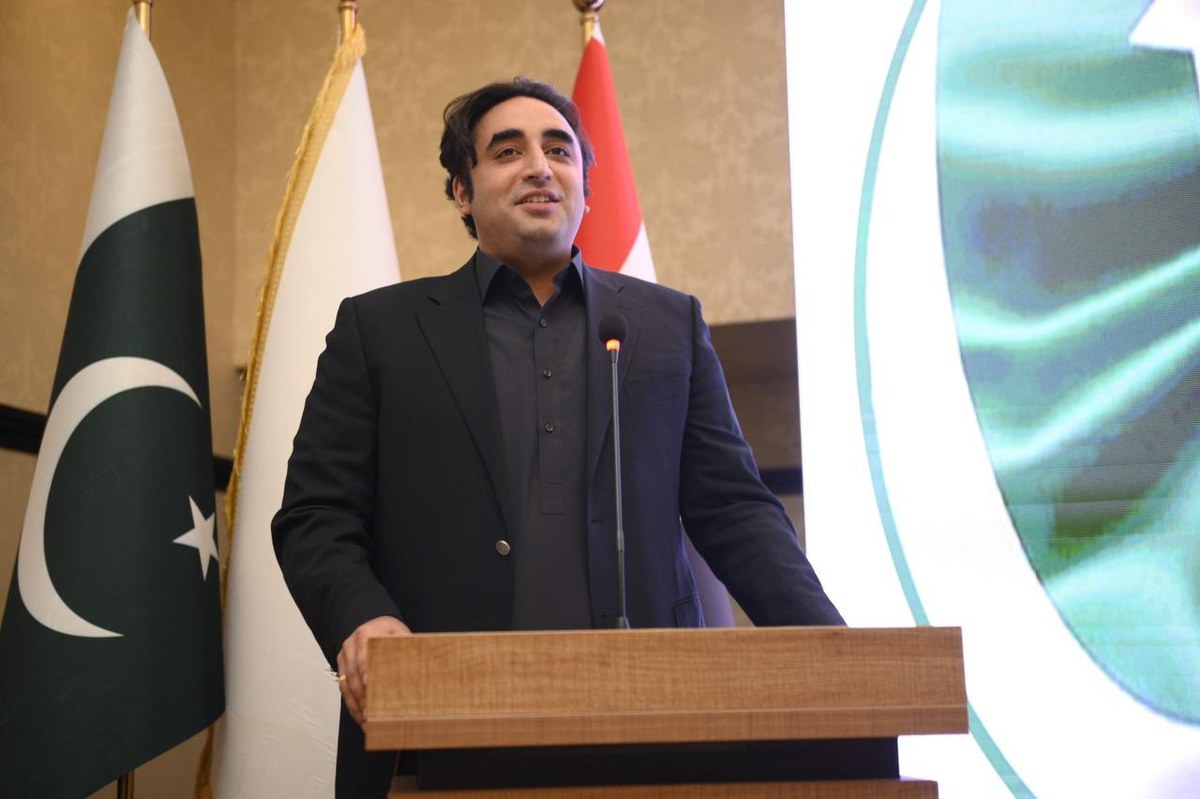


Pakistan's Foreign Minister Bilawal Bhutto-Zardari addresses Pakistan-Iraq Business Forum in Baghdad, Iraq, on June 6, 2023. (Foreign Office of Pakistan)

Pakistan would cooperate with Iraq in all fields, especially with business communities, to benefit from trade and investment opportunities, he assured. 

The two sides signed a memorandum of understanding on this occasion. 

“The MoU will facilitate linkages between business community of both countries,” the Pakistani foreign office said. 

Bhutto-Zardari arrived in Baghdad on a three-day visit Monday morning. During the visit, the foreign minister has held meetings with the Iraqi leadership and will lay the foundation stone of Pakistan’s own embassy building in Iraq, according to the Pakistani foreign office. 

On Monday, Pakistan and Iraq signed agreements to enhance cultural cooperation and abolish visas on diplomatic passports of both countries. 
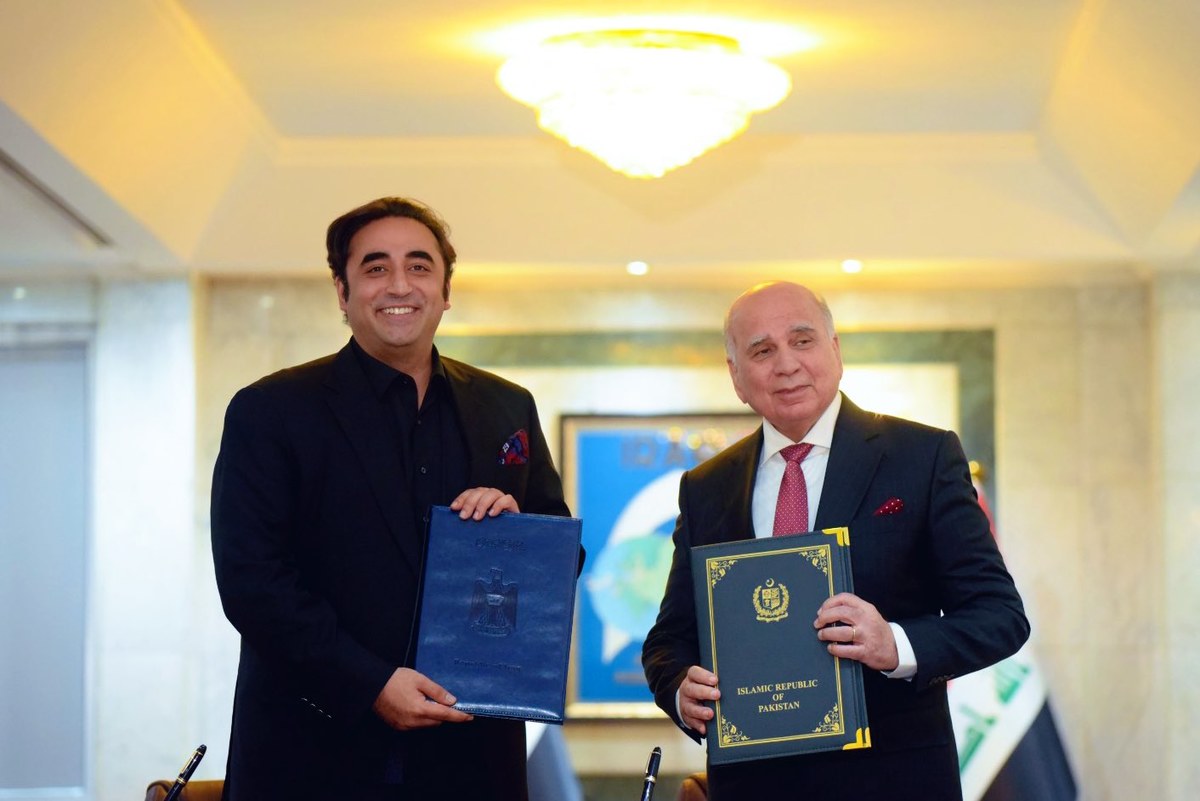


Iraqi Foreign Minister Fouad Hussein, right, and his Pakistani counterpart Bilawal Bhutto Zardari pose for a picture in Baghdad, Iraq, on June 6, 2023. (@BBhuttoZardari/Twitter)

Relations between Pakistan and Iraq have received a boost with a number of ministerial-level exchanges in recent years. 

In August last year, Iraq’s Foreign Minister Dr. Fuad Hussein visited Islamabad to discuss ways to strengthen bilateral relations. 


Pakistan to maintain hard line on Afghanistan after strikes as Taliban vows military response

Updated 5 sec ago
Follow

Pakistan to maintain hard line on Afghanistan after strikes as Taliban vows military response

  • Islamabad blames Afghanistan’s ‘guerrilla mindset’ for escalating tensions between the two countries
  • Afghan Taliban spokesperson denies militant presence in his country, accuses Pakistan of hitting civilians

ISLAMABAD: Pakistan vowed on Wednesday to continue its current policy toward Afghanistan unless the Taliban leadership abandons its “guerrilla mindset,” days after Islamabad carried out airstrikes inside Afghan territory, sharply escalating tensions between the two neighbors once again.

Pakistan conducted intelligence-based strikes overnight into Sunday in Afghanistan’s eastern Nangarhar and southeastern Paktika provinces, saying it had targeted camps of the banned Tehreek-e-Taliban Pakistan (TTP), its affiliates and Daesh-linked fighters.

Islamabad has long accused Kabul of allowing militant groups to use Afghan soil to launch attacks on Pakistani civilians and security forces, a charge the Taliban deny. The two sides also clashed in October last year, leading Pakistan to close key border crossings for bilateral and transit trade.

State Minister for Interior Talal Chaudhry told Geo News that Pakistan had attempted dialogue but would now persist with practical measures if the Taliban failed to change course.

“They call themselves a state, but they have not yet emerged from their guerrilla mindset,” he said.

“Now, with the practical steps we are taking, we want to change their behavior and see them in the form of a state,” he added.

Pakistan blamed a string of recent suicide bombings in Islamabad, Bajaur and Bannu on militants operating from Afghan territory before launching the latest strikes.

Chaudhry said Afghanistan had been acting like “an irresponsible neighbor,” warning that his country’s current approach would continue if attacks inside Pakistan persisted.

“This war will be won, and all this will end,” he said. “If it is not resolved the straight way, then it will be completely ended by a hard-line approach.”

Meanwhile, Kabul has condemned the airstrikes as violations of its sovereignty and said civilians were killed.

In an interview with Al Arabiya, Taliban government spokesman Zabihullah Mujahid also pledged to respond militarily.

“It would be a military response, but its details are confidential and I cannot explain further,” he said.

Mujahid rejected Pakistan’s allegations that TTP or Daesh militants operate from Afghan soil, saying security problems inside Pakistan were domestic in nature.

“Afghan soil is not allowed to be used against anyone,” he said, adding that Kabul had carried out extensive operations against Daesh and eliminated its presence in Afghanistan.

The 2,600-kilometer border between the two countries remains a vital trade and transit route, but crossings have faced repeated closures amid rising tensions, disrupting commerce and humanitarian movement.

Several regional countries, including Saudi Arabia, Türkiye and Qatar, have sought to mediate between the two countries, though their military exchanges risk further destabilizing their ties.