Saudi Arabia’s first sustainable guarantee issued to green hydrogen project at NEOM

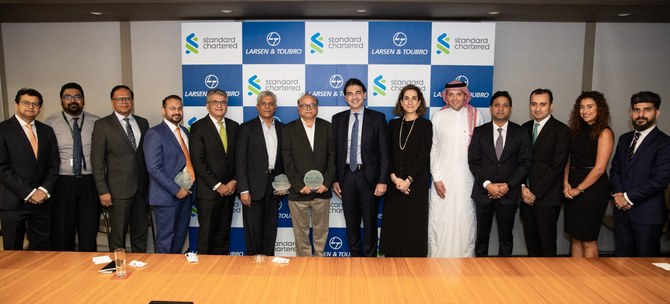
Standard Chartered said the sustainable guarantee will ensure that L&T receives the necessary financial support for the development of the wind and solar farms to support the green hydrogen generation in this project while meeting the bank’s environmental, social and governance standards. (Supplied)
Short Url
Updated 06 June 2023
Follow

Saudi Arabia’s first sustainable guarantee issued to green hydrogen project at NEOM

RIYADH: Saudi Arabia’s green hydrogen project being developed at NEOM received the Kingdom’s first sustainable guarantee from the British bank Standard Chartered, which agreed to extend funding support for its contractor Larsen & Toubro to build the necessary renewable energy infrastructure. 

Located at Oxagon, the world’s largest green hydrogen plant is being built by NEOM Green Hydrogen Co., which is an equal joint venture between ACWA Power, Air Products and the $500-billion giga-project.

Sustainable guarantees are issued by lending agencies for green projects that make positive contributions to the environment. 

The megaplant will produce green hydrogen at scale for global export in the form of green ammonia with a total investment of $8.4 billion. The project, which recently achieved full financial closure, is supported by 23 local, regional and international banking and financial institutions. 

In addition to limiting carbon emissions and promoting sustainable development in the Kingdom, this step will add to the country’s diversification efforts.   

“We are pleased to issue the first sustainable guarantee in the Kingdom of Saudi Arabia which supports the growth and development of green hydrogen. At Standard Chartered, we know that technological and financial innovation is critical in supporting the global transition towards a low-carbon economy,” said Mohammad Salama, Standard Chartered’s regional head of corporate, commercial, and institutional banking in the Middle East and North Africa. 

Standard Chartered said the sustainable guarantee will ensure that L&T receives the necessary financial support for the development of the wind and solar farms to support the green hydrogen generation in this project while meeting the bank’s environmental, social and governance standards. 

This comes after L&T won a $2.78 billion contract to establish the renewable energy generation, storage and grid infrastructure, from Air Products, which is the system-integrating engineering, procurement and construction contractor for the project.   

As part of the contract, L&T will engineer, procure and construct a 2.2 gigawatts alternating current photovoltaic solar plant, a 1.65 GW wind generation balance of plant and a 400 megawatt-hour battery energy storage system under the power elements package. 

Its subsidiary L&T Saudi Arabia is responsible for the design, local supplies, construction and commissioning of the renewable and grid packages while the international supplies will be handled by its other subsidiary LTIFZE. 

“Through such initiatives, we emphasize the power of partnerships in fostering sustainable development and practices. We remain focused on continuing to grow our green business in Saudi Arabia in partnership with and continued support from Standard Chartered as one of our key relationship banks,” said R. Shankar Raman, the chief financial officer at L&T Group. 


Kuwait to boost Islamic finance with sukuk regulation

Updated 05 February 2026
Follow

Kuwait to boost Islamic finance with sukuk regulation

  • The move supports sustainable financing and is part of Kuwait’s efforts to diversify its oil-dependent economy

RIYADH: Kuwait is planning to introduce legislation to regulate the issuance of sukuk, or Islamic bonds, both domestically and internationally, as part of efforts to support more sustainable financing for the oil-rich Gulf nation, Prime Minister Sheikh Ahmad Abdullah Al-Ahmad Al-Sabah said on Wednesday.

Speaking at the World Governments Summit in Dubai, Al-Sabah highlighted that Kuwait is exploring a variety of debt instruments to diversify its economy. The country has been implementing fiscal reforms aimed at stimulating growth and controlling its budget deficit amid persistently low oil prices. Hydrocarbons continue to dominate Kuwait’s revenue stream, accounting for nearly 90 percent of government income in 2024.

The Gulf Cooperation Council’s debt capital market is projected to exceed $1.25 trillion by 2026, driven by project funding and government initiatives, representing a 13.6 percent expansion, according to Fitch Ratings.

The region is expected to remain one of the largest sources of US dollar-denominated debt and sukuk issuance among emerging markets. Fitch also noted that cross-sector economic diversification, refinancing needs, and deficit funding are key factors behind this growth.

“We are about to approve the first legislation regulating issuance of government sukuk locally and internationally, in accordance with Islamic laws,” Al-Sabah said.

“This enables us to deal with financial challenges flexibly and responsibly, and to plan for medium and long-term finances.”

Kuwait returned to global debt markets last year with strong results, raising $11.25 billion through a three-part bond sale — the country’s first US dollar issuance since 2017 — drawing substantial investor demand. In March, a new public debt law raised the borrowing ceiling to 30 billion dinars ($98 billion) from 10 billion dinars, enabling longer-term borrowing.

The Gulf’s debt capital markets, which totaled $1.1 trillion at the end of the third quarter of 2025, have evolved from primarily sovereign funding tools into increasingly sophisticated instruments serving governments, banks, and corporates alike. As diversification efforts accelerate and refinancing cycles intensify, regional issuers have become regular participants in global debt markets, reinforcing the GCC’s role in emerging-market capital flows.

In 2025, GCC countries accounted for 35 percent of all emerging-market US dollar debt issuance, excluding China, with growth in US dollar sukuk issuance notably outpacing conventional bonds. The region’s total outstanding debt capital markets grew more than 14 percent year on year, reaching $1.1 trillion.