

Saudi Green Initiative steps up its drive against plastic pollution

The world produces around 400 million tons of plastic annually, and just 9 percent of it gets recycled. What's worse? Almost 130,000 tons of plastic waste end up in the ocean every year. (Shutterstock)
Short Url
Updated 04 June 2023
Follow

Saudi Green Initiative steps up its drive against plastic pollution

RIYADH: As the world is getting choked by plastic pollution, the planet is set to ring in another Environment Day on June 5, focused on ending the nondegradable waste’s disastrous effects. 

According to the UN Environment Programme, the world produces around 400 million tons of plastic annually, and just 9 percent of it gets recycled. What is worse? Almost 130,000 tons of plastic waste end up in the ocean every year. 

Within three years of its launch, the Saudi Green Initiative is playing a crucial role regionally in protecting the environment and reducing the use of plastic. 

Throughout these three years, the initiatives of the SGI have supported international efforts to remove plastic from oceans, develop innovative waste management systems at a national level and divert waste from landfill sites.

Catalyzing the SGI’s ambition to ensure a sustainable future, Saudi Basic Industries Corp. is participating in the Alliance to End Plastic Waste Program to clean plastic from the oceans.
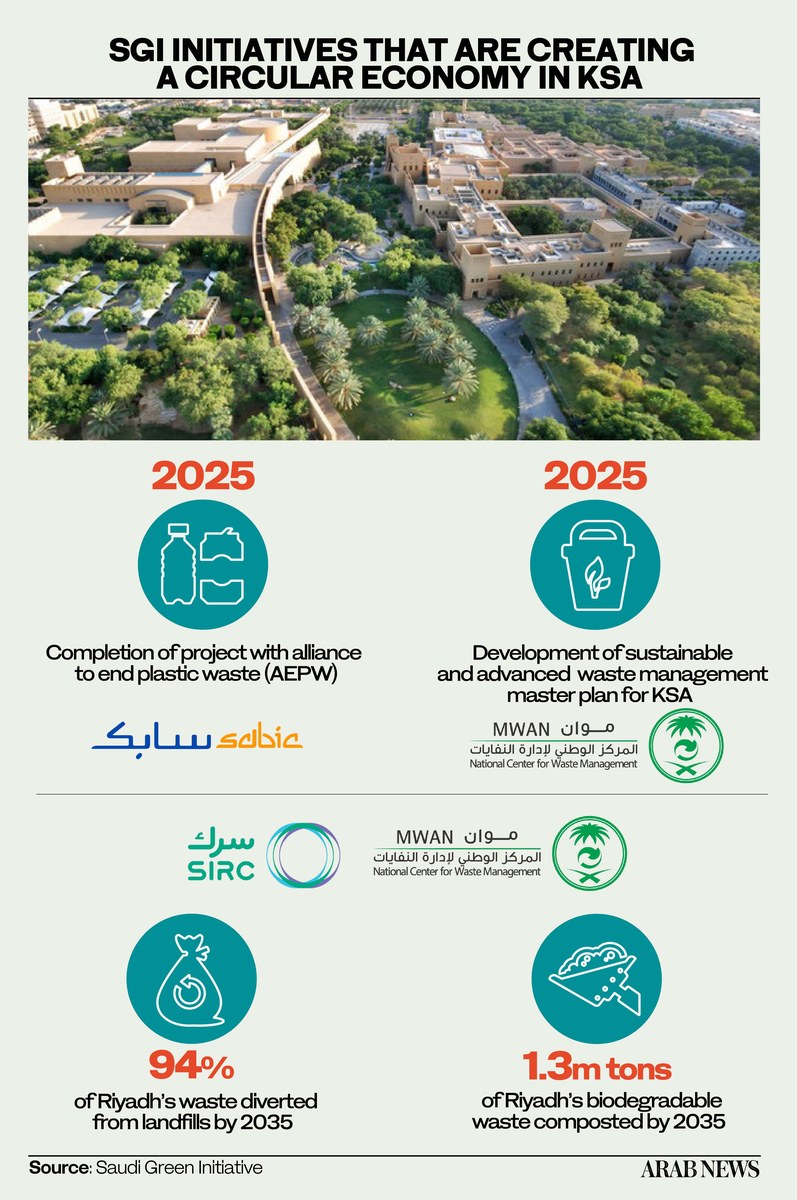
The initiative, expected to be completed in 2025, supports accelerated improvements to current waste management systems in developed regions.

Earlier in January, SABIC reaffirmed its commitment to accelerating the circular carbon economy by announcing plans to process 1 million metric tons of plastics through its Trucircle solutions initiative.

Trucircle is a portfolio of products SABIC offers, which include circular and bio-based products based on second- and third-generation renewable feedstock, mechanically recycled polymers, ocean and ocean-bound recycled solutions, and closed-loop services and designs for recyclability.

Meanwhile, Saudi Investment Recycling Co. and National Center for Waste Management are leading an initiative to transform waste management in Riyadh. This program aims to divert 94 percent of waste generated in Riyadh away from landfills and compost more than 1.3 million tons of biodegradable waste.

This program aims to create a proven waste management model that will be implemented across the Kingdom by 2035, which is expected to reduce 4.1 metric tons per annum of carbon dioxide emissions. 

Moreover, a separate SGI initiative with the NCWM is developing a comprehensive national waste management master plan for the Kingdom, pioneering circular economy practices. This project is expected to be completed by 2025. 

The SGI, inspired by Saudi Arabia’s commitment to achieving net-zero emissions by 2060, has also launched several initiatives, including investing in new energy sources, improving energy efficiency and developing a carbon capture and storage program. 

Furthermore, the SGI has also committed to planting 10 billion trees across Saudi Arabia and rehabilitating 40 million hectares of land to restore the Kingdom’s natural beauty. 

Earlier in April, the annual report issued by the National Transformation Program suggested that Saudi Arabia planted over 12 million trees in the past five years through the National Center for Vegetation Development.

Since the launch of the SGI, Saudi Arabia has planted 18 million trees within the Kingdom, of which 13 million are mangroves. Regionally, the SGI plans to plant 50 billion trees across the Middle East and restore an area equivalent to 200 million hectares of degraded land which will, in turn, reduce global carbon levels by 2.5 percent.

As part of the SGI’s initiatives, Saudi Arabia has also committed to protecting 30 percent of its terrestrial and marine area and is working in partnership with leading international organizations, including the International Union for the Conservation of Nature, to safeguard the pristine landscapes of the Kingdom.


RLC Global Forum highlights role of Saudi youth in retail digital shift 

Updated 8 sec ago
Follow

RLC Global Forum highlights role of Saudi youth in retail digital shift 

RIYADH: Saudi Arabia’s young and highly digital population is reshaping how the Kingdom’s retail sector adopts new technologies and artificial intelligence, advancing faster than many global competitors, industry leaders told Arab News. 

Speaking on the sidelines of the RLC Global Forum in Riyadh, executives told Arab News that the intersection of a youthful population and strong investment in AI is driving a shift in the industry’s priorities. 

From understanding consumer behavior to leveraging the Kingdom’s growing status as a global AI leader, Saudi Arabia is becoming as a unique destination for the retail sector to thrive, learn, and evolve in the digital sphere. 

Abdullah Al-Tamimi, CEO of commercial real estate company Hamat Holding, told Arab News that the firm is keen to analyze and understand consumer behavior, with a particular focus on the younger generation as a key part of that insight. 

“Actually, it’s a big part of our day-to-day operation,” he said, adding that the company invests heavily in understanding customer needs and behavior and works to correct any missteps. 

Al-Tamimi emphasized paying close attention to small details, noting that younger consumers are especially sensitive to the overall experience and “deserve that we work around the clock in order to improve it.” 

He added that this focus “can be a competitive advantage for Saudi Arabia as well.” 

Al-Tamimi said that as the younger generation grows accustomed to new technology shaping retail customer experiences, Hamat Holding is leveraging AI to enhance them further. 

“We started a couple of initiatives improving digitalization,” he said, adding that the company sees digital tools as a way to enhance its work by automating day-to-day operations and allowing teams to focus on bigger-picture and more complex tasks. 

While the firm has expanded its use of technology, he stressed it has not replaced human workers, emphasizing the continued importance of human capital for creativity and interaction. “AI is a big part of our strategy,” Al-Tamimi added. 

Amit Keswani Manghnani, chief omnichannel and AI officer at luxury goods retailer and distributor Chalhoub Group, told Arab News that bridging a younger customer base with continuous digital development is key to advancing the Kingdom’s retail strategies. 

On Saudi Arabia’s demographics, he said: “We look at 2030 as really building products which serve especially the younger population, which is growing and very digitally savvy.” 

Manghnani underscored the unique characteristics of the Kingdom’s retail market as a tool for developing effective products and customer experiences. 

“So it’s very digitally savvy, much more than in other markets,” he said, noting that e-commerce penetration is rising not only through online purchases but also via digital catalogs that drive in-store visits. 

Manghnani said investment is focused on making products more digitally accessible and easier to use, while strengthening customer service to meet the expectations of what he described as a demanding but welcome consumer base. “Service excellence, digital — all these things together are how we are tapping into the younger population, which again is extremely savvy.” 

Manghnani reinforced Al-Tamimi’s point that the Kingdom holds a competitive advantage, citing the speed at which its retail and technology industries are aligning. 

“As a market, we’re tending to see the adoption of digital,” he said, referring to AI, data and other forms of digital interaction, adding that these tools are increasingly being combined. 

He noted that this market is moving “much quicker than the other markets.” 

The two-day RLC Global Forum brought together more than 2,000 global leaders, policymakers, and innovators from over 40 countries over the two-day event to define the next chapter of growth across retail, consumer, and lifestyle industries.