

Saudi Green Initiative steps up its drive against plastic pollution

The world produces around 400 million tons of plastic annually, and just 9 percent of it gets recycled. What's worse? Almost 130,000 tons of plastic waste end up in the ocean every year. (Shutterstock)
Short Url
Updated 04 June 2023
Follow

Saudi Green Initiative steps up its drive against plastic pollution

RIYADH: As the world is getting choked by plastic pollution, the planet is set to ring in another Environment Day on June 5, focused on ending the nondegradable waste’s disastrous effects. 

According to the UN Environment Programme, the world produces around 400 million tons of plastic annually, and just 9 percent of it gets recycled. What is worse? Almost 130,000 tons of plastic waste end up in the ocean every year. 

Within three years of its launch, the Saudi Green Initiative is playing a crucial role regionally in protecting the environment and reducing the use of plastic. 

Throughout these three years, the initiatives of the SGI have supported international efforts to remove plastic from oceans, develop innovative waste management systems at a national level and divert waste from landfill sites.

Catalyzing the SGI’s ambition to ensure a sustainable future, Saudi Basic Industries Corp. is participating in the Alliance to End Plastic Waste Program to clean plastic from the oceans.
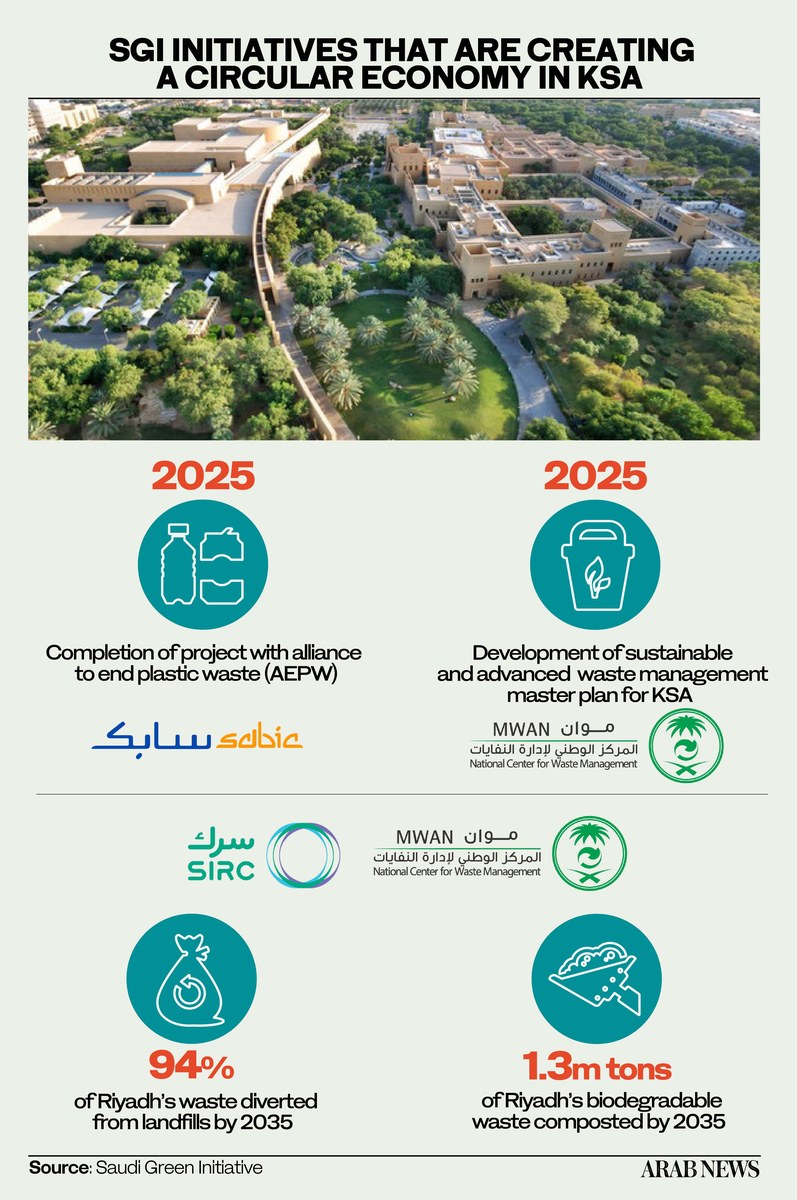
The initiative, expected to be completed in 2025, supports accelerated improvements to current waste management systems in developed regions.

Earlier in January, SABIC reaffirmed its commitment to accelerating the circular carbon economy by announcing plans to process 1 million metric tons of plastics through its Trucircle solutions initiative.

Trucircle is a portfolio of products SABIC offers, which include circular and bio-based products based on second- and third-generation renewable feedstock, mechanically recycled polymers, ocean and ocean-bound recycled solutions, and closed-loop services and designs for recyclability.

Meanwhile, Saudi Investment Recycling Co. and National Center for Waste Management are leading an initiative to transform waste management in Riyadh. This program aims to divert 94 percent of waste generated in Riyadh away from landfills and compost more than 1.3 million tons of biodegradable waste.

This program aims to create a proven waste management model that will be implemented across the Kingdom by 2035, which is expected to reduce 4.1 metric tons per annum of carbon dioxide emissions. 

Moreover, a separate SGI initiative with the NCWM is developing a comprehensive national waste management master plan for the Kingdom, pioneering circular economy practices. This project is expected to be completed by 2025. 

The SGI, inspired by Saudi Arabia’s commitment to achieving net-zero emissions by 2060, has also launched several initiatives, including investing in new energy sources, improving energy efficiency and developing a carbon capture and storage program. 

Furthermore, the SGI has also committed to planting 10 billion trees across Saudi Arabia and rehabilitating 40 million hectares of land to restore the Kingdom’s natural beauty. 

Earlier in April, the annual report issued by the National Transformation Program suggested that Saudi Arabia planted over 12 million trees in the past five years through the National Center for Vegetation Development.

Since the launch of the SGI, Saudi Arabia has planted 18 million trees within the Kingdom, of which 13 million are mangroves. Regionally, the SGI plans to plant 50 billion trees across the Middle East and restore an area equivalent to 200 million hectares of degraded land which will, in turn, reduce global carbon levels by 2.5 percent.

As part of the SGI’s initiatives, Saudi Arabia has also committed to protecting 30 percent of its terrestrial and marine area and is working in partnership with leading international organizations, including the International Union for the Conservation of Nature, to safeguard the pristine landscapes of the Kingdom.


Chinese company QCraft plans to enter Saudi autonomous driving market

Updated 14 sec ago
Follow

Chinese company QCraft plans to enter Saudi autonomous driving market

RIYADH: Chinese company QCraft intends to enter the autonomous driving market in Saudi Arabia and the Middle East region, according to its founder and CEO, James Yu, who spoke to Al-Eqtisadiah newspaper.

The company, which specializes in developing advanced autonomous driving technologies, made its first appearance in the region during its participation in the Global CommoMotion Summit 2025, held in Riyadh from Dec. 7 to 9.

The company’s interest in the Middle East comes after its expansion in Asia and Europe, according to Yu, who confirmed that the Saudi market is large and has strong demand.

He said: “We plan to increase our investments and support the local mobility industry through safer and more efficient solutions, relying on clean energy in logistics services.”

Why Saudi Arabia?

QCraft’s participation in the Global CommoMotion Summit was part of a series of presentations and lectures that focused on the latest developments in electric vehicles, autonomous mobility, and artificial intelligence in transportation as well as hydrogen and alternative fuel technologies, and the future of supply chains and logistics services.

This edition, held in Riyadh, highlights Saudi Arabia’s mega infrastructure projects, including the Riyadh Metro and autonomous vehicle trials on the capital’s streets.

Yu confirmed that the firm is preparing to launch pilot and investment projects in the Kingdom once market assessment is complete. He noted that its Level 2 products have reached approximately 1 million installations globally, while its Level 4 products have been sold in several cities worldwide, including Japan, Singapore, and Hong Kong.

Plans for expansion in the Middle East

QCraft has plans to expand into the Middle East in the coming phase, according to its CEO.

Yu said: “The company has become a major player in the autonomous vehicle sector. We brought RoboBus buses and RoboVan delivery trucks to the Middle East, and we are working to develop partnerships to implement these technologies in everyday services.”

He added that the company aims to build an autonomous driving network that will help improve operational efficiency in the logistics sector, while providing environmentally friendly and safer mobility solutions.

The CommoMotion Summit brings together the public and private sectors from Asia, the Middle East, Europe, North America, and the Global South to discuss the future of mobility and urban transformation, shaping the future of multimodal transportation in the world’s cities.

Saudi Arabia is charting a new course for mobility

Last July, Saudi Arabia launched the initial implementation phase for autonomous vehicles, aiming to develop a smart and safe transportation system in the Kingdom.

This step, which aligns with the National Transport and Logistics Strategy, aims to adopt sustainable mobility solutions that leverage the latest artificial intelligence technologies.

In this phase, autonomous vehicles are being deployed in a real-world operational environment covering King Khalid International Airport and several key locations in Riyadh. This includes highways and select destinations in the city center.

Minister of Transport and Logistics Saleh Al-Jasser confirmed at the time that launching the initial application phase embodies an ambitious vision toward building a smart and integrated transportation system that supports economic growth and improves the quality of life.
