Nepali guide rescues climber from Everest death zone

1 / 2
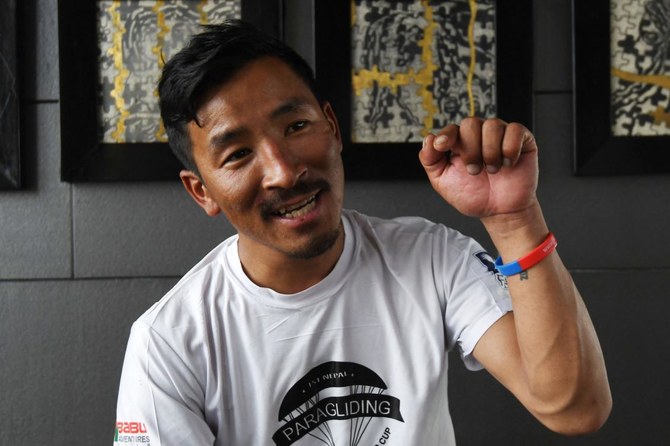
In this picture taken on June 2, 2023, Nepali guide Gelje Sherpa speaks during an interview with AFP in Kathmandu. (AFP)
2 / 2
Light illuminates Mount Everest, during sunset in Solukhumbu District also known as the Everest region, November 30, 2015. (Reuters)
Short Url
Updated 04 June 2023
Follow

Nepali guide rescues climber from Everest death zone

Katmandu: A Nepali guide abandoned his client’s Everest summit bid to rescue a Malaysian climber in a deadly mountaineering season that has seen at least twelve deaths.
Gelje Sherpa was guiding a Chinese client to the 8,849-meter (29,032-feet) peak and planned to assist him to paraglide down.
Instead, only a few hundred meters from the summit, they came across a lone man clinging to a rope and shivering in the area known as the “death zone.”
The area above 8,000 meters has earned its name because of its thin air, freezing temperatures and low oxygen levels that heighten the risk of altitude sickness. It is also notorious for its difficult terrain.
“When I found him in that state, my heart did not let me leave him there,” Sherpa told AFP.
Many other climbers had walked past the man that day, but he declined to criticize them.
“It is a place where you have to think of your survival first,” he said.
Sherpa told his client — who will have paid at least $45,000 to attempt Everest, including a permit fee of $11,000 — to return without a summit.
“When I decided to go down, my client did not agree at first. Of course, he was there after spending a lot of money, it must have been his dream for years and he had to find time to come here to climb.
“He got angry and said he wanted to go to the summit.
“I had to scold him and tell him that he has to descend because he was my responsibility and I couldn’t send him to the summit on his own. He got upset.”
He explained that he wanted to take the sick man down the mountain.
“Then he realized that by ‘rescue’ I meant that I wanted to save him. He understood and then he apologized later.”
Sherpa, 30, fitted the ailing climber with his supplemental oxygen supply, improving some of his symptoms, but he was still unable to walk.
The rocky uneven terrain meant that Sherpa, who is about 1.6 meters tall (five feet and three inches) and weighs 55 kilograms, had to carry the Malaysian in some sections.
“It is a very difficult task to carry someone and bring them down from there. But some sections are very rocky, I couldn’t drag him,” said Sherpa.
“If I did that, he could have broken his bones, he was already not doing well.”
Sherpa hauled the man down nearly 700 meters for almost six hours to Camp 4 by himself.
“I’ve been a part of many search and rescue missions, but this was very challenging,” he said.
Joined by another guide, the pair wrapped the climber in sleeping mats and secured him with ropes, dragging him on snowy slopes and carrying him on their backs when necessary.
Finally, they arrived at Camp 3 at 7,162 meters (23,500 feet) and a helicopter using a long line lifted the stricken climber down to the base camp.
Sherpa was not able to meet the Malaysian climber again but received a message thanking him.
“He wrote me ‘You saved my life, you are god to me’,” Sherpa said.
Nepali guides, usually ethnic Sherpas from the valleys around Everest, are considered the backbone of the climbing industry and bear huge risks to carry equipment and food, fix ropes and repair ladders.
Sherpa’s video of the rescue two weeks ago has been liked on his Instagram more than 35,000 times and shared widely over social media, many applauding his selfless decision.
“As a guide you feel a sense of responsibility for others on the mountain and you have to make tough decisions,” said Ang Norbu Sherpa, president of Nepal National Mountain Guide Association.
“What he has done is commendable.”
Nepal issued a record 478 permits for Everest to foreign climbers this season and about 600 climbers and guides reached the top.
Twelve climbers have been confirmed dead, and five more are still missing.
Gelje Sherpa has reached the world’s highest point six times and did not regret his decision to turn back that day.
“People just focus on the summit, but everyone can do that,” he said. “To bring someone from higher than 8,000 meters is a lot more difficult than to summit.”


Filipinos master disaster readiness, one roll of the dice at a time

Updated 29 December 2025
Follow

Filipinos master disaster readiness, one roll of the dice at a time

  • In a library in the Philippines, a dice rattles on the surface of a board before coming to a stop, putting one of its players straight into the path of a powerful typhoon

MANILA: In a library in the Philippines, a dice rattles on the surface of a board before coming to a stop, putting one of its players straight into the path of a powerful typhoon.
The teenagers huddled around the table leap into action, shouting instructions and acting out the correct strategies for just one of the potential catastrophes laid out in the board game called Master of Disaster.
With fewer than half of Filipinos estimated to have undertaken disaster drills or to own a first-aid kit, the game aims to boost lagging preparedness in a country ranked the most disaster-prone on earth for four years running.
“(It) features disasters we’ve been experiencing in real life for the past few months and years,” 17-year-old Ansherina Agasen told AFP, noting that flooding routinely upends life in her hometown of Valenzuela, north of Manila.
Sitting in the arc of intense seismic activity called the “Pacific Ring of Fire,” the Philippines endures daily earthquakes and is hit by an average of 20 typhoons each year.
In November, back-to-back typhoons drove flooding that killed nearly 300 people in the archipelago nation, while a 6.9-magnitude quake in late September toppled buildings and killed 79 people around the city of Cebu.
“We realized that a lot of loss of lives and destruction of property could have been avoided if people knew about basic concepts related to disaster preparedness,” Francis Macatulad, one of the game’s developers, told AFP of its inception.
The Asia Society for Social Improvement and Sustainable Transformation (ASSIST), where Macatulad heads business development, first dreamt up the game in 2013, after Super Typhoon Haiyan ravaged the central Philippines and left thousands dead.
Launched six years later, Master of Disaster has been updated this year to address more events exacerbated by human-driven climate change, such as landslides, drought and heatwaves.
More than 10,000 editions of the game, aimed at players as young as nine years old, have been distributed across the archipelago nation.
“The youth are very essential in creating this disaster resiliency mindset,” Macatulad said.
‘Keeps on getting worse’ 
While the Philippines has introduced disaster readiness training into its K-12 curriculum, Master of Disaster is providing a jolt of innovation, Bianca Canlas of the Department of Science and Technology (DOST) told AFP.
“It’s important that it’s tactile, something that can be touched and can be seen by the eyes of the youth so they can have engagement with each other,” she said of the game.
Players roll a dice to move their pawns across the board, with each landing spot corresponding to cards containing questions or instructions to act out disaster-specific responses.
When a player is unable to fulfil a task, another can “save” them and receive a “hero token” — tallied at the end to determine a winner.
At least 27,500 deaths and economic losses of $35 billion have been attributed to extreme weather events in the past two decades, according to the 2026 Climate Risk Index.
“It just keeps on getting worse,” Canlas said, noting the lives lost in recent months.
The government is now determining if it will throw its weight behind the distribution of the game, with the sessions in Valenzuela City serving as a pilot to assess whether players find it engaging and informative.
While conceding the evidence was so far anecdotal, ASSIST’s Macatulad said he believed the game was bringing a “significant” improvement in its players’ disaster preparedness knowledge.
“Disaster is not picky. It affects from north to south. So we would like to expand this further,” Macatulad said, adding that poor communities “most vulnerable to the effects of climate change” were the priority.
“Disasters can happen to anyone,” Agasen, the teen, told AFP as the game broke up.
“As a young person, I can share the knowledge I’ve gained... with my classmates at school, with people at home, and those I’ll meet in the future.”